Industry Transformation
The New AI Literacy Mandates: How States Are Rewriting the K-12 Curriculum
27 states now have active AI-literacy bills, 10 already law. Idaho, Maryland, Oklahoma, Alabama and Hawaii show three rival models for what an AI-literate K-12 system must teach.

Gabriele Masetti ·
Does My State Require AI Literacy Education? Twenty-Seven Now Have an Answer
Parents typing "does my state require AI literacy education" into a search bar in the autumn of 2026 get a real answer for the first time. Researchers are still arguing over whether chatbots help kids learn or let them cheat, but that argument has become background noise to a separate and faster-moving story: state legislatures writing AI literacy into statute. FutureEd's legislative tracker counted 77 bills across 27 states addressing artificial intelligence in classroom instruction as of its July 13, 2026 update, the most recent one, with ten of those bills already signed into law.
Five months before that count, only a handful had reached a governor's desk. The debate over AI's effect on learning outcomes continues in journals and op-eds; the debate over what schools are legally required to teach about AI is being settled, state by state, in statute books.
Trackers do not all agree on a single headline number, and the discrepancy is itself informative. MultiState's own scan counted a broader 134 bills across 31 states in March 2026, because it swept in privacy and data-governance measures that never touch curriculum. FutureEd's narrower count — bills that specifically address AI in classroom instruction — is the more useful yardstick for a parent asking whether their state actually requires students to learn about AI, rather than merely regulating the tools a district can buy.
Three distinct legislative models have emerged from that rush, and which one a state picks determines what its students will actually experience in a classroom. Graduation-requirement states are rewriting course catalogs. Governance-framework states are rewriting district policy manuals. Teacher-training-grant states are betting money on professional development before they mandate anything for students. None of the three models is winning outright, and a state can mix elements of more than one.
| State | Bill | Model | Status |
|---|---|---|---|
| Alabama | H.B. 329 | Graduation requirement | Signed (class of 2032) |
| Idaho | S.B. 1227 | Governance framework | Signed, in force since July 1, 2026 |
| Maryland | S.B. 720 | Governance framework | Signed, in force since June 1, 2026 |
| Oklahoma | S.B. 1734 | Governance framework | Signed May 12, 2026 |
| Virginia | H.B. 1186 | Governance framework + pilot | Signed, in force since July 1, 2026 |
| Utah | H.B. 218 | Curriculum integration | Signed, in force since July 1, 2026 |
| Hawaii | S.B. 2212 | Graduation requirement + grant | Still in committee |
Three Models, One Rush: Graduation Mandates, Governance Frameworks, and Grant Money
The graduation-requirement model treats AI literacy the way states once treated financial literacy or driver's education: as a discrete credit students must earn before a diploma is issued. Alabama's H.B. 329 is the clearest enacted example, folding AI instruction into a computer science course that becomes mandatory starting with the graduating class of 2032. Iowa, Illinois, Ohio, and Missouri all have companion bills moving through committee that would do the same on different timelines.
The governance-framework model, in contrast, does not touch a single course catalog. It tells the state education agency to write guidance, tells districts to adopt local AI policies aligned with that guidance, and often creates a new position — an AI coordinator — to make sure someone owns the paperwork. Maryland, Oklahoma, Idaho, Virginia, and Ohio (through a separate, already-enacted bill) have all taken this route.
The teacher-training-grant model puts money before mandates. Idaho backed its framework with a $250,000 grant from the STEM Action Center. Hawaii's still-pending bill would create a three-year, $5 million AI Education Grant Pilot Program. Maryland's law funds a "train-the-trainer" model so a wave of AI-literate teachers can train colleagues before any student-facing requirement lands.
| State | Program | Funding |
|---|---|---|
| Idaho | STEM Action Center grant | $250,000 |
| Hawaii | AI Education Grant Pilot Program (proposed) | $5 million over 3 years |
| Virginia | AI Innovation in Education Pilot Program | ~$2 million |
The K-12 AI Curriculum Requirement Wave: Alabama, Iowa, Illinois, Ohio, and Missouri
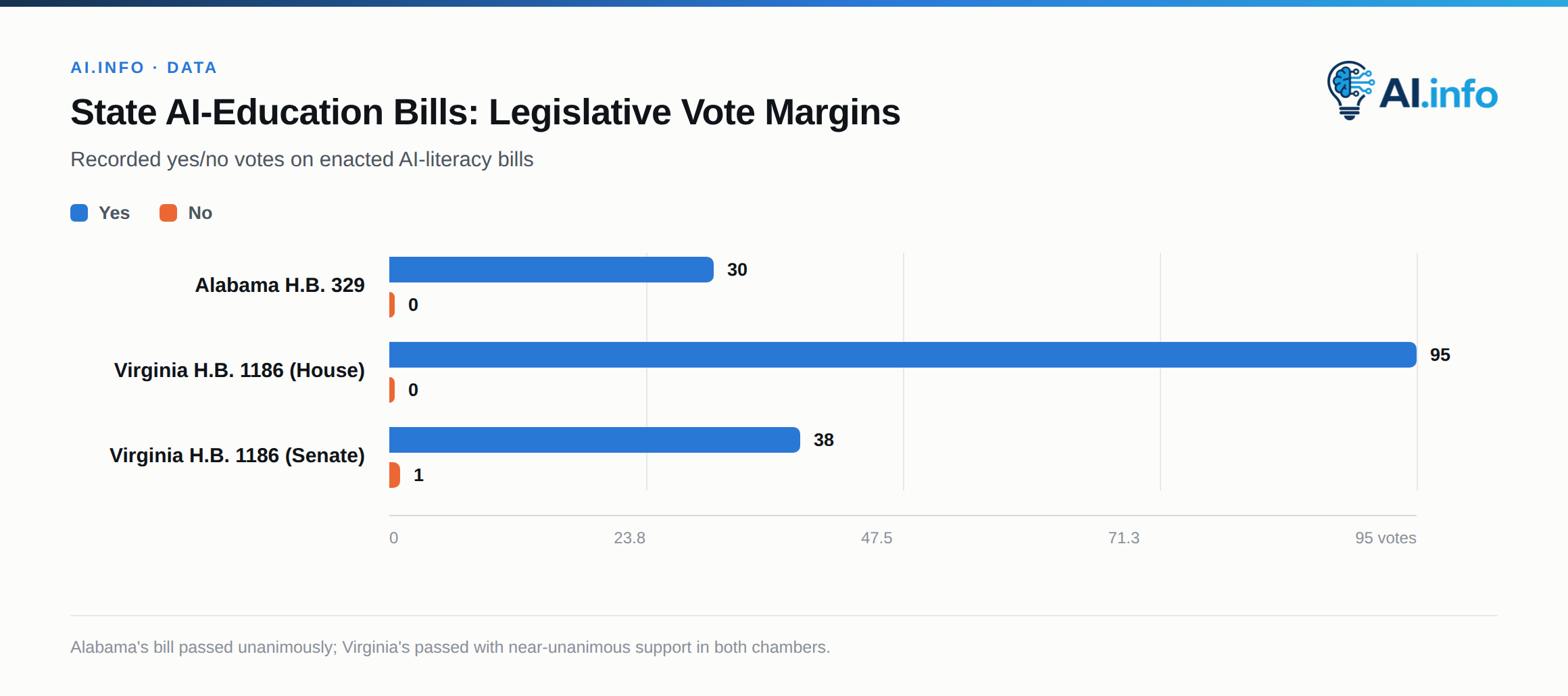
Alabama's H.B. 329, sponsored by Rep. David Faulkner and passed by the House 99-0 on February 12, 2026, adds artificial intelligence to the legal definition of computer science and makes a full computer-science-and-AI course a graduation requirement beginning with the class of 2032. It is the only graduation-requirement bill among this group that has actually become law.
The rest are still bills, not statutes, which matters for anyone reading the news through a "K-12 AI curriculum requirement" search rather than a legislative digest. Iowa's Senate File 2094, alongside companion measures House Study Bill 610 and House File 2540, would require one semester of computer science and artificial intelligence — covering foundational concepts, ethics, and societal impact — for students graduating in 2030-31 or later, potentially including instruction as early as eighth grade.
Illinois's H.B. 4411 would require a full year of computer science and AI beginning with students entering ninth grade in 2028-29. Ohio's H.B. 594, distinct from the AI-policy bill the state already enacted, would require one unit of computer science with AI content for students entering ninth grade on or after July 1, 2029. Missouri's H.B. 3139 would set a half-unit requirement starting in 2027-28. None had cleared its legislature when the tracker was last revised in mid-July 2026, and none has since.
Idaho's SB 1227 and the Nation's First Statewide AI Framework
If there is a bill that best answers an "Idaho AI literacy law" search, it is Senate Bill 1227. Sponsored by Sen. Kevin Cook of Idaho Falls, S.B. 1227 directs the State Department of Education to build a comprehensive generative-AI framework covering data privacy, procurement safeguards, transparency, academic integrity, AI literacy standards, and educator professional development, while barring AI from replacing a human teacher. Governor Brad Little signed it on March 26, 2026, and it took effect on July 1, 2026.
"You can make the argument that the AI genie is out of the bottle," Little said at the signing. "Nobody's putting that genie back in the bottle." State Superintendent Debbie Critchfield framed the underlying problem the bill was written to address: the students in Idaho classrooms were already ahead of the adults setting policy for them. The state paired the mandate with a $250,000 STEM Action Center grant and a public-private partnership with Micron, Microsoft, Stukent, and Idaho National Laboratory to build the statewide AI-literacy course the framework calls for.
Idaho's law is a template, not a course syllabus. It tells the department what to build and gives it a deadline; it does not, by itself, put a new class on a transcript. That distinction — mandate the framework versus mandate the credit — is exactly what separates Idaho from Alabama, and it is the fault line running through this entire legislative wave.
Maryland and Oklahoma Choose Local Control With State Guardrails
Maryland's S.B. 720, the Artificial Intelligence Ready Schools Act, was approved by the governor as Chapter 634 and took effect June 1, 2026. It requires the State Department of Education to issue AI guidance, requires every local school system to designate an AI coordinator, integrates AI into workforce and educator-training standards, and establishes a statewide collaborative on AI in K-12 education that runs through May 2028.
Oklahoma took a narrower, more restrictive tack, and Sen. Ally Seifried's bill reads more like a set of guardrails than an education plan. S.B. 1734, the Responsible Technology in Schools Act, was signed into law on May 12, 2026, and requires every district to adopt a written AI policy before the 2027-28 school year.
The policy must address approved and prohibited instructional uses, data protection, family transparency, and periodic review; the law bars AI from serving as the primary basis for grading, discipline, or placement decisions, requires educator-directed, human-in-the-loop use of the technology, and preserves a parent's right to opt a child out of AI tools without academic penalty. Districts must also notify parents annually about how AI is being used in their child's classroom.
Virginia and Utah rounded out the governance camp this session. Virginia's H.B. 1186, carried by Del. Sam Rasoul and passed 95-0 in the House and 38-1 in the Senate, created an AI Innovation in Education Pilot Program backed by roughly $2 million in the state's new biennial budget, and ordered the Department of Education to issue AI guidance and local school divisions to adopt aligned policies, in force since July 1, 2026.
Utah's H.B. 218 took the lightest touch of any enacted bill this session: rather than create a new course or a new state framework, it simply folded AI literacy — capabilities, limitations, ethics, and societal implications — into the seventh- and eighth-grade digital skills course every Utah student already has to take, in force since the same July 1 date.
Hawaii's Stalled Bet on a Standalone AI Course
Hawaii offers the clearest test of the third model, and it has not yet cleared committee. S.B. 2212 would require the Department of Education to build a statewide AI Literacy Curricula Plan and make a six-week course a graduation condition for eleventh and twelfth graders beginning in 2027-28, paired with a three-year, $5 million AI Education Grant Pilot Program for teacher training and curriculum development and a new Advisory Council for Artificial Intelligence Education.
Introduced in January 2026 and referred to the Senate's Education, Labor and Technology, and Ways and Means committees, it remained there — with progress the Legislature's own tracking system logs at roughly a quarter of the way through committee — as the session adjourned, meaning Hawaii's most ambitious course mandate is currently a proposal, not a law.
Whether it revives next session will show whether a dedicated, stand-alone AI course — rather than AI folded into an existing computer-science credit, as Alabama and Utah chose — can survive a funding fight in a state without Idaho's or Maryland's corporate partnerships to defray the cost.
Washington Sets the Backdrop, States Set the Rules
States are not legislating in a vacuum. In April 2025, President Trump signed Executive Order 14277, "Advancing Artificial Intelligence Education for American Youth," which created a White House Task Force on AI Education, directed federal agencies to prioritize AI-literacy grantmaking, and launched the Presidential AI Challenge. That challenge held its first National Champion Awards Ceremony at the White House on June 9, 2026, with state-level winners from all 50 states and U.S. territories.
The order encourages AI integration and educator training; it does not require any state to pass a curriculum mandate, and a separate December 2025 executive order aimed at discouraging state AI regulation explicitly exempted child-safety-related state laws. The federal government has set a tone and offered a stage. The graduation credits, the coordinator positions, and the written policies are being built entirely at the statehouse level.
What an AI-Literate Graduate Needs by Their Senior Year
A ninth grader starting high school this fall graduates in 2030, which is roughly when the first wave of graduation-requirement bills — Iowa's among them — would actually apply to an incoming class. Whether that student ends up with a mandatory AI credit, a district policy shaped by a state framework, or nothing at all still depends entirely on which state they live in, and that patchwork is the practical answer to "does my state require AI literacy education": for most families, not yet, though the number of states where the answer is yes has doubled since spring.
Strip away the bill numbers and three requirements recur across nearly every version of this legislation: a working understanding of how generative AI systems function and where they fail, explicit instruction in academic-integrity norms around AI-assisted work, and a teacher workforce that has itself been trained before it is asked to train students. States disagree sharply on mechanism — credit requirement, policy framework, or grant program — but agree on that underlying content.
A student who moves from an Alabama district, where AI literacy is a graduation credit, to a Utah district, where it is folded into a required seventh- or eighth-grade digital-skills course, will encounter the same three ideas taught at different depths and different ages, with no federal floor underneath either state's choice.
None of this resolves the tutoring-versus-cheating research debate playing out elsewhere; it simply makes AI literacy a compliance obligation rather than a pedagogical option, on a clock a research paper cannot set. Oklahoma's clock is already running: every district in the state must have a board-adopted, written AI policy in place before the 2027-28 school year opens.