Industry Transformation
AI in Telecommunications: Network Optimization and Beyond
How AI actually runs telecom networks in 2026: AI-native RAN scheduling, Nokia's GPU-based AI-RAN platform, digital twins, energy optimisation and autonomy claims — with the live-network numbers behind them.
Gabriele Masetti ·
The Network Stopped Being a Static Thing
For three decades, mobile networks were engineered like plumbing: fixed capacity, manual tuning, and quarterly optimization cycles run by radio engineers adjusting antenna tilts and handover thresholds by hand. That model is breaking down under 5G densification, the sheer parameter count of modern radios, and operator margins that no longer support armies of RF engineers. The replacement isn't a single product — it's a layer of machine learning now embedded in radio scheduling, energy management, fault prediction, customer retention, and network security simultaneously.
What separates 2026 from another year of vendor slide decks is that the AI ships inside commercial software subscriptions rather than research projects, and operators are disclosing numbers specific enough to be checked — including numbers lower than the marketing.
Self-Optimizing Networks Get a New Engine
Self-Organizing Networks (SON) — the industry's long-standing term for automated configuration, healing, and optimization of radio parameters — used to run on relatively simple rule-based logic. That's changing as vendors swap in trained models for the decision layer. Ericsson's "AI in RAN" is the clearest example: a software subscription, not new hardware, that brings trained AI models directly into existing basebands and radios.
Ericsson launched the package on 11 June 2026, with the first features available that quarter: an AI-native Scheduler for Link Adaptation, AI-powered Macro Positioning, AI-managed Beamforming and AI-powered Multi-layer Coordination. The claims attached to it are more than 15 deployments and trials worldwide, up to 20 percent higher downlink throughput, up to 10 percent better spectral efficiency, support for up to twice as many high-traffic users, and 90 to 95 percent coverage-prediction accuracy.
The live-network results came in below the brochure. T-Mobile US and Ericsson announced the first commercial-network result in mid-2026: close to 10 percent better spectral efficiency and up to 15 percent higher downlink throughput against legacy rule-based scheduling. SoftBank and Ericsson followed on 20 August 2026 with Japan's first validation of the same AI-native scheduler on a commercial 5G network, reporting up to roughly 50 percent higher downlink user throughput and up to roughly 25 percent better spectral efficiency at the strongest locations — but approximately 10 percent on average for both metrics across all evaluated locations. Peak and average differ by a factor of two to five, and the vendor maximum quotes the peak.
| Metric | Vendor claim | Live commercial network |
|---|---|---|
| Downlink throughput | up to 20% higher | up to 15% (T-Mobile US); ~10% average (SoftBank) |
| Spectral efficiency | up to 10% better | close to 10% (T-Mobile US); ~10% average (SoftBank) |
| Deployments and trials | 15+ worldwide | — |
Nokia runs a parallel play through AVA, its telco AI-as-a-service portfolio (evolved from what the company called Nokia Autonomous Systems). AVA packages anomaly prediction, 5G network-slicing assurance, customer-experience analytics, and energy optimization into a subscription model, offered both on-premises and through Azure-hosted deployments, with pricing structured around outcomes rather than upfront licenses. The strategic logic is the same across vendors: instead of an engineer reacting to a degraded cell after customers complain, a model trained on historical KPI drift, weather, event calendars, and traffic patterns flags the anomaly before it becomes a fault ticket.
RAN Intelligent Controllers Make This Multi-Vendor
The reason SON-style AI didn't stay locked inside single-vendor RAN stacks is the O-RAN Alliance's RAN Intelligent Controller (RIC) architecture, which formalizes where machine learning models actually plug into the network. The near-real-time RIC hosts xApps that make decisions on millisecond-to-one-second timescales — scheduling which user gets which radio resource, triggering handovers, mitigating interference between neighboring cells.
The non-real-time RIC, which sits inside the Service Management and Orchestration (SMO) layer, hosts rApps that operate on longer horizons — seconds to hours or even days — consuming network data to forecast demand and rewrite configuration policy. That division matters commercially, because it lets operators buy AI logic from a different vendor than their radio hardware supplier, which is exactly what Ericsson and Vodafone are now doing at scale: their five-year programmable-networks partnership, with Germany as the first market starting in the fourth quarter of 2025, deploys the Ericsson Intelligent Automation Platform alongside a slate of AI-powered rApps for automated RAN optimization, energy efficiency, and multi-vendor RAN management — explicitly designed to work across radios from more than one supplier.
AI-RAN: When the Radio Becomes a GPU
A more radical bet is running in parallel to software-only SON upgrades: replacing the RAN's dedicated signal-processing silicon with GPU compute that runs both AI inference and the radio's own physical-layer processing on the same hardware. That is the mission of the AI-RAN Alliance, founded in February 2024 with Arm, DeepSig, Ericsson, Microsoft, Nokia, Northeastern University, NVIDIA, Samsung, SoftBank, T-Mobile, and the University of Tokyo as founding members.
By 26 February 2026 the alliance counted 132 members, and it arrived at Mobile World Congress in Barcelona with 33 demonstrations and four industry blueprints; Qualcomm, SK Telecom and Vodafone joined its board that year.
Nokia and NVIDIA have gone furthest commercially. On 15 July 2026 Nokia launched what it calls the industry's first AI-native RAN platform, built on its anyRAN software and NVIDIA's Aerial stack and backed by a $1 billion NVIDIA investment in Nokia. It comes in three shapes running the same software: a GPU-powered capacity plug-in for existing AirScale hardware, a standalone AI-RAN node, and GPU-equipped commodity servers, all Open RAN compliant. Nokia says it has demonstrated more than 20 percent spectral-efficiency gains, targets 50 percent in 2027 and more than 100 percent in 2028, and sells the capability as a subscription rather than per unit. Commercial availability is 2027, not now.
SoftBank's AITRAS field trial, built on NVIDIA's AI-RAN platform, claims an industry first: 16-layer massive MIMO running on fully software-defined 5G.
T-Mobile US, working with Nokia and NVIDIA, has a staged rollout plan — a 2026 field trial of physical-AI applications at the network edge, commercial start in 2027, and mass deployment by 2028 — reframing cell sites as computing platforms that could eventually serve autonomous vehicles, robotics, and smart-city applications, not just phone traffic. It's worth being precise about the distinction: Ericsson's "AI in RAN" is software layered onto today's radios; AI-RAN Alliance hardware is a longer-horizon bet on GPU-native base stations. Both are real, and they are not the same product.
Digital Twins Before You Touch a Single Site
Network digital twins — simulated, continuously updated models of physical infrastructure — are moving from planning tool to operational safeguard. Ericsson's Site Digital Twin combines Building Information Modeling with LiDAR and drone-captured site data to build a geospatially accurate 3D model of each cell site before crews are dispatched, aimed at cutting rework and accelerating rollout.
Vodafone has gone further operationally: in a trial with Cirrus360, a "Declarative Digital Twin" forecasts hardware failures and predicts customer traffic and latency at a given site before any upgrade or new RAN deployment is made — letting engineers plan changes against a simulation rather than discovering problems in the field.
Separately, a reported Google Cloud, Vodafone, and Deutsche Telekom AI network-operations collaboration has been credited with cutting repair times by roughly 25 percent, an indicator of how much of "predictive maintenance" in telecom is really about triage speed — getting the right technician, with the right part, to the right site, before an outage cascades into complaints.
The Energy Case Made AI Non-Optional
Of every AI use case in telecom, energy is the one with board-level financial pressure behind it, because power is typically an operator's single largest network operating cost. The results being disclosed are specific enough to be checkable. China Mobile has deployed more than 20 distinct AI-driven energy-saving techniques across the time, frequency, spatial, and power domains of its commercial 5G network — dynamically switching off or scaling down cells, carriers, antennas, or power amplifiers during low-traffic windows rather than running every element at full power around the clock.
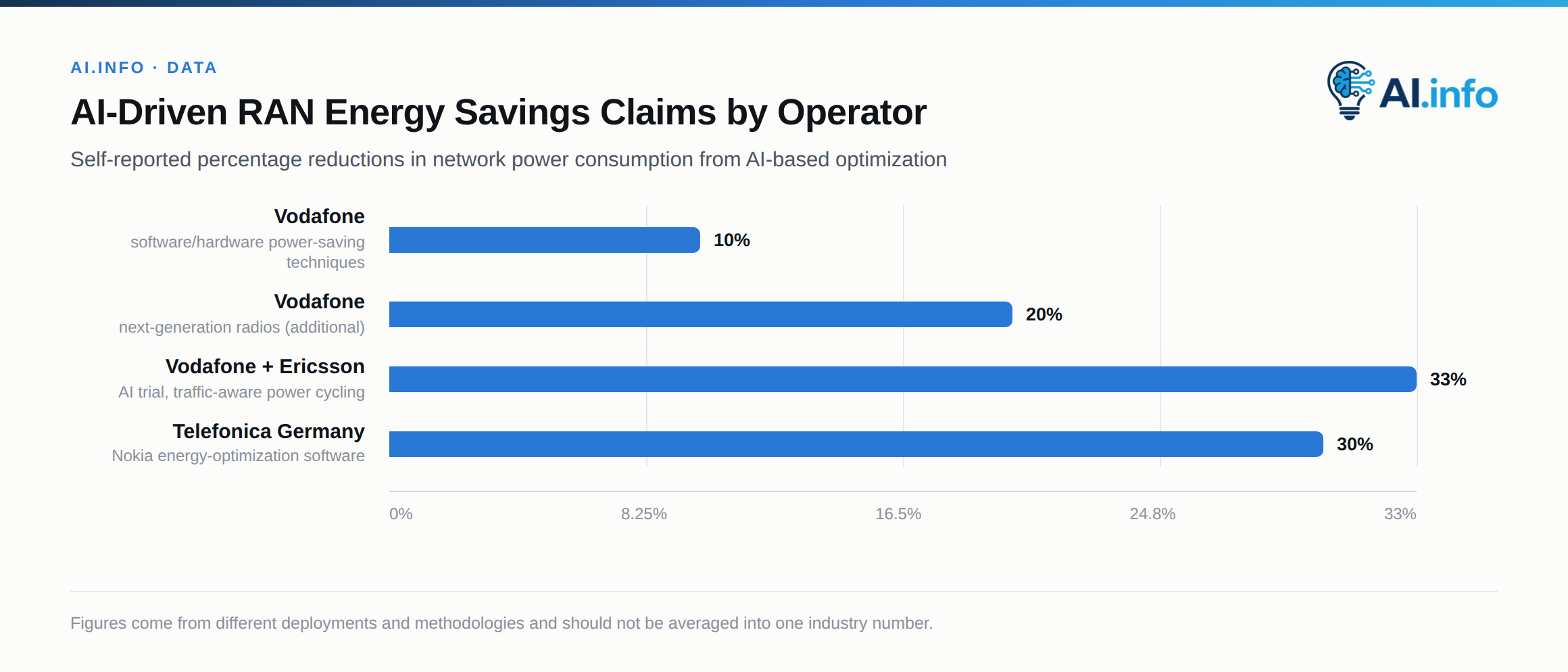
China Telecom's AI base-station efficiency program, covering roughly 6 million base stations and 3,400 facility rooms, claims annualized savings of about 1.1 billion kWh. Vodafone reports up to 10 percent energy savings from software- and hardware-based power-saving techniques, with an additional 20 percent from next-generation radios; in trials with Ericsson using AI to predict usage patterns and power sites down accordingly, the companies reported a 33 percent power reduction, alongside a 10-15 percent cut in diesel generator use at off-grid sites.
Nokia's energy-optimization software was selected by Telefónica Germany specifically to curb RAN power draw, with Nokia citing energy-cost and carbon-footprint reductions of up to 30 percent. None of these numbers describe the same deployment or methodology, so they shouldn't be averaged into a single industry figure — but directionally, they all point the same way: AI-driven, traffic-aware power cycling is now a standard line item in RAN modernization business cases, not an experimental add-on.
Toward Level 4 Autonomy
Huawei has pushed the most explicit maturity model for how far this automation can go, borrowing the automotive industry's driving-automation levels for its Autonomous Driving Network (ADN) framework: L0 is manual operations, L1 assisted, L2 partially autonomous, L3 conditionally autonomous within a domain, and L4 highly autonomous across complex, cross-domain environments with predictive, closed-loop management.
At Mobile World Congress Barcelona 2026, Huawei launched its AN L4 Phase 2 solution, built on a three-layer architecture of intelligent network elements, digital twins, and a central "intelligent brain" running a telecom-specific foundation model trained on a reported corpus exceeding 10 billion tokens, combined with what Huawei calls cloud-map algorithm-powered simulation.
The launch introduced A2A-T, described as the first carrier-grade agent-to-agent communication protocol for coordinating AI systems across network layers and vendor domains — a tacit admission that a single monolithic AI won't run a modern network; instead, specialized agents for RAN, transport, core, and OSS need a shared protocol to negotiate actions without conflicting.
Executives from China Mobile, Deutsche Telekom, Telefónica, and Orange attended the launch, which is a reasonable proxy for how seriously major carriers are evaluating L4 claims, even where public commercial deployment numbers remain scarce.
Beyond the Radio: Churn, Care, and Agentic BSS
Network optimization gets the engineering attention, but AI's oldest, most financially proven use in telecom is customer churn prediction. Because acquiring a new subscriber typically costs telcos five to ten times more than retaining an existing one, even modest gains in identifying at-risk customers translate directly to margin. Published approaches now routinely combine gradient-boosted ensembles — XGBoost, CatBoost, and LightGBM — or Random Forest classifiers achieving AUC scores around 87 percent on held-out telecom datasets, feeding into retention workflows that trigger discounts, plan changes, or proactive outreach before a customer calls to cancel.
| Metric | Value |
|---|---|
| Customer acquisition cost vs. retention cost | 5 to 10x higher |
| Churn-model AUC (gradient-boosted / RF classifiers) | ~87% |
| Repair-time reduction (Google Cloud/Vodafone/Deutsche Telekom) | ~25% |
The newer layer sitting on top of churn models is generative and agentic AI for customer engagement and back-office automation. Amdocs' amAIz platform, which powers its "Cognitive Core" product, provides pre-built telco-specific agent libraries spanning BSS, OSS, and network functions, with GenAI Care and Sales Agents handling billing inquiries and conversational selling; Amdocs built out these generative agents in partnership with NVIDIA DGX Cloud infrastructure, alongside integrations with Microsoft, Google, AWS, and Dell.
Separately, SK Telecom and Deutsche Telekom signed a letter of intent in 2023 to co-develop a telco-specific large language model for customer service, working with Anthropic's Claude and Meta's Llama models as base technology, under the banner of a "Global Telco AI Alliance" that also includes e& and Singtel — an explicit bet that a model fine-tuned on telecom terminology, tariffs, and troubleshooting flows outperforms a generic assistant for carrier support centers.
Security: Watching the Signaling Plane
AI's role in telecom security is less visible than RAN optimization but arguably more consequential, because the attack surface — SS7 and Diameter signaling used for call setup, SMS routing, and roaming — predates modern authentication norms by decades. Vendors like Mobileum sell cross-protocol signaling firewalls that apply machine-learning-based anomaly detection across SS7, Diameter, GTP, and HTTP/2 traffic simultaneously, flagging abnormal query volumes or rare MAP operations that rule-based filters tend to miss or over-trigger on.
Because signaling fraud (location tracking, SMS interception, call redirection) exploits legitimate protocol messages rather than malformed packets, static rules struggle with the false-positive/false-negative tradeoff — which is precisely the class of problem where models trained on real traffic baselines outperform hand-written thresholds.
What Still Doesn't Work Cleanly
The honest caveat across all of this is that "AI-native network" claims currently span a wide range of actual autonomy. Software-only SON upgrades like Ericsson's AI in RAN are shipping today on existing hardware with disclosed trial results. GPU-native AI-RAN has moved faster than a count of single-digit trials would suggest, but it has not moved into commercial service. On 16 September 2026 Nokia named twelve operators running proofs of concept or trials on NVIDIA platforms: A1 Group, Chunghwa Telecom, du, e&, Mobily, stc, TPG Telecom, Zain Saudi, NTT DOCOMO, T-Mobile, SoftBank and Indosat Ooredoo Hutchison. Twelve trials are not twelve deployments. Nokia's own commercial availability date is 2027, and T-Mobile's roadmap still pushes mass deployment to 2028.
Huawei's L4 claims are backed by architecture and a named foundation model, but public, audited performance data from carrier deployments running at L4 is still thin. Operators evaluating vendor pitches in this space are best served by asking a blunt question the marketing rarely answers upfront: is this a model making a recommendation an engineer approves, or a closed loop making the change and reporting it afterward?
That distinction — recommendation versus autonomous action — is where most of these programs currently sit, and it's the one that will determine which claims survive contact with a real multi-vendor, multi-generation network.