Industry Transformation
AI in Retail: From Recommendation Engines to Agentic Shopping
From Amazon's 2003 item-to-item algorithm to 2026's agent checkouts: verified cases on Walmart, Zara, Rufus, ACP and the agentic-payment rails — and the Ninth Circuit ruling that vacated Amazon's injunction against Perplexity's Comet.

Gabriele Masetti ·
The Recommendation Engine That Built the Playbook
Modern retail AI traces back to a 2003 paper: "Amazon.com Recommendations: Item-to-Item Collaborative Filtering," written by Amazon engineers Greg Linden, Brent Smith, and Jeremy York and published in IEEE Internet Computing. Instead of comparing shoppers to other shoppers — the dominant approach at the time — Amazon built an item-to-item matrix that could surface "customers who bought this also bought" recommendations independent of catalog or customer-base size. In 2017, when IEEE Internet Computing marked its twentieth anniversary, its editorial board picked that paper as the one that had best withstood the test of time.
The statistic that keeps this era alive in every retail-AI slide deck is that roughly 35% of what Amazon customers buy comes from its recommendation and personalization systems, a figure traced to a 2013 McKinsey analysis. The line has been republished so many times that the original report is rarely linked directly anymore, so treat it as an industry benchmark rather than an audited disclosure — real, but worth citing with that caveat rather than as gospel from Amazon itself.
That collaborative-filtering foundation is now the substrate for everything downstream: the same behavioral signals that once powered "customers also bought" modules now feed dynamic pricing engines, generative merchandising tools, and the shopping agents built by OpenAI, Google, Perplexity, and Amazon itself.
Personalization and Pricing at Machine Speed
Recommendation has merged with pricing. Retailers increasingly run machine-learning models that adjust prices in near real time against demand signals, competitor pricing, and inventory position — a shift consultancy Simon-Kucher's 2025 Holiday Shopping Report frames from the consumer side: 54% of shoppers said they used AI for holiday shopping support, 23% specifically to track deals, and 27% to compare prices, meaning shoppers are increasingly running their own price-comparison layer against the retailer's.
| Shopper behavior | Share |
|---|---|
| Used AI for holiday shopping support | 54% |
| Used AI specifically to track deals | 23% |
| Used AI to compare prices | 27% |
That consumer-side pressure is pushing retailers toward AI-assisted, rather than fully automated, pricing decisions: the algorithm proposes a price band, a merchandiser confirms it, and the loop tightens every selling season. The practical effect is that the price a shopper sees is decreasingly a fixed catalog number and increasingly a function of who is asking, when, and through which channel — the same infrastructure question that now sits underneath agentic checkout, discussed below.
Forecasting the Supply Chain Before Demand Arrives
Recommendation systems predict what a shopper wants; forecasting systems predict what a warehouse needs before that shopper even opens an app. Walmart has built a multi-horizon recurrent neural network, developed in-house, that forecasts demand down to the store-SKU-day level, folding in historical sales, weather, search trends, and promotional calendars so replenishment can shift automatically when a region's sell-through outpaces plan.
At its April 2023 investment community meeting Walmart said that by the end of fiscal 2026 roughly 65% of its stores would be serviced by automation and about 55% of fulfillment-center volume would move through automated facilities. That fiscal year closed on January 31, 2026 and the company landed under both marks. On the February 19, 2026 earnings call, finance chief John David Rainey put Walmart U.S. at "approximately 60% of stores" receiving some freight from automated distribution centers and "approximately 50% of e-commerce fulfillment center volume" automated.
Inditex, Zara's parent, has spent years building an RFID backbone — tags introduced with security-technology partner Tyco that track garments from factory to fitting room — paired since 2018 with an AI-driven consumer-behavior prediction partnership with Jetlore. That data layer is now feeding a new generation of physical infrastructure: Inditex's own half-year 2025 results disclose that its Zaragoza II distribution center became operational during the period, that the company invested in AI-driven logistics-automation startup Theker Robotics in July 2025, and that it is running roughly €900 million a year in logistics-capacity capital expenditure for 2024–2025 inside a broader €1.8 billion 2025 capex budget.
Amazon's version of this idea is older and stranger: a patent granted in December 2013 for "anticipatory shipping," which described moving inventory toward a region — or even dispatching a partially addressed package — before a specific order existed, once a probability threshold on regional demand was crossed. Amazon never confirmed operating the patent as literally described, but the underlying principle, pre-positioning inventory against predicted regional demand, is now standard practice across a fulfillment network spanning more than 1,000 facilities that feed Prime's two-day and same-day promises.
Generative AI Moves Into Daily Retail Operations
Where recommendation and forecasting are prediction problems, the newest wave of retail AI is a generation problem. Amazon built a large-language-model tool that turns a seller's few-word product notes into full titles, bullet points, and descriptions. eBay shipped a comparable "magical listing" tool that extracts product details from a photo. Shopify's Sidekick assistant, rebuilt in late 2025 on Anthropic's Claude models, now drafts product descriptions, promotion copy, and customer-service replies for merchants directly inside Shopify Admin.
Visual commerce got its own generative layer: Google Labs launched Doppl in June 2025, an experimental iOS and Android app that lets a shopper upload a full-body photo and a picture of an outfit — sourced from a store, a friend, or social media — and generates an animated, personalized try-on rather than a static overlay. Google has since folded try-on rendering into AI Mode in Search and the Gemini app's shopping features.
Customer service is where the operational case is most concrete. Amazon's own account of Rufus, its generative shopping assistant, states that more than 250 million customers used it in 2025, with monthly active users up 149% and interactions up 210% year over year; customers who use Rufus while shopping are over 60% more likely to complete a purchase in that session, and shoppers using its auto-buy feature save an average of 20% per purchase. In May 2026, Amazon folded Rufus into a broader assistant called Alexa for Shopping, available to any signed-in U.S. account without a Prime membership or Echo device.
| Metric | Value |
|---|---|
| Users in 2025 | 250 million+ |
| Monthly active users growth (YoY) | +149% |
| Interactions growth (YoY) | +210% |
| Purchase likelihood increase (Rufus users) | 60%+ |
| Average savings via auto-buy feature | 20% per purchase |
The Agentic Commerce Land Grab — and Its First Retreat
The step beyond generation is delegation: letting an AI agent act on a shopping instruction rather than just answer a question. OpenAI's Operator agent demonstrated this in January 2025, reading a handwritten shopping list off a webcam and building an Instacart cart unassisted. OpenAI turned that into a product on September 29, 2025, launching Instant Checkout in ChatGPT with Etsy live on day one and roughly a dozen Shopify brands — including Glossier, Vuori, and Spanx — added over the following weeks; the feature reached all U.S. ChatGPT users on February 16, 2026.
It did not stick. By March 2026, Walmart's EVP of AI acceleration was telling reporters Instant Checkout was "a very temporary moment in time," and OpenAI began routing ChatGPT purchases through partner apps — Instacart, Target, Booking.com — instead of completing them inside chat listings. Analysts at Forrester read the pullback as evidence that in-chat checkout for physical retail was harder to make work than the January 2025 demo suggested, even as OpenAI kept building toward agentic commerce through other means.
Rivals have taken different paths. Perplexity's "Buy with Pro," live since 2024 and expanded to all users in November 2025, routes checkout through PayPal's passkey authentication, charges merchants no commission, and reportedly drove a 5x increase in shopping-intent queries on the platform.
Google has built agentic checkout into AI Mode and the Gemini app: a shopper can track a price, then tap "buy for me" to let Google add the item to a merchant's cart and complete payment via Google Pay, a flow now live with merchants including Wayfair, Chewy, and Quince. Shopify, rather than building its own assistant, opened "Agentic Storefronts" so merchants manage their presence across ChatGPT, Perplexity, Microsoft Copilot, and Google's AI Mode from one dashboard, with no added transaction fee.
The Plumbing: Who Gets Paid, and How
Underneath every one of those experiences sits a payment-authorization question, and 2025 was the year card networks and AI labs raced to answer it. OpenAI and Stripe co-developed the Agentic Commerce Protocol (ACP), an Apache 2.0 open standard released September 29, 2025, that defines how an agent collects a buyer's payment choice, hands the merchant a narrowly scoped token, and lets the merchant charge it through any compliant processor while remaining merchant of record; PayPal joined as a supported payment provider on October 28, 2025.
The card networks moved almost in lockstep a day apart in spring 2025: Mastercard unveiled Agent Pay on April 29, with Microsoft, IBM, Salesforce, and Checkout.com as launch partners, built on a new "Agentic Tokens" credential that binds a tokenized card to a specific agent identity with per-session and per-merchant limits; Visa announced Intelligent Commerce the next day, April 30.
Mastercard says it completed the first live agentic-payment transaction — an AI agent buying a product with a tokenized credential — on September 29, 2025. Visa followed with its own Trusted Agent Protocol on October 14, 2025, and later packaged support for that protocol alongside ACP and Google's Universal Commerce Protocol (UCP, launched January 2026) into a single "Intelligent Commerce Connect" integration for merchants.
Friction: Bots at the Door, Ads in the Dark
Not every retailer wants an agent shopping on its site, and the clearest test case landed in court. Amazon sued Perplexity in November 2025 under the federal Computer Fraud and Abuse Act, alleging its Comet browser disguised automated shopping sessions as ordinary Chrome traffic; Amazon says it warned Perplexity at least five times starting in November 2024, then erected a technical block in August 2025 that Perplexity circumvented within 24 hours.
On March 9, 2026, U.S. District Judge Maxine M. Chesney granted Amazon a preliminary injunction barring Comet from completing Amazon purchases, finding strong evidence that Perplexity's agent had accessed Amazon's systems without authorization. Amazon held that win for less than five months.
The Ninth Circuit stayed the injunction pending appeal and then vacated it on August 4, 2026. Writing for the panel, Circuit Judge Milan D. Smith Jr. held that on the record before the court it is the user, not Perplexity, who accesses Amazon's computers for purposes of the Computer Fraud and Abuse Act: the user's own browser talks to Amazon's servers, while Comet works from screenshots of that browser view and sends back navigation instructions.
It is the first appellate ruling on how computer-access law applies to agentic AI, and the panel limited it to the record in front of it. The practical effect for retailers is that the Computer Fraud and Abuse Act is a weaker lever against a user-directed agent than Amazon's March win suggested, pushing the fight back toward terms of service, bot detection and commercial negotiation.
Perplexity's countervailing argument — that Amazon's real concern is losing the advertising it shows human shoppers, not security — points at a deeper structural threat: agents that buy without browsing skip the on-site ad impressions retail media networks depend on.
That threat is now being quantified. Retail media spend is on pace to approach $200 billion globally in 2026, but research cited across trade press warns that AI-mediated shopping journeys run roughly a third shorter than human-browsed ones, cutting the on-site ad inventory retailers currently monetize, and industry analysts have called the shift an "existential" risk to the retail-media business model built over the past decade. When discovery and comparison happen inside ChatGPT, Gemini, or Perplexity rather than on a retailer's own pages, attribution — knowing which ad or placement drove a sale — degrades along with it.
Where the Numbers Point Next
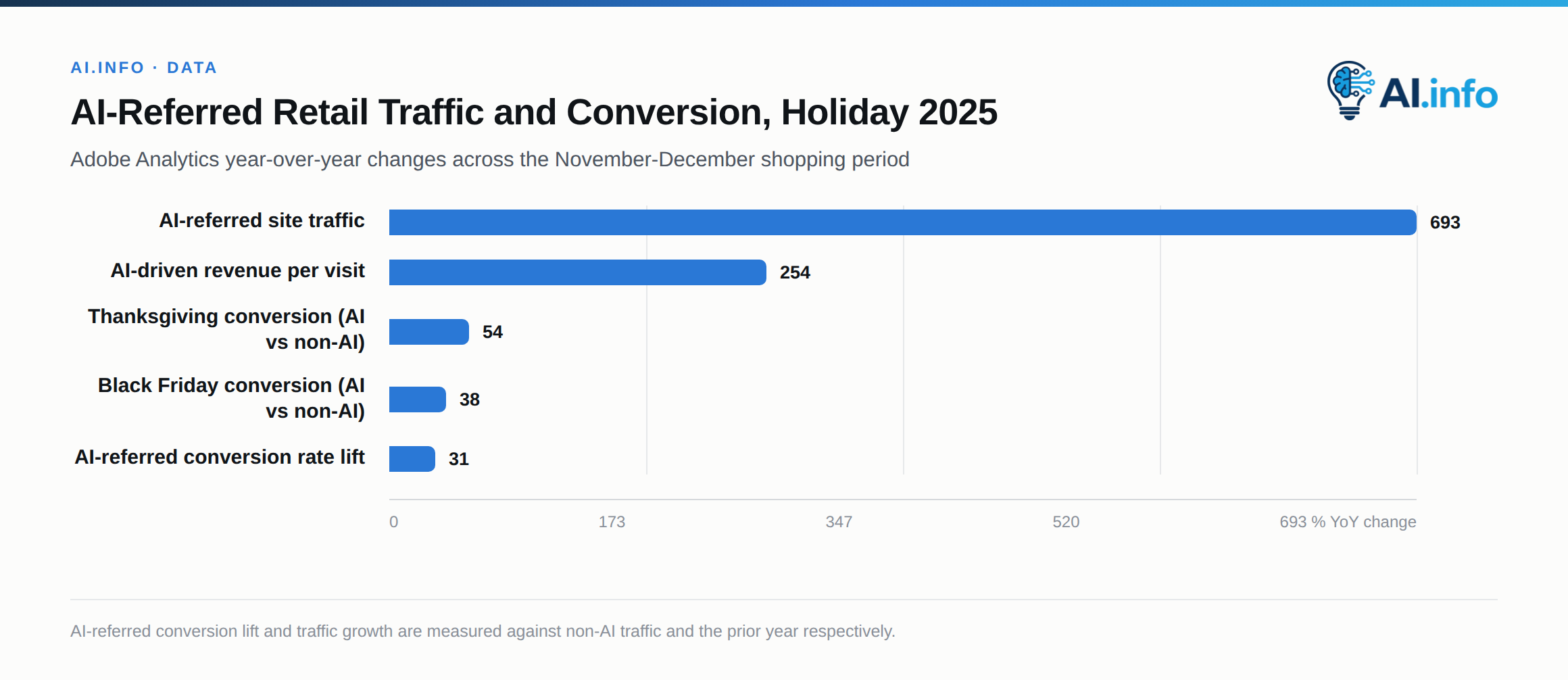
The clearest evidence that agentic shopping is not just a narrative came from Adobe Analytics' holiday-2025 data: traffic to U.S. retail sites from generative-AI sources rose 693% year over year across November and December, AI-referred visitors converted 31% more often than other traffic — nearly double the prior year's gap — and AI-driven revenue per visit was up 254% for the holiday period. Conversion gaps spiked on the two biggest shopping days: Thanksgiving conversions from AI traffic ran 54% higher than non-AI traffic, Black Friday 38% higher.
Readiness for that traffic is wildly uneven. Digital Commerce 360 and ReFiBuy's new AI Commerce Rankings, published July 15, 2026 against the 2026 Top 1000 retailer benchmark, scored catalogs on bot accessibility, AI-referred traffic, and source diversity — and found only 20 retailers scoring above 60 out of 100, with smaller, structured-catalog merchants often outranking sales leaders.
That gap marks where the next competitive line is being drawn. With the courts declining to treat a user-directed agent as an intruder, value is concentrating less in owning the checkout button, which OpenAI's retreat suggests is contested and thin-margin, and more in controlling discovery — being legible to an agent in the first place — and in the loyalty and payment credentials, like Amazon's account linkage or Google Pay, that agents need permission to spend against. Google's agentic checkout is still expanding merchant by merchant through 2026, with what its own announcement calls "many more coming soon."