Industry Transformation
AI in Pharmaceutical Drug Discovery
Isomorphic Labs raised $2.1 billion in May 2026 without a molecule in the clinic, and Insilico dosed the first Phase III patient in September. Where AI has compressed drug discovery, and where it has not.

Gabriele Masetti ·
The industry is placing real money on AI, not just press releases
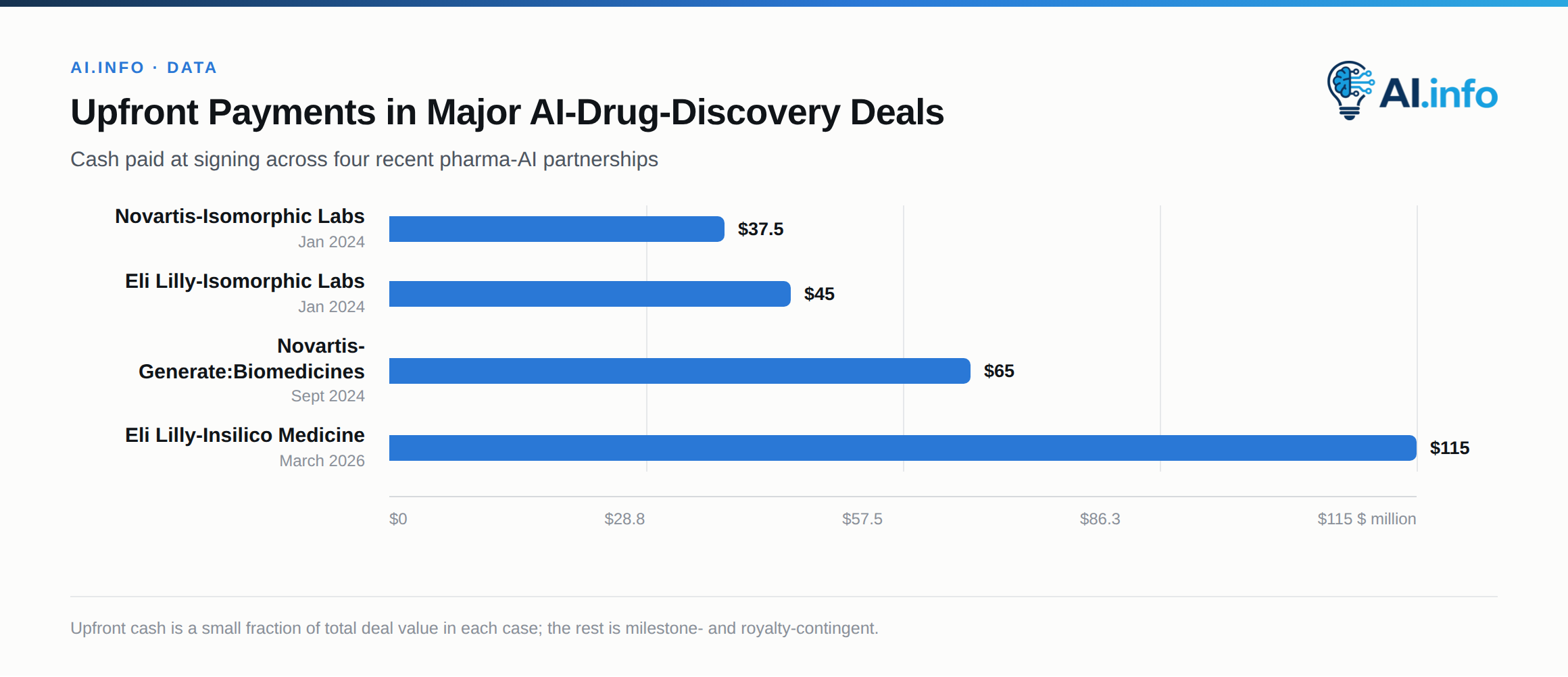
Strip away the demo videos and the phrase "AI-designed drug" gets thrown around loosely. But the capital flowing into this space is unambiguous and traceable. Isomorphic Labs, the Alphabet subsidiary built on DeepMind's AlphaFold work, signed multi-target drug discovery deals with Eli Lilly and Novartis in January 2024 worth close to $3 billion combined: Lilly paid $45 million upfront against more than $1.7 billion in milestones, Novartis paid $37.5 million upfront against up to $1.2 billion in milestones.
In February 2025, Novartis expanded its side of that arrangement from three research programs to as many as six, evidence that early technical progress — the two companies reported preclinical candidates emerging from previously "undruggable" targets by early 2026 — was strong enough to justify writing a bigger check rather than an announcement of a finished drug.
Isomorphic raised $600 million in its first outside round in April 2025, then $2.1 billion in a Series B on 12 May 2026, led by Thrive Capital with Alphabet, GV, MGX, Temasek, CapitalG and the UK sovereign AI fund alongside it. Three and a half times the money, thirteen months later, and still not one molecule of its own in a clinic.
| Company | Partner | Deal Value | Date |
|---|---|---|---|
| Isomorphic Labs | Eli Lilly | $45M upfront + $1.7B+ milestones | Jan 2024 |
| Isomorphic Labs | Novartis | $37.5M upfront + $1.2B milestones | Jan 2024 |
| Insilico Medicine | Eli Lilly | $115M upfront, $2.75B total | March 2026 |
| Recursion | Exscientia (acquisition) | ~$650 million | Aug 2024 |
| Novartis | Generate:Biomedicines | $65M upfront ($15M equity) of $1B+ deal | Sept 2024 |
| Isomorphic Labs | Series B (Thrive Capital lead) | $2.1B raised | May 2026 |
That is the shape of the industry right now: platform companies are being paid enormous sums for the promise of faster, cheaper hit-to-lead and lead-optimization cycles, years before anyone knows whether the resulting molecules will survive Phase 2 and Phase 3. The bet pharma is making is not that AI cures diseases traditional chemistry couldn't touch — it's that AI compresses the front end of a process that has gotten steadily more expensive and slower, and that compression is worth billions even at the pilot stage.
Insilico Medicine: from a Hong Kong lab to a public listing
The clearest proof point that AI-driven pharma has become an investable asset class, not just a research curiosity, is Insilico Medicine. The company's TNIK inhibitor rentosertib (also known by its earlier code, ISM001-055 or INS018_055) was identified using Insilico's generative chemistry engine, Chemistry42, paired with its target-discovery engine, PandaOmics, as a treatment for idiopathic pulmonary fibrosis (IPF), a progressive and ultimately fatal lung-scarring disease with few effective therapies.
In June 2025, Nature Medicine published results from the Phase IIa GENESIS-IPF trial: 71 patients across 22 sites in China were randomized to placebo or one of three rentosertib dosing regimens over 12 weeks. Patients on the highest dose (60 mg once daily) gained a mean 98.4 mL in forced vital capacity, versus a 20.3 mL mean decline on placebo — a dose-dependent signal in a disease where lung function normally only gets worse.
Insilico has since taken rentosertib into Phase III. The first patient in GENESIS-IPF-3 was dosed on 10 September 2026: a randomised, double-blind, placebo-controlled trial of 320 patients across 47 centres in China, with 52 weeks of treatment and the annual rate of decline in forced vital capacity as its primary endpoint. A 52-week endpoint means no readout before late 2027, and the trial's lead investigator put final approval three to four years out under favourable conditions.
The company's own accounting of its pipeline claims 31 preclinical candidates nominated since 2021 and 13 IND clearances, with a target-to-preclinical-candidate cycle averaging 12 to 18 months against an industry rule of thumb closer to 4.5 years for that stage alone.
Those are self-reported figures and should be read as a vendor's efficiency claim rather than an audited benchmark, but they're the numbers the company is now defending in front of public shareholders: Insilico listed on the Hong Kong Stock Exchange on December 30, 2025 (ticker 3696.HK), raising roughly HK$2.28 billion (about $290 million) in what was reported as the largest Hong Kong biotech IPO of 2025.
Eli Lilly and Tencent were among the cornerstone investors — Lilly's participation marked its debut as a cornerstone investor in a biotech IPO. Three months later, in March 2026, Lilly and Insilico signed a $2.75 billion agreement granting Lilly exclusive global rights to develop and commercialize drugs discovered through Insilico's Pharma.AI platform across multiple disease areas, with $115 million paid upfront and the rest tied to regulatory, commercial, and royalty milestones.
The two companies had already been working together since 2023, which suggests the enlarged deal was a renewal of a relationship with a track record, not a first date.
| Metric | Value |
|---|---|
| Preclinical candidates nominated since 2021 | 31 |
| IND clearances | 13 |
| Target-to-preclinical-candidate cycle (Insilico) | 12-18 months |
| Industry rule-of-thumb cycle time | ~4.5 years |
Consolidation: why Recursion bought Exscientia
Not every AI-pharma story is expansion. In August 2024, Recursion Pharmaceuticals — known for its automated cell-imaging and phenomics platform — announced an all-stock acquisition of Exscientia, the Oxford spinout famous for putting some of the first AI-designed small molecules into human trials. The deal, valued at roughly $650 million, closed in November 2024 after both companies' shareholders approved it.
The combined company kept the Recursion name and was led by Recursion's Chris Gibson, with Exscientia's David Hallett moving into the chief scientific officer role. The rationale was straightforwardly complementary: Recursion's strength was large-scale biological screening and target discovery, Exscientia's was precision chemistry design and automated synthesis, and management projected roughly $100 million in annual cost synergies from combining them, alongside about $850 million in combined cash and a plan to run roughly ten clinical trials by the end of 2025.
Those were projections made at the merger, not results. Two years on, Recursion's most advanced assets were still in Phase 2, nothing from either platform had reached a Phase 3 trial, and the company was guiding 2026 cash operating expenses below $375 million with runway into early 2028. The full-stack argument has not yet been tested where it matters, because nothing has got that far.
The merger is a signal about where the sector's economics actually sit. Neither company, on its own, had converted its technology into an approved drug or a blockbuster licensing deal comparable to Isomorphic's or Insilico's. Combining platforms was a way to build the "full stack" — target ID through chemistry through clinical execution — that a single pure-play AI company had struggled to fund on its own, especially with public markets valuing AI-drug-discovery stocks well below their earlier hype-cycle highs.
The failures nobody puts in the pitch deck
The industry press release format has a predictable blind spot: it announces deals and trial starts, and quietly buries discontinuations. But the failures are informative, because they show exactly where AI has and hasn't changed the odds.
Exscientia's own early clinical history illustrates the gap between speed and success. DSP-1181, developed with Sumitomo Dainippon Pharma as a treatment for obsessive-compulsive disorder, was widely reported as the first AI-designed drug to enter Phase 1 trials — and it was discontinued after failing to meet the criteria needed to advance.
EXS-21546, an A2A receptor antagonist paired with a PD-1 inhibitor for renal cell carcinoma and non-small-cell lung cancer, was being tested in the Phase 1/2 IGNITE-AI trial (NCT05920408) before Exscientia wound the program down in 2023, concluding that modeling of the clinical and preclinical data made it unlikely the drug could reach an adequate therapeutic index. AI got both molecules into human testing quickly; neither got a pass from human biology once they were there.
BenevolentAI's trajectory is starker still. Its lead program, BEN-2293, a topical pan-Trk inhibitor for atopic dermatitis, failed to hit statistically significant improvement on its primary endpoints in a Phase IIa trial reported in April 2023. The company laid off roughly 180 people the following month — about $56 million in savings — and by 2024 was cutting another 30% of staff and closing its U.S. site as its share price languished below $1.
In March 2025, BenevolentAI delisted from Euronext Amsterdam via a merger with Osaka Holdings and continued as a private company. The lesson pharma executives keep drawing from this case is specifically about target validation: BenevolentAI's platform helped identify the pan-Trk mechanism as a candidate for atopic dermatitis, but no amount of molecular design speed can substitute for the underlying question of whether a target is actually causal in a disease — that's still established the traditional way, through biology and genetics, and AI inherits that risk unchanged.
Put next to the Tufts Center for the Study of Drug Development's widely cited estimate that developing an approved drug costs on the order of $2.6 billion once capitalized time costs are included, the pattern becomes clear: AI is visibly compressing the discovery and preclinical stages — Insilico's 12-to-18-month figure against a roughly 4.5-year baseline is a real, material change. It has not yet been shown to move the needle on the clinical-stage attrition that drives most of that $2.6 billion, because Phase 2 and Phase 3 failure is overwhelmingly a biology problem, not a molecule-design problem.
Build versus buy: how big pharma is actually adopting the technology
Large pharmaceutical companies are not waiting to see how the platform companies shake out; they are hedging by both buying access and building internal capability, sometimes with the same partner in parallel. Sanofi's May 2024 collaboration with Formation Bio and OpenAI is a useful example of the "buy plus build" model: Sanofi contributes proprietary clinical and R&D data, OpenAI contributes model fine-tuning and technical expertise, and Formation Bio — itself a drug developer with engineering resources built for the pharma-AI intersection — does the integration work, all aimed at custom tools across Sanofi's development lifecycle rather than a single drug program.
Sanofi has been explicit that its ambition is to become the first major biopharma company "powered by AI at scale," a statement about internal operations, not just a discovery pipeline.
Novartis, meanwhile, is running a portfolio approach across several partners rather than betting on one platform. Alongside its Isomorphic Labs deal, it signed a September 2024 agreement worth over $1 billion with Generate:Biomedicines — $65 million upfront, including $15 million for an equity stake, plus milestone payments and royalties — to use Generate's generative protein-design platform for de novo biologics across multiple targets. Combined with its expanded Isomorphic arrangement, Novartis is effectively running two independent AI-discovery bets simultaneously, on small molecules and on proteins, rather than consolidating around a single technology stack the way Recursion and Exscientia did by merging.
The fight over who gets to use AlphaFold 3
A quieter but consequential industry story is playing out over access to protein-structure prediction itself. Google DeepMind released AlphaFold 3's code and model weights in late 2024, but the AlphaFold Server built on it remains restricted to non-commercial use — DeepMind's clear intent is to commercialize the technology through Isomorphic Labs rather than give competitors free access to the same tool its own spinout is charging billions for.
That restriction has pushed a consortium of major pharmaceutical companies, including AbbVie, Johnson & Johnson, Sanofi, and Boehringer Ingelheim, to back OpenFold3, a fully open and commercially licensable reimplementation of the AlphaFold 3 architecture. Under a Federated OpenFold3 Initiative, several of these companies are separately training OF3 on their own proprietary protein-drug interaction data — reportedly on the order of 4,000 to 8,000 protein-drug pairs per company — rather than pooling that data with each other or depending on DeepMind's roadmap.
It's a direct response to a strategic risk: no pharma company wants its structural-biology capability gated by a single competitor's corporate sibling.
Regulators are drawing the line between discovery and evidence
The FDA has so far drawn a deliberate boundary around what regulatory scrutiny of AI in drug development actually covers. Its January 6, 2025 draft guidance, "Considerations for the Use of Artificial Intelligence to Support Regulatory Decision-Making for Drug and Biological Products," explicitly excludes AI used purely for discovery or operational efficiency from its scope. What it does regulate is AI used to generate data or information intended to support an actual regulatory decision on safety, efficacy, or quality — spanning nonclinical, clinical, post-marketing, and manufacturing use of models.
The guidance proposes a seven-step, risk-based framework for establishing a model's "credibility" for a specific regulatory context of use, plus expectations for monitoring model performance over its lifecycle, and it was open for public comment through April 2025.
That distinction matters for the business side of the industry. It means a company can use generative chemistry or AlphaFold-style structure prediction to pick a molecule with essentially no regulatory friction — the FDA doesn't care how you found your candidate. But the moment a company wants an AI model's output (a biomarker prediction, a manufacturing quality assessment, a clinical trial simulation) to count as evidence in an application, it now faces a defined, documented credibility-assessment process.
Expect that boundary to become the next fault line pharma companies test, as platforms like Insilico's and Isomorphic's mature from "we found the molecule" claims toward "our model predicted this trial outcome" claims that would actually fall inside the FDA's framework.
What this actually adds up to
None of this amounts to AI having cured a disease traditional methods couldn't. What it does show is an industry restructuring itself around a genuinely faster front end: platform companies commanding multi-billion-dollar partnership terms and public listings on the strength of preclinical-stage speed, established players hedging across multiple AI partners rather than picking one, sub-scale AI-native companies merging or delisting when speed alone didn't translate into cash, and a regulator carefully separating "how you found it" from "how you prove it works."
The molecules discovered this way still have to survive the same Phase 2 and Phase 3 gauntlet that kills the large majority of clinical candidates industry-wide — rentosertib's Phase III readout, which cannot arrive before late 2027, will say more about whether the compressed timelines translate into approved medicines than any partnership announcement has so far.