Industry Transformation
AI in Legal: Transforming Contract Analysis and Legal Research
Contract extraction, legal research and the verification duty: Harvey at $15.5bn, Lexis+ with Protégé, a hallucination tracker past 2,000 cases, a $110,204 Oregon sanction, and California's draft AI rule.

Gabriele Masetti ·
Contract review stops being a headcount problem
For decades, the economics of due diligence were simple: more contracts meant more junior associates and paralegals reading them line by line, flagging change-of-control clauses, indemnification caps, and governing-law provisions. That model is being unwound by a specific class of software built to extract structured data from unstructured contract text.
Kira Systems, now sold as a module within the Litera platform after Litera's acquisition of the company, remains the reference point for this category. It combines lawyer-trained predictive models with generative AI to pull defined terms, clauses, and obligations out of large diligence sets, and it is still primarily positioned for the task it was built for in the mid-2010s: M&A due diligence at volume.
Luminance takes a broader stance, positioning itself across due diligence and contract lifecycle management. On 19 June 2026 it launched Luna Crescent, the first model in a proprietary Luna family, fine-tuned on a subset of a dataset the company says is drawn from over 220 million verified legal documents. Luminance claims 5 percent higher accuracy than leading general-purpose models on contract-understanding tasks and generation up to four times faster, at 200 to 400 tokens per second, on its own ContractIQ Bench. A benchmark built and scored by the vendor shows a direction, not a result.
Ironclad occupies an adjacent but distinct niche — contract lifecycle management, meaning intake, approval routing, redlining, e-signature, and obligation tracking for high volumes of routine agreements, rather than the forensic clause extraction that Kira and Luminance specialize in.
The practical distinction matters for buyers: Kira extracts data from contracts you already have, Luminance reviews and increasingly negotiates them, and Ironclad manages them through their lifecycle. Law firms and corporate legal departments running large diligence exercises still tend to use more than one of these tools rather than picking a single winner, because the underlying workflows — one-time bulk extraction versus ongoing contract administration — are genuinely different problems.
The research assistant arms race
The more visible fight is over legal research and drafting, where three companies have set the pace. Thomson Reuters closed its $650 million acquisition of Casetext in August 2023, absorbing CoCounsel, the generative AI legal assistant Casetext had launched on March 1, 2023, as the first such product built on GPT-4.
Thomson Reuters has since folded that technology into Westlaw as "AI-Assisted Research" and expanded the CoCounsel brand across its tax, audit, and compliance product lines; by February 2026 the company reported CoCounsel had reached one million users across 107 countries. LexisNexis answered with Lexis+ AI, its own generative research and drafting assistant built on top of its case-law database. That product has since been superseded: on 24 February 2026 LexisNexis made Lexis+ with Protégé generally available in the United States, describing Lexis+ AI as its first-generation AI experience and the replacement as a new flagship platform rather than a rename.
Harvey, the third major player, has taken a different path — a horizontal legal AI platform rather than an extension of an existing research database, built with OpenAI as an early investor. Allen & Overy (now Allen & Overy Shearman, following its 2024 merger with Shearman & Sterling) ran a beta trial starting in November 2022 in which roughly 3,500 of the firm's lawyers across 43 offices submitted about 40,000 queries to Harvey, then converted the trial into a firm-wide deployment.
Harvey's funding trajectory tells its own story about how much capital is chasing this bet: a $100 million Series C at a $1.5 billion valuation in July 2024, a $300 million Series D at a $3 billion valuation in February 2025, $200 million at an $11 billion valuation in the first half of 2026, and then $550 million announced on 9 September 2026. Harvey put that round's valuation at $15.5 billion; Bloomberg reported $15.6 billion. The company says it has passed $400 million in annual recurring revenue and that 80 percent of Am Law 100 firms use it, and it has begun post-training its own open-weight legal model.
That is venture-scale money being placed on the premise that large law firms will pay recurring, enterprise-grade fees for AI research and drafting tools — a premise that depends heavily on those tools being reliable enough that partners will actually sign off on their output.
| Round | Date | Amount Raised | Valuation |
|---|---|---|---|
| Series C | July 2024 | $100 million | $1.5 billion |
| Series D | February 2025 | $300 million | $3 billion |
| Later round | First half of 2026 | $200 million | $11 billion |
| Latest round | 9 September 2026 | $550 million | $15.5bn (company) / $15.6bn (Bloomberg) |
What these tools are actually asked to do, in practice, is narrower than the marketing suggests: drafting first-pass memos summarizing case law on a discrete question, comparing a proposed contract clause against a firm's playbook of acceptable positions, summarizing deposition transcripts, and surfacing precedent that a human researcher then has to confirm. None of the major vendors — Harvey, CoCounsel, or Lexis+ with Protégé — market their products as a replacement for attorney review of the final work product; the pitch is speed on the first draft, not authority on the final one.
That framing matters because it is also the legal standard courts have started to apply when deciding how much blame attaches to a lawyer who filed something an AI tool got wrong: the tool's error is not the point of failure the sanctions turn on, the lawyer's failure to check it is.
A precedent from before the LLM era
It is worth remembering that courts have been here before with a narrower but related technology. In Da Silva Moore v. Publicis Groupe (S.D.N.Y. 2012), Magistrate Judge Andrew Peck issued the first judicial endorsement of technology-assisted review — predictive coding — as an acceptable method for reviewing millions of documents in discovery, provided it was implemented and validated properly under the proportionality standard in Federal Rule of Civil Procedure 26(b)(2)(B).
That ruling didn't approve TAR because the technology was flashy; it approved a specific, auditable workflow with sampling and validation built in, and that framework is essentially what courts still expect when any AI system's output substitutes for human review at scale. The generative AI tools now marketed for research and drafting have not yet received an equivalent, settled judicial framework — which is part of why the sanctions record below matters as much as it does.
When the machine cites cases that do not exist
The starkest cautionary tale is Mata v. Avianca, decided in the Southern District of New York in May 2023. Plaintiff's counsel filed a brief opposing a motion to dismiss that cited several cases — including one involving a fictitious airline — that did not exist. The lawyers had used ChatGPT to research and draft the filing, and when opposing counsel and then the court could not locate the cited cases, the attorney asked the chatbot to verify them; it assured him the cases "indeed exist" and could be found in Westlaw and LexisNexis. Judge P. Kevin Castel found the filings misleading, held a sanctions hearing, and fined the two attorneys and their firm $5,000.
| Case | Date | Sanction |
|---|---|---|
| Mata v. Avianca | May 2023 | $5,000 fine (two attorneys + firm) |
| Smith v. Farwell (Bednar) | Feb 2024 | Pay opposing fees, refund client, nonprofit donation |
| Morgan & Morgan (3 attorneys) | Feb 2025 | $3,000 + $1,000 + $1,000 fines |
Mata was not an isolated event, and the pattern has continued well past 2023. In February 2024, a Massachusetts case, Smith v. Farwell, involved counsel filing multiple pleadings with fictitious cases generated by AI. A Utah attorney, Richard Bednar, was sanctioned after submitting a brief citing a non-existent case, "Royer v. Nelson," and was ordered to pay opposing fees, refund his own client, and make a donation to a legal nonprofit.
In February 2025, a federal court sanctioned three attorneys from the national plaintiffs' firm Morgan & Morgan after motions in limine cited nine cases, eight of which turned out not to exist — the drafting attorney was fined $3,000 and the two who filed the motions were fined $1,000 each.
The tracker Damien Charlotin maintains listed 2,045 decisions involving AI-fabricated content in filings as of 19 September 2026. The penalties have grown with the count. In Couvrette v. Wisnovsky, an Oregon federal case whose three briefs carried 15 non-existent cases and eight fabricated quotations, the court struck the briefs, dismissed the claims with prejudice, fined lead counsel $15,500 in December 2025 and in March 2026 awarded the defendants $94,704.38 in fees — $110,204.38 in total, with a referral to the Oregon State Bar.
The ladder now runs past money: the same tracker records bar discipline, and in August 2026 the UK Solicitors Disciplinary Tribunal struck a lawyer off in Solicitors Regulation Authority v Kumar over false quotations. The common thread across nearly all of these is not that a lawyer used AI — it is that a lawyer did not independently verify the AI's citations before signing and filing the document.
What the Stanford data actually says
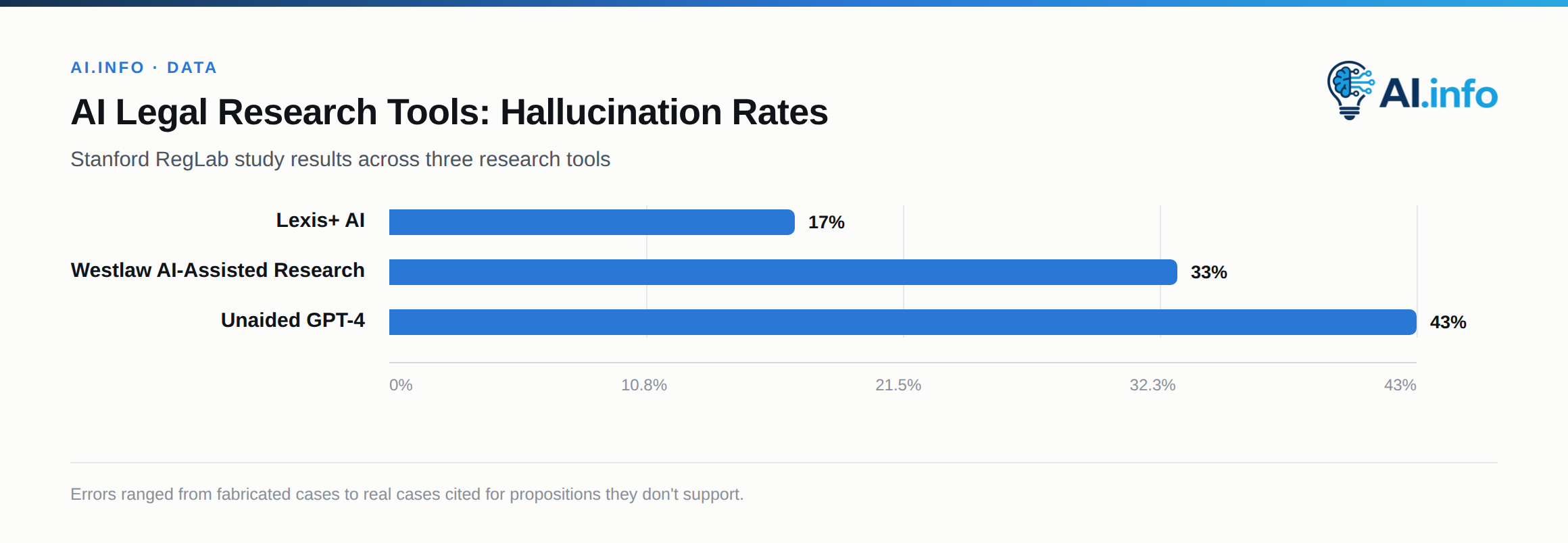
For a while, vendors of legal-specific AI research tools argued that retrieval-augmented systems built on verified case-law databases would essentially solve the hallucination problem that plagues general-purpose chatbots. A Stanford RegLab study, published as "Hallucination-Free? Assessing the Reliability of Leading AI Legal Research Tools," tested that claim directly against Lexis+ AI, Westlaw's AI-Assisted Research (the product built on the acquired Casetext/CoCounsel technology), and general-purpose GPT-4.
The results undercut the "solved" narrative without validating the doomsayers either: Lexis+ AI hallucinated in roughly 17% of tested queries, Westlaw's AI-Assisted Research in roughly 33%, and unaided GPT-4 in roughly 43%. Errors ranged from outright fabricated cases to more insidious problems — a real case cited for a proposition it doesn't actually stand for, or authority that is technically real but inapplicable to the point being argued, which is arguably more dangerous than an outright fabrication because it survives a cursory existence check.
The finding forced at least one public correction: after the study's publication, LexisNexis walked back marketing language that had described its product as "hallucination-free," clarifying that the claim applied only to linked legal citations rather than to substantive accuracy, and that no vendor could credibly promise zero-error output.
The honest takeaway is that legal-specific RAG systems built on curated case-law databases are measurably better than a bare general-purpose model — roughly half the error rate of GPT-4 in the Stanford numbers — but "better" is not "safe to rely on unchecked." A one-in-six to one-in-three chance of a meaningful error, extrapolated across the volume of queries a busy litigation practice runs, guarantees that unverified errors will eventually reach a filing.
The regulatory response has been fast, and unusually specific
Because the hallucination problem produced court sanctions rather than abstract risk, professional regulators moved quickly and concretely rather than issuing generic technology-neutral guidance. The Florida Bar's Board Review Committee on Professional Ethics issued Opinion 24-1 in January 2024, telling Florida lawyers that generative AI use is permitted but that they must protect client confidentiality, obtain informed client consent before disclosing confidential information to a third-party AI tool, provide accurate and competent services, avoid billing clients for time spent learning the technology, and comply with advertising rules if AI is used in client-facing marketing.
The American Bar Association's Standing Committee on Ethics and Professional Responsibility followed in July 2024 with Formal Opinion 512, its first formal guidance specifically addressing generative AI. It maps existing Model Rules onto the technology: Rule 1.1 competence requires lawyers to understand a tool's capabilities and limitations well enough to supervise its use, Rule 1.6 confidentiality requires understanding how a given AI system stores and potentially reuses submitted data, Rule 1.5 on fees bars charging clients to learn a general AI tool (though client-requested, matter-specific tool training can be billed), and — explicitly — lawyers must guard against hallucinations forming the basis of arguments they file.
The California State Bar had already published its own Practical Guidance for the Use of Generative Artificial Intelligence in the Practice of Law in November 2023, and in an August 2025 letter the California Supreme Court directed the State Bar to consider converting that guidance into binding rules of professional conduct rather than leaving it as advisory commentary.
That instruction produced text. On 13 March 2026 the State Bar's Standing Committee on Professional Responsibility and Conduct approved proposed amendments to six Rules of Professional Conduct and opened a comment period that closed on 4 May 2026. The proposed comment to Rule 1.1 says a lawyer using technology, including AI, "must independently review, verify, and exercise professional judgment regarding any output generated by the technology that is used in connection with representing a client." The rulemaking is unfinished, the Supreme Court holds final authority and no effective date is set — but the duty being drafted is the one the sanctions record has been enforcing case by case.
The shape of the trade lawyers are actually making
None of this argues against adoption — the funding numbers behind Harvey and the acquisition price Thomson Reuters paid for Casetext both reflect a real, defensible bet that AI materially speeds up document-heavy legal work. What the sanctions record and the Stanford numbers argue against is treating any current tool, general-purpose or legal-specific, as a substitute for a lawyer independently pulling and reading the cited authority before it goes in a filing.
The firms getting real value out of these tools — A&O Shearman's scaled Harvey deployment is the clearest public example — are the ones that built verification into the workflow rather than around it, treating AI output the same way a supervising partner would treat a first-year associate's draft: useful, often fast, and never signed without being checked.