Industry Transformation
AI in Insurance: Risk Assessment, Claims Processing, and Fraud Detection
AI already prices individual roofs, reads damage photos and flags fraud. Fairness is the unsettled part: Lemonade's loss ratio reached 60% in 2026 while the EU pushed its high-risk insurance rules to December 2027.

Gabriele Masetti ·
Insurance is a business built on estimating things that haven't happened yet, and that makes it fertile ground for machine learning. Over the past decade the industry has quietly become one of the heaviest commercial users of applied AI outside of tech itself — not for chatbots and demos, but for the unglamorous work of pricing risk, reading damage photos, and catching liars. The technology mostly works. The harder problem, still unresolved, is proving it doesn't work unfairly.
Underwriting: seeing risk at the level of a single roof
Traditional underwriting priced risk with broad proxies — ZIP code, building age, credit-based insurance scores. AI-driven underwriting tools now price risk at the level of an individual property or driver, using imagery and sensor data traditional actuarial tables never had access to.
ZestyAI, a San Francisco-based risk analytics company, built its Z-FIRE model to score wildfire risk for individual parcels using aerial imagery, vegetation data, and fire-science modeling rather than county-level fire maps. The company says the model is roughly 44 times more precise than traditional regional wildfire models at the property level, and its broader risk platform — covering wildfire, hail, wind, severe convective storms, and non-weather water damage — now informs underwriting decisions on more than $3 trillion in insured property value.
ZestyAI says its data helped carriers extend coverage to more than 511,000 previously "uninsurable" properties in 2024, a meaningful claim in a period when major insurers, including State Farm and Allstate, were pulling back from wildfire-exposed California markets rather than expanding into them. Whether that expansion holds up as climate losses mount is the real test; for now it's evidence that better property-level data can cut both ways — insurers can use it to exclude risk, or to underwrite risk they'd otherwise decline outright. ZestyAI has stayed independent and kept signing distribution: in February 2026 Marsh McLennan Agency's private client services arm adopted Z-FIRE, Roof Age and Z-Property to assess wildfire exposure on high-value homes.
On the auto side, usage-based insurance has moved from novelty to mainstream. Progressive's Snapshot program, one of the longest-running telematics products in the U.S., tracks braking, acceleration, time of day, mileage, and phone handling through a plugged-in device or app, then adjusts pricing accordingly. Progressive reports that roughly four in five participants earn a discount, about half earn a double-digit discount, and one in five actually see their rate go up based on measured driving behavior.
The company says it has paid out more than $2.2 billion in Snapshot discounts since the program launched in 2009. That last detail matters: usage-based insurance is often sold to consumers as a pure discount play, but it is explicitly a two-way pricing mechanism, and a fifth of participants learn that the hard way.
| Progressive Snapshot metric | Value |
|---|---|
| Participants earning a discount | ~4 in 5 |
| Participants earning a double-digit discount | ~half |
| Participants seeing a rate increase | ~1 in 5 |
| Total discounts paid out since 2009 | $2.2 billion |
Catastrophe modeling — the actuarial backbone of property reinsurance — has also absorbed generative AI faster than most expected. Verisk's research leadership has described using generative AI to model extreme wind and rain jointly rather than sequentially, arguing it captures storm-system spatial variability that older Monte Carlo approaches miss; the company has disclosed roughly 40 generative AI initiatives in development across its catastrophe modeling business.
Moody's RMS, the other dominant cat-modeling vendor, uses AI to read satellite imagery after hurricanes and wildfires to estimate insured losses within days rather than weeks — the technology was used to distinguish wind damage from flood damage and partial from total losses after Hurricanes Helene and Milton in 2024, work that historically required slow, expensive field adjusting at scale. Moody's has since rolled out IRP Navigator, which it bills as the first vendor generative-AI tool built specifically for the catastrophe-modeling workflow.
Claims: computer vision replaces the adjuster's clipboard
The most visible AI application in insurance is in claims, where computer vision has genuinely compressed timelines that used to run days or weeks into minutes.
Tractable, a UK-based computer vision company founded in 2014, trains its models on hundreds of millions of vehicle and property damage images to generate repair estimates directly from smartphone photos submitted at first notice of loss. The company says its tools can accelerate estimating by up to 10 times relative to manual inspection, and it now partners with more than a third of the world's top 100 insurance carriers, including GEICO, The Hartford, and American Family.
It raised a $65 million Series E in 2023 led by SoftBank Vision Fund 2, having reached unicorn status in 2021 — a signal that investors still see automated damage assessment as a durable category rather than a pandemic-era novelty.
Lemonade built its entire brand around claims automation, and its record is genuinely mixed in an instructive way. In its 2020 IPO filing, the company said its claims bot, nicknamed AI Jim, could take a claim through to full resolution — payment or denial, no human involved — in about a third of cases.
The following year, Lemonade posted a since-deleted Twitter thread claiming its AI could pick up on "non-verbal cues" in the videos claimants submit, and used the phrase in a way that read as implying it evaluated claimants' body language or physical presentation. The backlash was immediate and specific: users pointed out that claimants of color, or people who were nervous, disabled, or simply awkward on camera, could be flagged as suspicious by a system with no accountability for how it reached that judgment.
Lemonade deleted the thread and clarified that the actual technology was facial recognition used to catch the same person filing near-identical claims under different identities — a fraud-duplication check, not a lie detector — and that the fully automated approve/deny step in the pipeline "isn't artificially intelligent" at all.
The episode is worth dwelling on precisely because Lemonade is the insurtech that leans hardest into an AI-first identity: even its own marketing overstated what its models actually do, and it took public pressure, not internal review, to walk it back.
Whatever the marketing excesses, the underlying underwriting numbers have improved, and they kept improving. Lemonade's gross loss ratio — the share of premium paid out in claims, and the single most important number in whether an insurer's pricing model actually works — fell from 77% in the fourth quarter of 2023 to 63% a year later, and reached 60% in the second quarter of 2026.
The company attributes the gains to its AI-driven underwriting and lifetime-value models achieving finer risk segmentation as they mature on more data. Sixty percent sits inside the band most property-and-casualty insurers aim for rather than above it, which means the cautious verdict this essay could once offer — demonstrably improving, not demonstrably winning — no longer holds. On the number that decides whether an underwriting model works, Lemonade's is working. The open question has moved to whether it holds through a bad catastrophe year, not whether it prices risk at all.
| Lemonade metric | Value |
|---|---|
| Claims resolved with no human involved (2020 IPO filing) | ~1/3 of cases |
| Gross loss ratio, Q4 2023 | 77% |
| Gross loss ratio, Q4 2024 | 63% |
| Gross loss ratio, Q2 2026 | 60% |
Fraud detection: the least controversial win
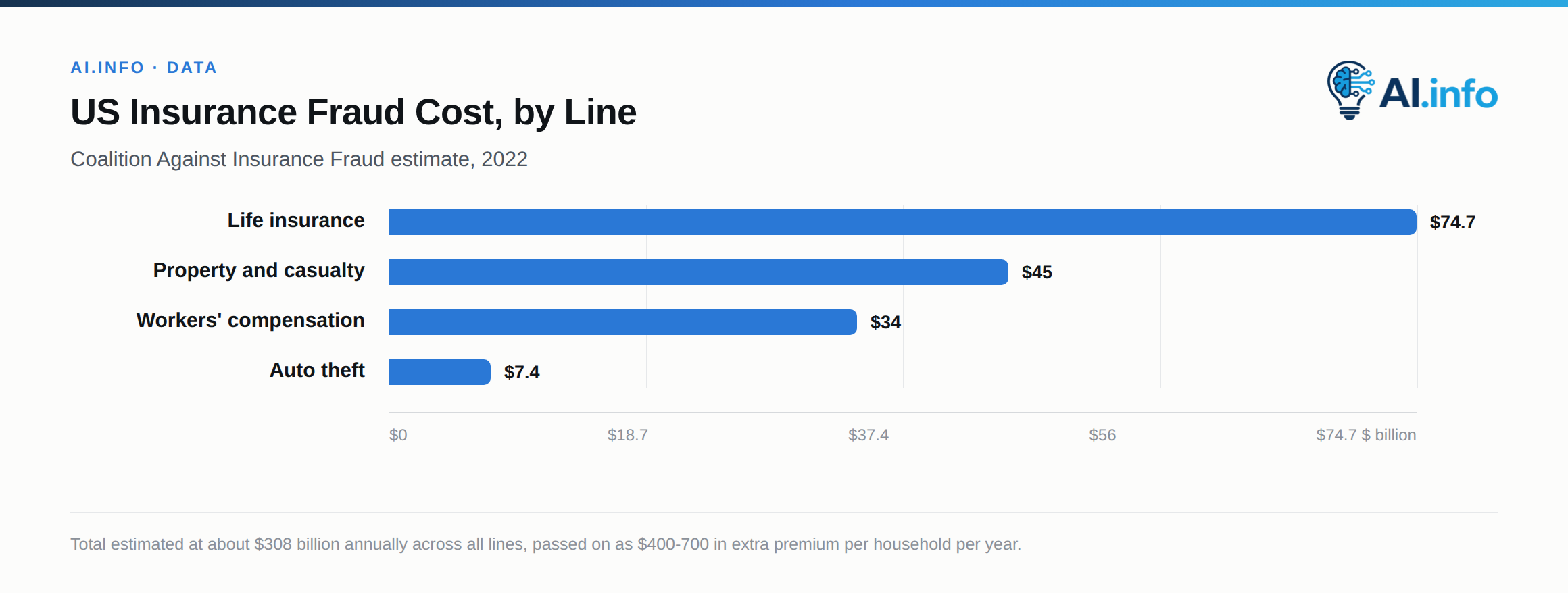
If there's one corner of insurance AI with a genuinely strong evidence base and comparatively little fairness controversy, it's fraud detection. The Coalition Against Insurance Fraud estimated in 2022 — a study still being quoted as the industry's headline number four years later, which says more about how rarely it is redone than about its precision — that fraud costs the U.S. insurance industry about $308 billion annually across all lines — life insurance ($74.7 billion), property and casualty ($45 billion), workers' compensation ($34 billion), and auto theft ($7.4 billion) among the categories it broke out — a figure it says is passed on to policyholders as $400 to $700 in extra premium per household per year.
(The FBI's separate estimate of more than $40 billion a year for non-health lines is still far lower and reflects a narrower methodology; the wide gap between the two figures is itself a reminder that fraud-cost statistics in this industry are contested and should be read with the source's scope in mind, not treated as a settled number.)
Shift Technology, a Paris-founded company that has offered an AI fraud-detection platform since 2014, is the clearest commercial validation that the fraud-detection use case scales. It raised a $220 million Series D in 2021 at a valuation above $1 billion, led by Advent International with participation from Accel, Bessemer Venture Partners, General Catalyst, and others, bringing total funding to $320 million.
Shift now says it works with more than 100 insurers across 25-plus countries — including AXA Spain, Liberty Mutual, CNA Financial, and MS&AD Insurance Group — and reports more than $5 billion in fraud losses avoided across its customer base. Unlike underwriting or claims-denial models, fraud-detection systems are typically built to flag cases for human investigator review rather than to auto-deny claims outright, which sidesteps some of the due-process objections that dog other AI use cases — though it doesn't eliminate them, since a flag itself can still delay a legitimate payout and disproportionately fall on the same populations that already face more underwriting scrutiny.
The fairness reckoning regulators are only starting to run
The unresolved question across all of this is whether AI models are pricing and deciding fairly across race, and for years insurers answered that question themselves, with no external testing requirement. That is changing, slowly and unevenly.
Colorado has moved furthest. Under SB 21-169, signed in 2021, the state's Division of Insurance built out Regulation 10-1-1, effective for life insurers in November 2023, which requires them to maintain a governance framework for any algorithm or predictive model built on external consumer data.
A companion quantitative-testing regulation, out for comment since September 2023, requires annual testing of whether Hispanic, Black, and Asian/Pacific Islander applicants are declined coverage, or charged different premium rates per $1,000 of face value, at statistically different rates than white applicants. In August 2025, Colorado extended that governance-and-testing framework beyond life insurance to health insurance and private passenger auto — the first state to require this kind of race-based statistical audit of insurance algorithms across multiple lines.
At the national level, the NAIC adopted a Model Bulletin on the Use of Artificial Intelligence Systems by Insurers in December 2023. It isn't a law and doesn't take effect anywhere until a state insurance department formally adopts it, but by 2026 nearly half of U.S. states had done so in full or substantially similar form.
It requires insurers to maintain a written AI governance program with board and senior-management accountability, documented risk controls, and testing for errors, bias, and unfair discrimination — including oversight of third-party AI vendors like Tractable, ZestyAI, and Shift, whose tools the insurer remains legally responsible for even though it didn't build them.
The EU has gone further on paper: the AI Act classifies AI systems used for risk assessment and pricing in life and health insurance as "high-risk" under Annex III, which triggers mandatory fundamental-rights impact assessments, registration in an EU database before deployment, and fines of up to €15 million or 3% of global turnover for noncompliance.
None of it binds yet. The Digital Omnibus — Regulation (EU) 2026/1744, published in the Official Journal on 24 July 2026 and in force from 27 July 2026 — pushed the obligations for stand-alone Annex III systems back to 2 December 2027, and those for high-risk AI embedded in regulated products to 2 August 2028. Insurance pricing models stayed on the list. The date by which anyone must do something about them moved by more than a year, which is the gap between a regulation existing and one operating.
Meanwhile, the sharpest current test case is playing out in litigation, not regulation. A 2022 lawsuit against State Farm, filed in Illinois on behalf of homeowners Jacqueline Huskey and Riian Wynn, alleges the insurer's claims-handling algorithms flag Black policyholders' claims for heavier scrutiny than white policyholders' claims, using signals — voice, geolocation, social media presence, browsing history, historical housing and claims data — that plaintiffs argue function as race proxies even without race being an explicit input.
A federal judge let the core of it through in September 2023: the claim under §3604(b) of the Fair Housing Act survived, along with the disparate-impact theory, while claims under §3604(a) and §3605 were dismissed without prejudice. Nearly four years after filing, the case is still in a phased discovery aimed first at identifying which algorithmic screening tools State Farm actually uses, and no class has been certified.
The pace is itself a finding: auditing an insurer's models through litigation is slow enough that the models will have been retrained several times before a court rules on them. That distinction — auditing the model's real-world outputs rather than trusting the vendor's description of its inputs — is exactly what Colorado's testing regime and the NAIC bulletin are trying to force proactively, and exactly what nobody was doing five years ago.
Where this actually leaves the industry
Taken together, the honest picture is lopsided. On the actuarial and operational side, AI in insurance has a real, measurable track record: sharper property-level risk pricing, claims settled in minutes on photos instead of weeks on adjuster visits, and fraud losses avoided in the billions.
On the fairness side, the industry has almost no comparable track record, because almost nobody was required to produce one until the last two or three years — and the one AI-native insurer that built its whole brand on the technology still managed to publicly mischaracterize what its own model does.
Regulators in Colorado and the EU, and the NAIC's slowly-spreading model bulletin, are the first serious attempts to close that gap, but they're arriving after the algorithms are already pricing millions of policies and denying or flagging millions of claims — and, in the EU's case, arriving a year later than the statute originally promised. The audits happening now are forensic as much as they are preventive.