Industry Transformation
The AI Energy Crisis: How Nuclear Power is Fueling the Intelligence Explosion
How the electricity demands of frontier AI are forcing a pivot to nuclear power — with Three Mile Island's restart pulled forward to 2027 and the first US construction permit for an advanced reactor granted in March 2026.
Gabriele Masetti ·
The Load Nobody Priced In
For most of the last two decades, electricity demand in wealthy countries was flat or falling — efficiency gains offset population and economic growth, and utilities planned around modest, predictable curves. That era is over. The International Energy Agency's Electricity 2026 report puts global data center electricity consumption at roughly 485 terawatt-hours in 2025, on a path to nearly double to about 945 TWh by 2030 — just under 3% of world electricity use, but growing at around 15% a year, four times faster than electricity demand from every other sector combined.
The IEA's separate Energy and AI analysis is blunter still: consumption from AI-optimized data centers is set to roughly triple over that period, outpacing the broader data center build-out that includes ordinary cloud storage and web hosting.
In the United States specifically, data center electricity demand was on track to exceed 260 TWh in 2026, according to IEA modeling — a number that keeps getting revised upward as hyperscalers announce ever-larger training clusters. That demand doesn't arrive gradually. A single new AI campus can require several hundred megawatts to a gigawatt of continuous power, roughly the output of a large nuclear reactor, and utilities that used to add generation in decade-long increments are now fielding requests for gigawatt-scale interconnections within a few years.
That is the mechanical root of what's become known, only half-hyperbolically, as the AI energy crisis: the compute buildout is real and funded, but the electrons to run it are not showing up on the timeline anyone wants.
Nuclear power has become the industry's answer of choice — not because it's cheap or fast, but because it's the only large-scale, carbon-free, always-on source that can plausibly match the load profile of a data center running inference and training around the clock. What's happened over the past two years is a genuine restructuring of how Big Tech buys electricity, and it's worth separating the real deals from the noise.
Reviving What Already Exists
The clearest signal came in September 2024, when Microsoft signed a 20-year power purchase agreement with Constellation Energy tied to restarting Unit 1 at Three Mile Island in Pennsylvania — the same site, though a physically separate reactor, as the 1979 partial meltdown that shaped a generation's fear of nuclear power. Constellation is investing $1.6 billion to bring the 835-megawatt unit back online, rebranding the facility the Crane Clean Energy Center after former Exelon CEO Chris Crane, with a target restart date of 2027.
The restart cleared its most awkward obstacle on 1 June 2026, when the Federal Energy Regulatory Commission granted Constellation a waiver from PJM's interconnection rules, letting it move 760 megawatts of capacity interconnection rights from the retired Eddystone plant to the Crane site instead of waiting on transmission upgrades not due until December 2030. The project is also backed by a $1 billion Department of Energy loan, closed in November 2025. It's a genuinely unusual transaction — reversing a shutdown that happened in 2019 because the plant, at the time, couldn't compete economically with cheap natural gas. AI demand changed that math.
| Company | Partner | Capacity | Deal length/value |
|---|---|---|---|
| Microsoft | Constellation (Three Mile Island) | 835 MW | 20-year PPA; $1.6B investment |
| Amazon | Talen Energy (Susquehanna) | up to 1,920 MW | 17-year, ~$18 billion PPA |
| Kairos Power | 500 MW by 2035 | — | |
| Meta | Vistra, Oklo, TerraPower | up to 6.6 GW by 2035 | — |
Amazon took a different but related path with Talen Energy, whose Susquehanna nuclear plant in Pennsylvania already supplies a large data center campus next door. What began as a smaller co-located arrangement was restructured and expanded in June 2025 into a 17-year, roughly $18 billion power purchase agreement covering up to 1,920 megawatts — nearly 80% of Susquehanna's total 2.5-gigawatt output — delivered as a grid-connected, front-of-the-meter retail supply rather than the original "behind the meter" model regulators had scrutinized.
Full contracted volume is expected by 2032, and the companies have said they'll jointly explore new small modular reactors and plant uprates in Pennsylvania. Both the Microsoft and Amazon deals share a structural logic: rather than fund new construction from scratch, hyperscalers are using long-term contracts to make idle or underused nuclear capacity economically viable again, effectively acting as anchor tenants for plants that utilities alone might not have bothered to fully monetize.
Betting on Reactors That Don't Exist Yet
The more speculative — and more revealing — bets are on next-generation reactor designs that haven't been commercially proven at scale. Google's arrangement with Kairos Power, first announced in October 2024, aims to bring 500 megawatts of advanced nuclear capacity online by 2035 through a series of small modular reactors.
The first concrete step came in August 2025, when the Tennessee Valley Authority signed a 50-megawatt power purchase agreement with Kairos to supply Google data centers in Montgomery County, Tennessee, and Jackson County, Alabama, from Kairos's Hermes 2 plant under construction in Oak Ridge. TVA called it the first binding utility agreement in the country with a next-generation SMR developer; Kairos expects Hermes 2's first unit finished by late 2027, with power delivery targeted around 2030.
Fifty megawatts is a fraction of what a single data center campus needs — this is a demonstration project, not a solution, and Google has been careful not to claim otherwise.
Meta's approach has been the most methodical. In December 2024 the company issued a formal request for proposals seeking 1 to 4 gigawatts of new nuclear generation, open to both large conventional reactors and SMRs, with power needed starting in the early 2030s. That process produced results in January 2026: agreements with three different developers totaling up to 6.6 gigawatts by 2035.
Vistra will supply roughly 2.6 gigawatts from existing plants — Beaver Valley in Pennsylvania and the Perry and Davis-Besse plants in Ohio — including uprates that add new capacity to units already running. Oklo will build an advanced reactor campus in Pike County, Ohio, aiming for up to 1.2 gigawatts with a first phase targeted as early as 2030.
TerraPower's contribution is the largest single commitment: up to eight Natrium reactors providing 2.8 gigawatts of baseload power plus 1.2 gigawatts of integrated molten-salt energy storage, though the earliest Natrium units aren't expected to supply power before 2032. Meta has described this as one of the largest corporate nuclear procurement efforts to date — a defensible claim given the combined gigawattage, even if "largest in history" claims about any single one of these deals don't hold up to scrutiny once you check the underlying contract sizes against national grid-scale nuclear fleets.
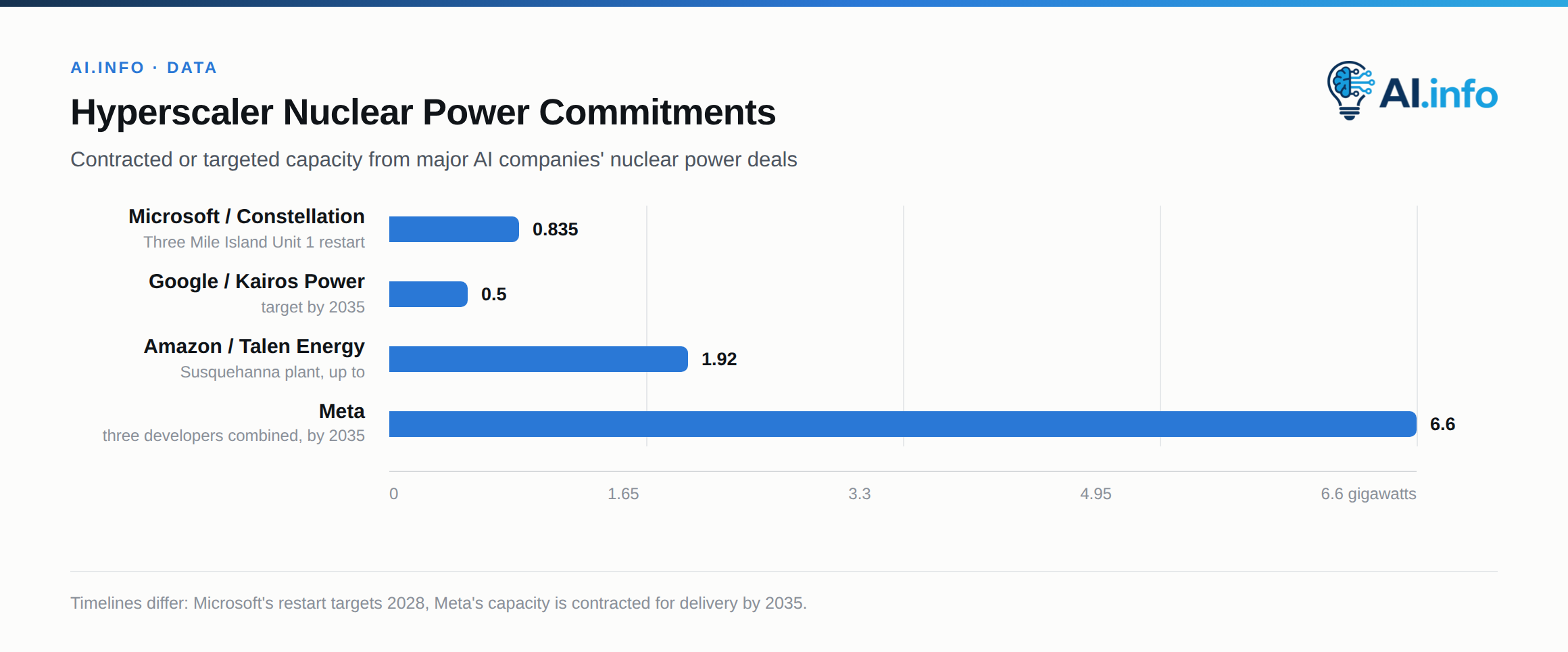
The pattern across all three companies is the same: a small amount of real, near-term capacity — Kairos's 50 MW, Vistra's existing uprated plants — bundled with a much larger bet on reactor designs that have never operated at commercial scale in the United States: Natrium's sodium-cooled fast reactor, Oklo's Aurora microreactor, Kairos's molten-fluoride-salt-cooled design. None of these designs has an operating commercial unit today, but the licensing wall has been breached. On 4 March 2026 the NRC issued a construction permit for TerraPower's 345-megawatt Natrium unit at Kemmerer, Wyoming — the first such permit for a commercial-scale advanced reactor in the United States — and TerraPower began construction in April 2026, targeting completion in 2030. The 2030-to-2035 delivery dates still depend on first-of-a-kind construction going smoothly, which first-of-a-kind nuclear construction in the US rarely has.
Why the Government Is Suddenly in a Hurry
None of this activity is happening in a policy vacuum. The bipartisan ADVANCE Act, signed in 2024, streamlined some NRC licensing fees and procedures for advanced reactors before AI demand fully crystallized the argument for it. The Trump administration went considerably further: on May 23, 2025, the White House issued four executive orders directing the NRC to overhaul its culture and timelines, setting an 18-month deadline to evaluate new construction and operating license applications, and instructing the Department of Energy to designate AI data centers as critical defense infrastructure eligible for expedited reactor siting on federal land.
The stated national goal is to quadruple US nuclear capacity from roughly 100 gigawatts today to 400 gigawatts by 2050 — a target that implies a construction pace the American nuclear industry hasn't sustained in half a century.
The DOE has backed this with money as well as mandates: loan guarantees of up to $3.5 billion per project for new Westinghouse AP1000 reactors, on top of the roughly $1 billion loan supporting the Three Mile Island restart. That part of the story gets less attention than the corporate PPAs, but it is arguably more important: hyperscaler contracts provide revenue certainty for developers, but it's the federal regulatory and financing apparatus that determines whether reactors licensed today can actually be built on anything resembling the 2030 timelines everyone is quoting.
An NRC review that used to take four or five years compressed to eighteen months is either a genuine unlocking of bureaucratic slack or a real safety-review shortcut, and which one it turns out to be will matter far beyond the AI industry.
The Grid Can't Wait for Reactors
Nuclear's fundamental problem, government urgency notwithstanding, is speed. Even an expedited SMR timeline puts first power years out, and data centers are being built in 24 to 36 months. That mismatch is why the more immediate reality of the AI buildout is running on natural gas, not atoms. Data center developers have announced roughly 100 gigawatts of on-site natural gas generation specifically to bypass grid interconnection queues that now average around five years nationally and stretch past seven years in constrained markets like Columbus, Ohio.
The irony is that this dash for gas turbines has created its own bottleneck: GE Vernova, Siemens Energy, and Mitsubishi Power are quoting turbine delivery timelines as long as eight years, meaning the "fast" alternative to nuclear is no longer particularly fast either. Nuclear PPAs and gas turbine orders are, in practice, running in parallel as hedges against each other — nobody in this industry believes any single supply strategy will arrive on schedule.
Water Is the Bottleneck Nobody Budgeted For
Electricity gets the headlines, but cooling water is the quieter constraint, and it's directly coupled to the power question because most large data centers use evaporative cooling that scales with the same heat load as the electricity draw. Google reported using more than 5 billion gallons of water across its data centers in 2023, with roughly a third of that freshwater withdrawal coming from watersheds already under medium or high water stress.
Its Council Bluffs, Iowa facility alone consumed about 1 billion gallons in 2024, peaking at 2.7 million gallons a day during summer months — comparable to the daily water use of a city of 25,000 people. Microsoft's five Des Moines-area facilities together used 68.5 million gallons, enough to make Microsoft the single largest water user in that local utility district.
Training a single large model isn't trivial either: widely cited estimates for GPT-3-scale training runs put direct water evaporation at several hundred thousand liters. Lawrence Berkeley National Laboratory projections cited in recent water-policy analyses suggest total US data center direct water consumption, roughly 66 billion liters in 2023, could double or quadruple by 2028 if AI-driven growth continues at its current pace — which is one reason nuclear plants, many of which already have established water-cooling infrastructure and permits, look more attractive to hyperscalers than building fresh capacity in water-stressed regions.
| Facility/Company | Water Use |
|---|---|
| Google (all data centers, 2023) | 5+ billion gallons |
| Google Council Bluffs, Iowa (2024) | ~1 billion gallons (peak 2.7 million gal/day) |
| Microsoft (5 Des Moines-area facilities) | 68.5 million gallons |
Efficiency Gains Are Real, Just Not Fast Enough
The one genuinely encouraging thread in this story is that the compute-per-watt curve is bending the right way, even as total demand explodes. Hyperscalers moving inference and training workloads onto custom silicon are extracting real efficiency gains: Amazon says its Trainium3 chips deliver roughly 40% more performance per watt than the prior generation, with Trainium2-based instances already claimed to offer 30–40% better price-performance than comparable Nvidia GPU instances at lower power draw.
Each new Google TPU generation is pitched as delivering up to twice the performance-per-watt of its predecessor, and Google says its data centers overall now deliver about six times more computing power per unit of electricity than they did five years ago — a genuine, measurable efficiency dividend from a decade of silicon and system co-design.
The problem is that Jevons paradox is winning. Efficiency gains have historically made compute cheaper per unit, which increases total usage rather than capping total demand — and that's exactly the pattern playing out now. A 40% efficiency gain per chip means little for aggregate electricity demand if the number of chips deployed grows several-fold in the same period, which is roughly what's happening across the hyperscaler capital expenditure plans currently being disclosed. Efficiency is necessary to keep unit economics viable; it is not, on its own, going to prevent the load growth the IEA is forecasting.
What This Actually Adds Up To
Strip away the press-release framing and what remains is a fairly coherent industrial strategy: hyperscalers are using their balance sheets to de-risk nuclear projects that utilities and developers couldn't finance alone, in exchange for long-dated, price-certain electricity that insulates them from volatile power markets over a 15-to-20-year investment horizon. That's a rational trade for companies committing hundreds of billions of dollars to data center buildouts.
It is not, yet, a solved energy problem. The megawatts actually flowing today from these deals — Susquehanna's existing output, TVA's 50 MW Kairos pilot, uprates at plants that were already running — are a small fraction of what's been announced for the 2030s. Two commitments have since moved from paper to ground: Crane is now aimed at 2027, a year earlier than first announced, and the Natrium unit at Kemmerer is being built rather than reviewed. The gigawatt-scale figures attached to Oklo and the broader SMR fleet remain commitments on paper, contingent on regulatory approvals, supply chains, and first-of-a-kind construction schedules that the nuclear industry has a poor historical record of hitting — and Natrium's 2030 date is the first real test of whether a permit turns into power.
The AI industry has, in effect, made a multi-decade bet on nuclear power meeting an accelerated deployment timeline it has never previously achieved, with natural gas turbines — themselves now supply-constrained — as the improvised bridge in the meantime. Whether that bet pays off will be determined less by Silicon Valley than by whether the NRC's compressed licensing clock and America's atrophied heavy-nuclear-construction supply chain can actually move at the speed both the White House and the hyperscalers are now demanding of them.