Industry Transformation
AI in Construction and Real Estate
Construction AI wins where it measures and loses where it judges. An update through September 2026: Buildots at $297m, Procore buying agents, and the DOJ settlement that reset rental pricing algorithms.
Gabriele Masetti ·
The industry AI adoption forgot
Construction has a productivity problem that predates any of the tools in this article. Global construction productivity grew by roughly 0.4% a year between 2000 and 2022, versus about 2% for the economy as a whole — a compounding gap that leaves the sector barely 10% more efficient than it was two decades ago. In the United States, McKinsey has calculated that construction labor productivity actually shrank over parts of that period even as manufacturing productivity climbed.
Against that backdrop, AI adoption in construction is thin: multiple industry surveys put overall firm-level AI adoption in construction at around 1.5%, compared with 70-90% in manufacturing, and a late-2025 ASCE-reported survey found only about 27% of architecture, engineering and construction professionals using AI in any form. The tools below are real, and some produce genuinely large numbers on the projects that use them.
But "genuinely large numbers on early-adopter projects" and "industry transformation" are not the same claim, and this piece tries to keep that distinction honest throughout.
Computer vision on the jobsite: capturing what actually got built
The most mature category of construction AI is reality capture — walking or driving a camera through an active jobsite, feeding the imagery to a model, and comparing what was actually built against the plan.
OpenSpace, founded in 2017 and based in San Francisco, is the largest player by scale, with more than 95,000 projects documented on its platform. Its workflow is deliberately low-friction: a 360-degree camera clips to a hardhat or a cart, and a superintendent walks the site as part of a normal round; the software stitches the footage into a navigable, timestamped visual record and uses computer vision — semantic segmentation and object detection — to estimate what percentage of planned work is complete in a given area.
OpenSpace has raised $199 million across Series A through D rounds, including a $102 million Series D in 2021 led by PSP Growth, from investors including Lux Capital, Menlo Ventures and Alkeon Capital. It has since absorbed the rival reality-capture firm Disperse, whose technology now sits behind OpenSpace's progress-tracking product — the category is consolidating rather than proliferating. In July 2026 the company said it had worked on more than 1,000 data centre projects worldwide, which is a fair indication of where the spending in this sector has gone.
Buildots, founded in 2018 by Roy Danon, Aviv Leibovici and Yakir Sudry, takes a more prescriptive approach. Hardhat-mounted 360-degree cameras feed images that Buildots' computer vision matches trade-by-trade against the BIM model and the master schedule, then surfaces a chatbot-style interface that can answer "where are we behind" and flag pacing risks before they cascade into delays. On 14 September 2026 the company raised $130 million in a round led by Eyal Ofer's O.G. Venture Partners, with Lightspeed, Intel Capital, Qumra Capital, Viola Growth and others participating, taking its total to about $297 million. The money is aimed squarely at the buildings the AI boom itself requires: data centres, chip fabs and hospitals, in North America and EMEA, plus extending the product from bidding through handover.
Doxel, founded in 2015 and based in Redwood City, pushes further into automated quantity tracking: its AI compares captured imagery against BIM models across more than 80 stages of construction to identify installed quantities per trade, and the company cites a 95% reduction in the manual labor of progress tracking, an 11% acceleration in project schedules and roughly 10% savings on monthly cash flow from earlier problem detection. Doxel has raised $56.5 million, including a $40 million Series B led by Insight Partners with participation from Andreessen Horowitz, and says it's used by 18 of the top 30 U.S. general contractors by volume.
The pattern across all three: none of them are predicting the future. They are eliminating the lag between "something went wrong" and "someone found out." On big capital projects, where a two-week reporting delay on a mis-installed duct run can compound into a six-figure rework bill, that alone is a real, if unglamorous, return.
Generative design and BIM: Autodesk's AI bet
Autodesk's clearest AI wager is Forma, built substantially on Spacemaker, the Norwegian site-planning startup Autodesk acquired for $240 million in late 2020. Forma combines Spacemaker's AI-driven site analysis, FormIt's freeform conceptual modeling, and a cloud data model with live sync into Revit — letting an architect generate and score dozens of massing options against sun exposure, wind, noise and daylight before committing to a design direction.
In 2025, Autodesk extended the product with Forma Building Design, aimed at bringing BIM-level detail earlier into the same generative workflow, and has previewed "neural CAD" concepts intended to move from early massing to detailed layouts using text-prompted generation.
The honest caveat: generative design in AEC still mostly automates the exploration of a design space a human already bounded. Set the parameters — site, program, zoning constraints, a cost target — and the system returns dozens of scored options rather than one. It is a meaningful acceleration of early-stage design iteration, not an architect-replacement engine, and Autodesk's own marketing is fairly careful to frame it as an "AI assistant" for the schematic phase rather than an autonomous designer.
Predictive scheduling and estimating: simulating the build before it happens
ALICE Technologies sells a generative scheduling engine that ingests an existing schedule (from Primavera P6 or Microsoft Project) along with drawings, then simulates hundreds of millions of possible sequencing and resourcing combinations to find schedules that hit a deadline, a budget, or a labor-availability constraint.
ALICE reports an average 17% reduction in construction duration and about 14% in labor cost savings across projects using the platform; contractor Zachry Construction used it to cut 28 days from a highway project's timeline, and one data center developer reported a roughly 40% reduction against its baseline schedule. In 2025, McKinsey and ALICE formalized a partnership to bring generative scheduling to capital-project clients — a signal that AI schedule optimization has moved from startup pitch to consulting-firm product line.
| ALICE Technologies result | Value |
|---|---|
| Average construction duration reduction | 17% |
| Average labor cost savings | 14% |
| Zachry Construction highway project | 28 days cut |
| Data center project (one developer) | ~40% schedule reduction |
On the estimating side, Procore has built AI directly into its preconstruction workflow: its takeoff tools can auto-detect floor-plan areas and count repeated symbols to speed quantity surveys, and its Procore Helix analytics engine applies predictive models to historical project data to flag cost and schedule risk before it materializes. The company completed its acquisition of Datagrid on 16 January 2026, for $168.0 million in cash, adding agents that handle documents across systems — searching Autodesk, Fieldwire, Sage and Trimble, reviewing submittals, drafting RFIs — rather than inside Procore alone. Hexagon consolidated its own reality-capture and modelling businesses under the Multivista brand in the same quarter.
That is incremental rather than transformative. It compresses hours of manual takeoff and document chasing, and estimators still own the judgment calls — contingency, market conditions, subcontractor risk — that a model can't fully see.
Robotics: printing layout, driving excavators
Two robotics companies represent the leading edge of physical automation in the field, and both are narrower than "robot construction workers" — each automates a single, well-defined, historically manual task.
Dusty Robotics' FieldPrinter is a small autonomous robot that drives around a job site printing the BIM-derived layout — walls, doors, MEP rough-in points — directly onto the concrete slab at full scale, replacing the two-person chalk-line-and-tape-measure crew that has done this work for a century. The current generation, FieldPrinter 2, is a 23-pound unit that prints at up to 1/16-inch accuracy at 600 DPI, can shadow-print around columns, and covers roughly 10,000 to 15,000 square feet per day with a single operator. A companion Revit plug-in automates converting BIM drawings into robot-ready layout files.
Built Robotics takes the opposite approach: rather than building a bespoke robot, its Exosystem is an aftermarket, sensor-and-actuator retrofit kit that turns standard excavators and other heavy equipment into autonomous machines for repetitive earthmoving tasks like grading and trenching. The company has raised $112 million across three rounds, including a $64 million Series C in 2022 led by Tiger Global with Founders Fund and Fifth Wall participating. Neither company claims full-site robotic construction is here; both are attacking single labor-intensive, physically repetitive tasks — layout and earthmoving — where precision and endurance are the constraint, not judgment.
Real estate valuation: what Zillow's iBuying collapse actually teaches
No discussion of AI in real estate should skip Zillow Offers, both because it's the sector's highest-profile AI failure and because the postmortem is more instructive than most success stories.
Zillow built Zestimate, its automated valuation model (AVM), by training on public records, tax assessments, comparable sales and market trends to estimate home values. In 2018 the company launched Zillow Offers, an "iBuying" business that used Zestimate-derived pricing to make instant cash offers on homes, renovate them, and resell at a markup — essentially betting real capital on the AVM's short-horizon price predictions in a fast-moving market.
It didn't hold. Home prices moved faster and less predictably than the model assumed during 2021's supercharged market, Zillow found itself overpaying relative to resale value, and by Q3 2021 the company disclosed roughly $304 million in inventory write-downs on top of hundreds of millions more in related losses — over $1 billion in cumulative losses across roughly 3.5 years of the program.
On November 2, 2021, Zillow's board voted to wind the business down entirely, cutting about 25% of the company's workforce in the process. Zillow's stock lost roughly $7.8 billion in market value within days of the announcement.
| Zillow Offers metric | Value |
|---|---|
| Inventory write-downs disclosed, Q3 2021 | $304 million |
| Cumulative losses over ~3.5 years | over $1 billion |
| Workforce cut after shutdown | ~25% |
| Market value lost within days of announcement | ~$7.8 billion |
The lesson isn't "AVMs don't work" — it's that AVM accuracy is asymmetric and conditional. Zillow's own published figures show Zestimate's median error rate for on-market (actively listed) homes running around 2-2.4% nationally, which is genuinely tight. But for off-market homes — the ones iBuying depends on pricing sight-unseen — the median error rate is roughly 7.5%, which on a $400,000 home is close to a $30,000 swing in either direction.
An AVM that's accurate to within 2% when a human has already priced a home for sale is a very different tool from one used to autonomously commit capital to homes nobody has yet listed. Zillow's failure was a business-model failure — deploying a valuation tool outside the error band where it was actually reliable — more than a modeling failure.
Opendoor and Offerpad, the other major iBuyers, survived 2021-2022 but at sharply reduced scale and with their own significant write-downs, reinforcing that this was a structural problem with the iBuying thesis rather than a Zillow-specific bug.
Property management: less flashy, more measurable
Away from valuation, AI in property management has quietly become a genuine operating-efficiency category rather than a moonshot. AppFolio, whose Realm-X platform introduced autonomous AI Leasing Agents in 2025, says its agents can respond to prospect inquiries and schedule showings around the clock without human handoff, and the company cites customers saving an average of 10 hours per week on leasing and maintenance workflows along with a 73% increase in lead-to-showing conversion.
Competitor RealPage has pushed a comparable product, Lumina AI Workforce, aimed at automating leasing, accounting and resident-engagement tasks. It arrives with a caveat the category should not skip. On 24 November 2025 the Justice Department settled its algorithmic price-fixing case against RealPage: the company may no longer use competitors' nonpublic pricing data at runtime, may train its models only on data at least twelve months old, must analyse at state level or broader rather than at individual-market granularity, and accepts court-appointed compliance monitoring. The settlement is the first clear statement of where an algorithm stops being a pricing tool and starts being a mechanism for coordination, and every vendor selling revenue optimisation to landlords now works inside it.
Those are narrower claims than "AI runs your building," but they're also the kind of repetitive, high-volume, low-judgment work — answering the fortieth "is this unit still available" message of the day — that's a legitimately good fit for current-generation AI, in contrast to valuation calls that carry real capital risk.
Digital twins: the operations-phase payoff, still early
Digital twins extend the BIM model past construction handover into building operations — a live, sensor-connected 3D counterpart of the physical asset rather than a static as-built drawing. Autodesk Tandem, built on Revit's BIM foundation, is Autodesk's entry here, and the company has added AI-driven operational insight layers aimed at things like automated energy-efficiency optimization.
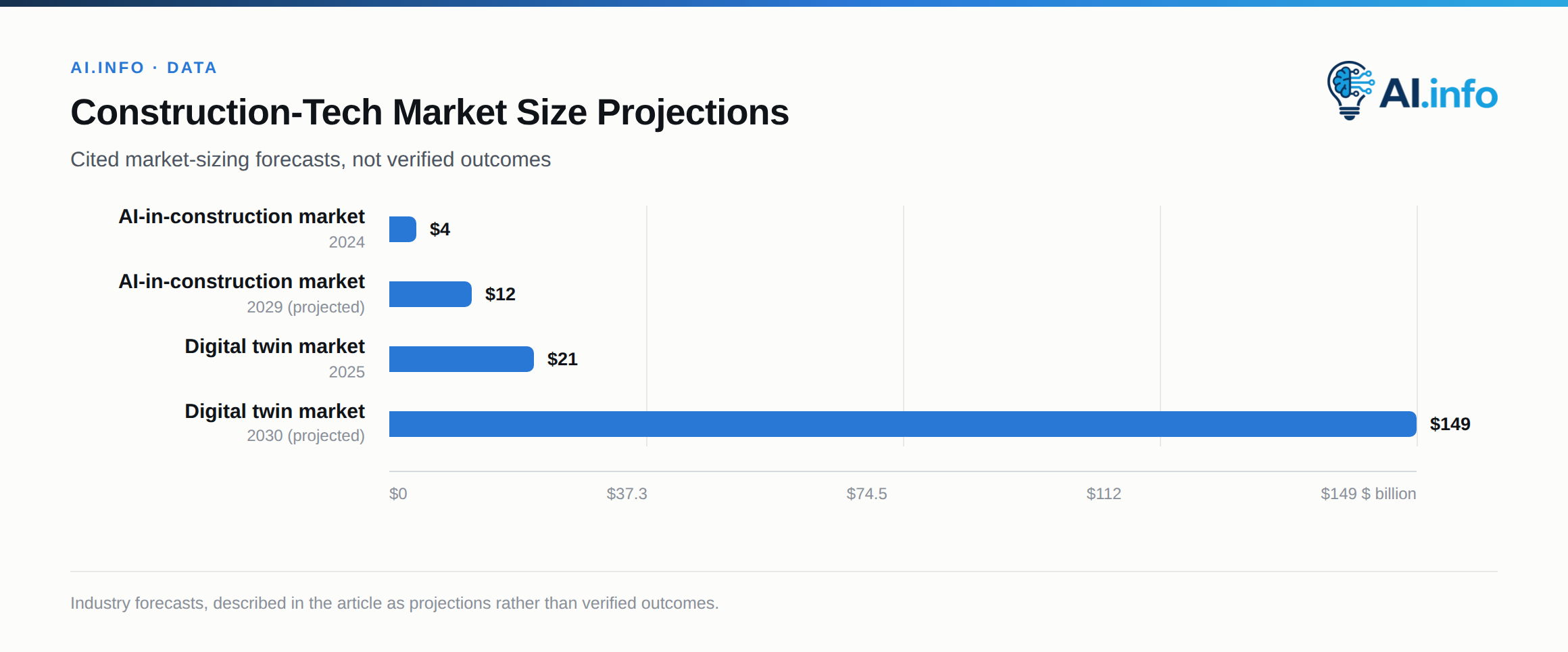
Eaton announced a 2025 collaboration with Autodesk to build AI-powered digital energy twins for buildings and data centers, and Globant became a certified Tandem digital-twin solution provider in 2026 with pilot deployments planned for airports and logistics centers. Industry forecasts put the digital twin market growing from roughly $21 billion in 2025 to $149 billion by 2030 — a figure worth treating as a market-sizing projection rather than a verified outcome, since digital twin ROI in AEC is still mostly demonstrated in pilots and case studies rather than broad portfolio-wide deployment.
What's actually different, and what isn't
Stack these examples up and a pattern emerges that's more useful than a generic "AI is transforming construction" headline. The tools with the clearest, most repeatable ROI — OpenSpace, Buildots, Doxel, Dusty Robotics, Built Robotics — all automate measurement or repetition of something a human was already doing, just slower and with more error: walking a site, tracking installed quantities, chalking a layout line, running an excavator bucket over the same trench pass after pass.
The tools making the boldest claims about judgment — generative design, generative scheduling, automated valuation — are genuinely useful as decision support but get overextended when someone treats their output as a decision itself rather than an input to one. That's exactly what happened when Zillow let an AVM built for on-market accuracy make blind offers on off-market homes.
That distinction is also probably why AI adoption in construction remains so low relative to manufacturing: manufacturing runs in a controlled, repeatable environment where a vision model's job is comparing this widget to the last million widgets. A construction site is a different location every time, with different subcontractors, different soil, different weather, and a schedule that shifts weekly — a much harder environment for any model to generalize across.
The market-growth numbers exist (sizings published in 2024 put AI in construction at about $4 billion that year and near $12 billion by 2029 — projections, not outturns, and two years old now), but they describe a market still mostly in the early-adopter phase, concentrated among the largest general contractors and developers who can absorb integration costs and tolerate a learning curve.
For the median contractor, none of this has arrived yet, and the industry's decades-long productivity stagnation isn't going to reverse on the strength of a hardhat camera and a scheduling algorithm alone.