Future Horizons
The World Model Wars: Why the Next Architecture Battle Is About Grounding AI in Physical Reality
Three bets on grounding AI in the physical world — generate the video, predict the embedding, or build persistent 3D — and why NVIDIA's Cosmos 3, which now emits robot actions, changed the shape of the contest.

Gabriele Masetti ·
The wrong fight is getting all the attention
For three years, the loudest argument in AI has been about scale: how many parameters, how many tokens, how many GPUs. That argument is ending, not because anyone won it but because it stopped being the interesting question. The frontier labs building for robotics, autonomous driving, and physical simulation are no longer competing on how big their language models are. They are competing on a much narrower and more consequential question: when a machine needs to predict what happens next in the physical world, should it predict pixels, or should it predict something else entirely?
That is the real architecture battle of 2026, and it is being fought under the banner of "world models." Google DeepMind has Genie 3. NVIDIA has Cosmos. Wayve has GAIA-3. OpenAI has Sora, whether it wants the label or not. Fei-Fei Li's World Labs has Marble. And Yann LeCun, having left Meta after twelve years as its chief AI scientist, has taken his Joint Embedding Predictive Architecture (JEPA) and founded AMI Labs to build world models his own way.
Every one of these efforts claims the same territory — grounding AI in physical reality — and almost none of them agree on what "grounding" requires. That disagreement, not benchmark scores, is what will determine which companies end up controlling the substrate that embodied AI runs on.
Even the labs that still profit most from language models now say the quiet part out loud. DeepMind CEO Demis Hassabis has argued that getting to AGI requires two things beyond scaling chat assistants: a genuine world model that understands physics and space, and automated experimentation that lets a system test its understanding against reality rather than against more text. That is a remarkable concession from the head of a lab that also owns Gemini — an admission that predicting the next token, however well it's done, is not the same achievement as predicting the next state of a room.
Three camps, one unresolved problem
Strip away the branding and there are really three distinct bets being made about how to build a world model.
The generative camp: predict the video
NVIDIA's Cosmos, launched at CES 2025 as a "world foundation model" platform, generated physics-based video from text, image or robot sensor input. It has since stopped being only a video model. On 31 May 2026, at GTC Taipei, NVIDIA released Cosmos 3, which it calls the first fully open omnimodel: one mixture-of-transformers model with native vision reasoning and generation across text, image, video, ambient sound and action trajectories, published under the Linux Foundation's OpenMDW 1.1 licence in Super, Nano and Edge variants. Action trajectories are the part that matters here. The model is meant to serve as the backbone for world action models that output what a robot should do, not footage of a robot doing it.
Wayve's GAIA-3, a 15-billion-parameter model launched in December 2025, does something related for driving: it takes real driving footage and re-renders it with controlled variations — change the ego vehicle's trajectory, keep everything else in the scene physically consistent — explicitly to validate autonomy software rather than just generate training clips.
DeepMind's Genie 3, unveiled in August 2025, generates fully interactive, navigable 3D worlds from a text prompt at 24 frames per second, holding physical consistency even though DeepMind says it never explicitly programmed that persistence in. It is no longer a demo: on 29 January 2026 Google shipped Project Genie, an experimental prototype built on Genie 3, to Google AI Ultra subscribers in the United States, with generations capped at 60 seconds and a warning that the worlds may not adhere to real-world physics. And OpenAI's Sora, though marketed as a video generator, was pitched by OpenAI itself as a "world simulator" — the implicit claim being that if you train a big enough model to predict video, physics falls out as a side effect.
The predictive camp: skip the pixels
Yann LeCun has spent years arguing that this entire camp is solving the wrong problem. His position, laid out in his 2022 paper "A Path Towards Autonomous Machine Intelligence" and operationalized through I-JEPA and V-JEPA, is that predicting raw pixels forces a model to waste capacity on irrelevant, unpredictable detail — the exact texture of rustling leaves, the noise pattern in a video frame — when what actually matters for planning and control is the structure underneath.
JEPA instead predicts in an abstract representation space: the model learns to predict the embedding of a masked or future patch of video, not its pixels. Meta's V-JEPA 2, released in June 2025, was trained this way on video and then fine-tuned on just 62 hours of robot arm data from the Droid dataset, enough for zero-shot pick-and-place planning on robots in environments it had never seen. The line continued after LeCun left: Meta released V-JEPA 2.1 on 16 March 2026, a family trained with a new recipe for temporally consistent dense features — an incremental research release, not a product.
LeCun has since taken this bet outside Meta entirely: he left the company in November 2025 amid reported friction over Meta's pivot toward commercial LLM development under its new Superintelligence Labs unit, and co-founded AMI Labs with Alexandre LeBrun to pursue JEPA-based world models full time.
The spatial camp: predict persistent structure
Fei-Fei Li's World Labs occupies a third position. Rather than predicting the next video frame or the next abstract embedding, its product, Marble, generates persistent, editable 3D environments from text, images, video, or rough layouts — explicit spatial scenes that can be walked through, edited, and reused, aimed squarely at robotics, gaming, and simulation. World Labs calls these "large world models," and the framing matters: the bet here is that grounding is fundamentally a geometry problem before it is a prediction problem.
A robot or an autonomous system needs a persistent, addressable model of the room it is in, not just a plausible-looking hallucination of the next few seconds.
Why the pixel bet is more fragile than it looks
The generative camp's demos are, without exception, the most visually impressive thing happening in AI right now. That is also the problem. A model that produces a convincing video of a room is not the same as a model that has learned the room's physics, and the failure modes keep surfacing in exactly the way LeCun predicted they would.
Sora clips have shown chairs materializing out of nowhere, candle flames that don't flicker, and animals with the wrong number of limbs — critics have pointed to violations of object permanence and spatiotemporal continuity that no amount of visual fidelity papers over. OpenAI itself has acknowledged Sora can fail to simulate the physics of complex scenes or model specific cause and effect correctly.
Project Genie caps a generated world at 60 seconds, which is fine for a consumer prototype and a real constraint for anything that needs to run a robot policy for longer than that. The uncomfortable truth for the generative camp is that photorealism and physical correctness are only loosely correlated, and the metrics used to tout these systems — frame quality, temporal coherence, resolution — mostly measure the former.
Closing that gap is precisely what JEPA-style prediction is built for: by refusing to reconstruct pixels at all, it forces the model to represent only the parts of a scene that are actually predictable and therefore actually useful for planning. Whether that theoretical advantage translates into better real-world robot performance at scale is still an open empirical question — V-JEPA 2's robot results are promising but come from tightly scoped manipulation tasks, not open-ended embodied deployment. LeCun's bet is architecturally cleaner. It is not yet commercially proven.
The market is not waiting for the theory to settle
That distinction — architecturally cleaner versus commercially proven — is exactly where the current money is landing, and it is not landing evenly. NVIDIA has already wired Cosmos into a live ecosystem of robotics and automotive partners, including 1X, Figure AI, Agility, Agile Robots, Foretellix, Galbot, NEURA Robotics, XPENG, and Uber, which makes Cosmos less a research bet and more an infrastructure layer that gets adopted regardless of which downstream architecture eventually wins. Wayve is using GAIA-3 today to cut synthetic-test rejection rates in its own autonomous driving validation pipeline, according to the company, by roughly fivefold — a concrete operational payoff, not a promise.
World Labs and AMI Labs, by contrast, are pre-product bets on architecture, and investors are pricing them accordingly aggressively. World Labs closed a $1 billion round in February 2026, including a $200 million cheque from Autodesk alongside AMD, Nvidia, Fidelity and Emerson Collective, on top of the $230 million it raised leaving stealth in 2024 at roughly a $1 billion valuation. It had been reported in talks at a $5 billion valuation earlier that year, and the company declined to confirm whether the closed round reset its valuation upward — so the closed money, not the reported number, is the fact.
AMI Labs moved even faster: founded in late 2025, it raised more than $1.03 billion in a seed round at a $3.5 billion pre-money valuation by March 2026, reportedly the largest seed round ever raised by a European company, co-led by Cathay Innovation, Greycroft, Hiro Capital, HV Capital, and Bezos Expeditions, with Nvidia and Temasek among the backers — corroborated independently by TechCrunch and Sifted with consistent figures. Both AMI and World Labs are, notably, pre-revenue research bets. NVIDIA is selling infrastructure to companies that are already shipping robots.
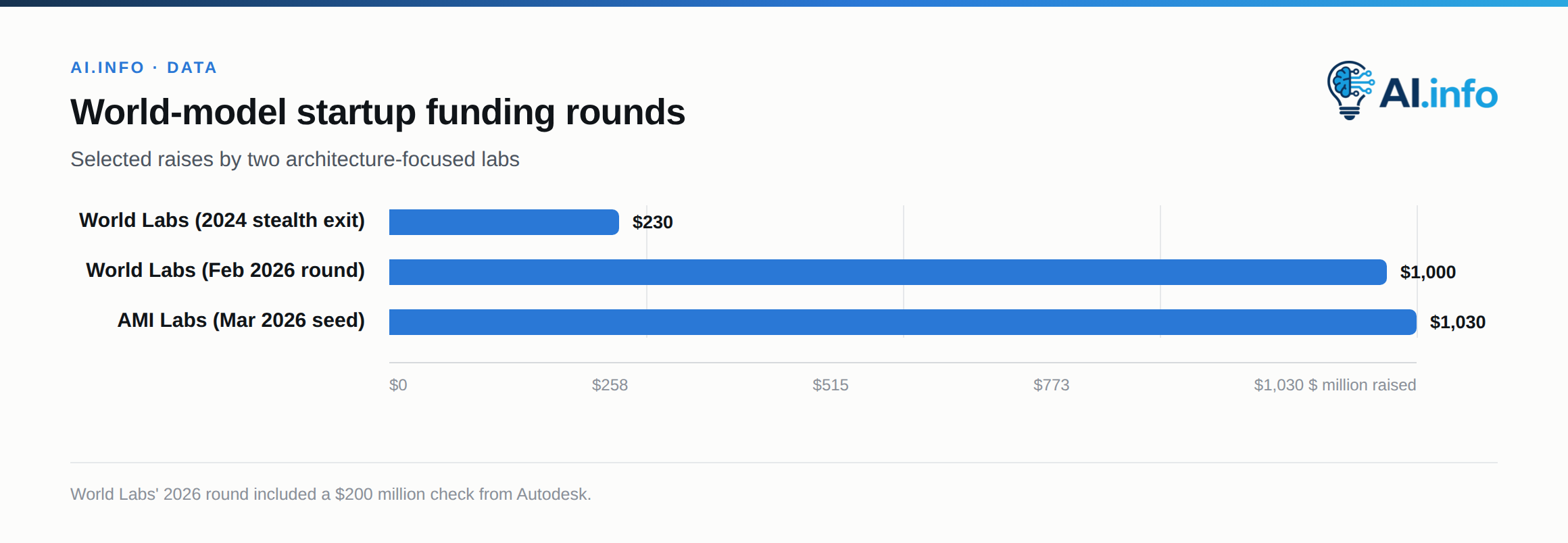
| Company | Event | Amount / valuation |
|---|---|---|
| World Labs | Stealth exit (2024) | $230M raised, ~$1B valuation |
| World Labs | Valuation talks (early 2026) | ~$5B valuation (reported) |
| World Labs | Funding round (Feb 2026) | $1B raised (incl. $200M from Autodesk) |
| AMI Labs | Seed round (Mar 2026) | $1.03B raised at $3.5B pre-money |
That asymmetry is the tell. The generative and spatial-generative camps have found paying customers because their outputs are immediately usable as simulators, synthetic-data generators, and validation harnesses — you don't need to resolve the philosophical question of "real understanding" to sell a company a tool that cuts its testing costs fivefold. The predictive camp is selling a promise about sample efficiency and generalization that is more defensible on the whiteboard than it is in a term sheet, which is exactly why LeCun needed over a billion dollars in patient capital, assembled outside a Big Tech balance sheet, to even attempt it at scale.
What robots actually need, and who's closest to it
The clearest signal of what "grounding" needs to mean in practice comes from where these systems are actually being pointed: not at generating impressive video, but at closing the loop between prediction and action with as little real-world data as possible. V-JEPA 2's zero-shot planning result — 62 hours of robot data producing usable pick-and-place behavior in new environments — is a stronger evidence point for sample efficiency than anything the generative camp has published, because sample efficiency is the actual bottleneck in robotics: collecting real robot interaction data is slow, expensive, and dangerous to scale carelessly.
Cosmos and GAIA-3 solve a different, also-real bottleneck: they generate synthetic scenarios cheaply enough to stress-test a driving or manipulation policy against edge cases a real fleet would rarely encounter. Neither bottleneck is fake. They are not the same bottleneck, and until 2026 no single system addressed both.
Cosmos 3 is the first credible attempt to. Putting generation and action output in one open model collapses the distance between the simulator and the policy it is meant to train, which is the fusion this essay's earlier framing said to watch for. What it does not supply is persistence: an omnimodel that emits a trajectory still does not carry an addressable map of the room between episodes, which is the thing World Labs builds and the thing a robot working a shift actually needs.
The convergence nobody is pricing in yet
The framing of this as a war with a single winner is probably wrong, and it's worth saying plainly: the labs treating it that way are the ones most exposed. A robot operating in an unstructured environment needs a persistent spatial model of the room it's in (World Labs' bet), an efficient predictive representation of how that room's state will evolve under its own actions (LeCun's bet), and enough synthetic scenario coverage to be tested against situations it has not yet lived through (NVIDIA and Wayve's bet).
Project Genie's 60-second ceiling and Sora's object-permanence failures both point at the same missing piece — none of the pure generative systems yet maintain the kind of persistent, addressable world state that spatial and predictive approaches are built around from the outset. Conversely, nobody has shown a JEPA-based system operating at the visual richness or generative flexibility of Genie 3 or Cosmos. The architectures are currently solving adjacent, non-identical problems and calling it the same fight.
What should actually be watched now is not whose demo looks more like a video game, but whether anyone adds the missing third element. Cosmos 3 has action-conditioned generation and cheap synthetic coverage in one model. Persistent 3D state is still somewhere else, and the loop only closes when all three run together in real time against a fleet that corrects them.
That's an integration problem as much as a research one, and integration favors whoever already has both the compute infrastructure and the fleet-scale interaction data to close the loop — which, for now, looks more like NVIDIA and Wayve than it looks like either of the well-funded architecture purists. AMI Labs and World Labs have bought themselves the runway to prove their architectural bets are right. They have not yet bought themselves a robot fleet's worth of evidence that being right is enough.