Future Horizons
The Demographic Imperative: How AI Becomes the Only Viable Answer to a World Running Out of Caregivers
Falling fertility, a care workforce short by millions, and 59 million unpaid American caregivers doing $1.01 trillion of work: why AI's real role in eldercare is detection and triage, not humanoid hands.
Gabriele Masetti ·
An Arithmetic Problem Before It Is a Technology Problem
Start with the numbers, because the numbers are not in dispute. In Japan, people aged 65 and over made up 29.4 percent of the population in the government's September 2025 estimate — 36.19 million people, a record — and the national population institute's 2023 projection puts that share at 34.8 percent by 2040. South Korea's fertility rate fell to 0.75 births per woman in 2024, barely a third of the 2.1 needed to hold a population steady, after a record low of 0.72 in 2023; the government declared a "national demographic crisis" and stood up a dedicated ministry.
Korea's number has since turned. The rate rose to 0.80 in 2025, on births up 6.8 percent to roughly 254,000, the most since 2021, and reached 0.95 in the first quarter of 2026, with officials expecting the full year to clear 0.9 for the first time since 2019. That is a real reversal, driven by a rebound in marriages and a larger cohort in their thirties. It changes nothing about the next twenty years: a child born in 2026 does not enter the care workforce until the late 2040s, and the people who will need care in 2040 have already been born.
Italy's fertility rate has slid from 2.5 in 1950 to about 1.2 today, and the country now records roughly twelve deaths for every seven births. These are not outlier cases. The United Nations' 2024 World Population Prospects projects that by 2050 one in six people on Earth will be over 65, and by the late 2070s the global population aged 65 and older — around 2.2 billion people — will outnumber children for the first time in human history.
| Country / region | Metric | Figure |
|---|---|---|
| Japan | Population aged 65+ (Sept 2025 estimate) | 29.4% |
| Japan | Projected population 65+ (2040) | 34.8% |
| South Korea | Fertility rate (2024 low / 2025) | 0.75 → 0.80 births/woman |
| South Korea | Fertility rate (Q1 2026) | 0.95 births/woman |
| Italy | Fertility rate (1950 vs. today) | 2.5 → 1.2 |
| Global (UN, by 2050) | Share of people over 65 | 1 in 6 |
What makes this a crisis rather than a slow-moving statistic is that the people who provide care are drawn from the same shrinking pool of working-age adults as everyone else. Every country simultaneously aging out of its workforce and into its care needs is competing for a labor supply that is not being replenished.
That is the actual "demographic imperative" — not a vague sense that societies are getting older, but a closing scissors: rising numbers of people who need daily assistance, and a stagnant or shrinking number of people available to provide it, with no policy lever capable of reopening the gap on the timeline required. Raising fertility rates takes at least two decades to produce a working-age adult.
Immigration can help but runs into political limits precisely in the societies — Japan, Italy, South Korea — most resistant to large-scale immigration. That leaves productivity: finding ways to make each available caregiver capable of supporting more people. That is the narrow, unglamorous sense in which artificial intelligence becomes not a preference but close to the only lever left.
The Workforce Shortfall Is Already Here, Not Coming
The World Health Organization projects a global shortfall of health workers reaching roughly 10 to 11 million by 2030, concentrated overwhelmingly — about 7.5 million of it — in low- and middle-income countries. That is a shortfall in doctors and nurses broadly; the caregiving gap specifically, for the unglamorous, low-wage work of bathing, feeding, and monitoring elderly people day to day, is arguably worse because it pays less and turns over faster.
In the United States, the Bureau of Labor Statistics projects that employment of home health and personal care aides will grow 18 percent between 2025 and 2035, much faster than the average for all occupations, with about 760,500 openings projected each year — most of them from workers leaving the field rather than from net new demand alone. In absolute terms it is the largest projected gain of any US occupation: 847,300 additional jobs over the decade.
AARP's "Valuing the Invaluable" update, published on 26 March 2026, found that 59 million Americans provided unpaid care to an adult family member in 2024, contributing 49.5 billion hours valued at $20.41 an hour, or $1.01 trillion — the work of 23.8 million full-time workers, about 17 percent of the country's full-time workforce, done for free and mostly by people also holding down paying jobs. That total exceeded all federal, state and local Medicaid spending in 2024, which came to $932 billion.
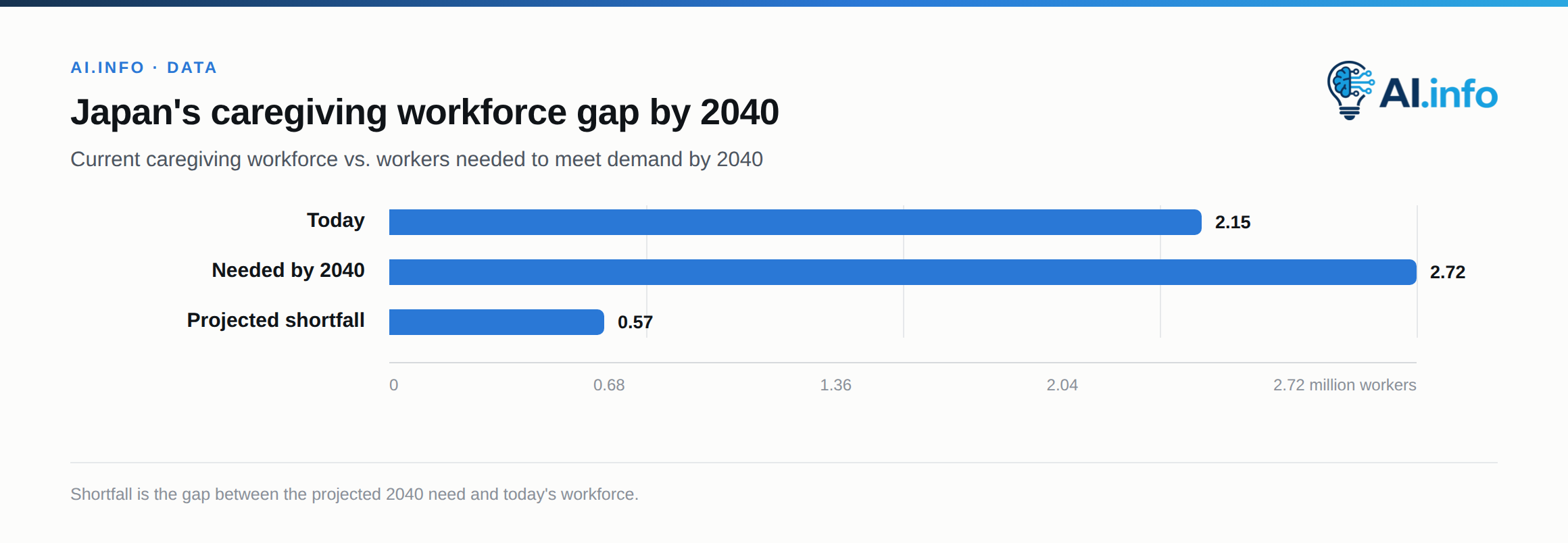
Japan shows where this trajectory leads if it runs long enough unaddressed. The country's caregiving workforce of about 2.15 million today will need to grow to roughly 2.72 million by 2040 to meet demand, a projected shortfall of about 570,000 workers, with a job-to-applicant ratio in care work of roughly 3.9 open positions for every applicant. Perhaps the starkest indicator: in 2025, a record 37.1 percent of Japanese households providing home care had both the caregiver and the care recipient aged 75 or older — elderly people caring for even older people, because there is no one younger left to do it.
Why the Robot Solution Undersold Itself
If there is one thing the last two decades should have taught anyone forecasting this space, it is caution about the humanoid-robot narrative. Japan ran the most serious, best-funded real-world experiment anywhere: national and prefectural governments began subsidizing nursing-home robot adoption in 2015, with the national government alone spending well over $300 million on care-robot research and development by 2018, and 36 of 47 prefectures offering to cover up to half the cost of a robot, up to about $1,000 per unit, by fiscal 2018.
The results were modest at best. A national survey of more than 9,000 elder-care institutions found that care-robot adoption remained limited and uneven as of the late 2010s, concentrated in monitoring and communication devices rather than the mobility- and transfer-assist robots that would most ease caregiver workload.
By 2022, a more granular breakdown showed 63 percent of facilities using monitoring robots — sensors and cameras that watch for falls or wandering — against only 26.4 percent using physical mobility or transfer robots, the kind meant to lift and move residents. That split is itself the finding: the technology that succeeded was the passive, sensing kind; the technology that tried to substitute for physical human labor largely did not.
| Robot / robot type | Setting | Reported figure |
|---|---|---|
| Monitoring robots (sensors/cameras) | Japanese care facilities, 2022 | 63% adoption |
| Mobility/transfer robots | Japanese care facilities, 2022 | 26.4% adoption |
| SoftBank Pepper (humanoid) | Global sales, 2014–2021 | ~21,000 sold of ~27,000 built |
Robear, the bear-shaped robot developed by Japan's RIKEN research institute to lift patients out of bed, became internationally famous as a symbol of robotic eldercare — and was never actually deployed in a working care facility. It remained a research prototype, too expensive and impractical for real-world use, and has since been retired. Its own inventor, Toshiharu Mukai, later said publicly that robots were not the answer to Japan's care crisis and that migrant labor was a more realistic solution.
SoftBank's Pepper, the humanoid robot deployed experimentally in some care and retail settings worldwide, tells a similar story on the commercial side: production was halted in 2021 after only around 27,000 units were ever built and roughly 21,000 sold since its 2014 debut; its manufacturer Aldebaran was liquidated in 2025.
Economic research by Karen Eggleston and Yong Suk Lee examining robot adoption in Japanese nursing homes did find a real, if narrower, benefit: facilities that adopted robots saw improvements in staff retention and measures of care quality, without evidence that robots displaced human workers. That is a genuine finding, but it is a story about workplace tools improving conditions for existing staff — not the science-fiction image of robots replacing caregivers that drove the original investment thesis.
Where the Software, Not the Robot Body, Is Actually Working
The more durable gains are showing up not in humanoid machines but in software layered onto sensors, phones, and clinical workflows — tools that extend what a fixed number of human caregivers and clinicians can monitor and catch early, rather than tools that try to replace hands-on labor.
Fall detection is the clearest example of real, measurable progress, and also the clearest example of where the evidence still needs more real-world validation before overclaiming: systematic reviews published in the Journal of the American Medical Directors Association through 2024 and 2025 have evaluated smart-home sensor systems and wearable devices for detecting and predicting falls in both community and residential care settings, generally finding strong detection accuracy in controlled and pilot conditions, alongside consistent caveats that evidence from large real-world deployments and randomized trials remains thinner than the underlying machine-learning results would suggest.
Speech-based screening for cognitive decline is further along toward clinical usefulness. Researchers, including a team at UT Southwestern Medical Center, have developed AI tools that analyze recorded speech for the subtle linguistic and acoustic markers of early Alzheimer's disease and mild cognitive impairment; one widely cited 2024 analysis found that an AI model examining transcripts of past cognitive-test speech predicted progression to Alzheimer's within six years with more than 78 percent accuracy, and separate modeling work has estimated that AI-based speech screening in primary care could meaningfully cut unnecessary PET-scan referrals.
These are diagnostic aids for extending the reach of a limited supply of geriatricians and neurologists, not replacements for the caregivers who provide daily assistance — but that distinction is exactly the point: the honest AI story in eldercare is about triage and detection, not substitution for hands-on labor.
The Limit Nobody Should Paper Over
None of this closes the gap in the work that actually consumes caregiver hours: bathing, dressing, feeding, transferring someone from bed to chair, and simply being present. A 2022 meta-analysis of 66 studies on companion and social robots in elder care found that many older adults genuinely liked the devices and that studies commonly reported reduced loneliness and anxiety — but the same body of research concluded the underlying studies were not rigorous enough to establish real, durable benefit, particularly for people living with dementia.
Ethicists studying these deployments have flagged a sharper problem than lukewarm evidence: deception and dependency. Research summarized by University of Tokyo researchers in 2025 found that residents who formed strong emotional attachments to AI companion devices experienced genuine distress when those devices malfunctioned or were removed — a harm that a purely human relationship does not carry in the same way, and one that did not exist before the technology was introduced to solve a shortage.
The scholarly consensus emerging from this literature is not that robots and AI have no place in care, but that care is stubbornly relational: something built through a physically present person's touch, judgment, and continuity, in a way that sensors and screening algorithms cannot substitute for even as they get better at their narrower jobs. The critique running through recent ethics literature on the subject is specific — that the deeper fix for the caregiving shortage is better pay and working conditions for human caregivers, not technological workarounds that are cheaper to fund than raising wages.
The Actual Shape of the Imperative
Put together, the honest version of this argument is narrower and more useful than "AI will replace caregivers." The demographic math — falling fertility across the countries with the oldest populations, a workforce shortfall in the millions with no on-ramp fast enough to fill it, and a rising share of elderly people being cared for by other elderly people — means that whatever gains are available have to come from making existing caregivers, paid and unpaid alike, capable of covering more ground safely.
Fall-detection and remote-monitoring systems that let one paid aide or one exhausted family member effectively watch over several people instead of one, and screening tools that let a scarce geriatrician catch cognitive decline months or years earlier, are not going to make eldercare fully staffed. They are the only intervention that plausibly changes the ratio of available attention to unmet need within the next decade, because policy fixes to fertility and immigration operate on a much longer clock than the shortage does.
That is a modest claim next to the imagery of humanoid caregiving robots, and it is the correct one on the evidence so far. Japan spent roughly a decade and hundreds of millions of dollars testing the more ambitious version of this bet — physical robots standing in for human hands — and adoption topped out at around a tenth of facilities before plateauing, while the software layered around sensors and monitoring quietly reached most of them.
One input to that experiment has changed since it ended, and the sceptical case should say so. Unitree launched its R1 humanoid in July 2025 at $5,900, against about $16,000 for its own G1, and listed on Shanghai's STAR Market on 19 August 2026, having priced the offering at roughly a $9 billion valuation and closing several times higher on day one. A machine an order of magnitude cheaper than the prototypes Japanese facilities trialled is a different procurement decision, and the old adoption numbers were measured against hardware that no longer sets the price. The harder constraint is unchanged: transfer robots stalled not only on cost but on the judgement, dexterity and continuity that lifting a frail person out of bed demands. Cheap hardware moves the first constraint, not the second, and no care system should budget as though it has.
The lesson for every other aging society watching Japan's trajectory a decade or two ahead of their own is to stop funding robot theater and start funding the parts of this technology that have already shown they work: detection, triage, and coordination tools built to make a shrinking, aging pool of human caregivers go further, not to make them disappear.