Future Horizons
AI and Materials Science: Designing Matter from First Principles
AI can now propose millions of crystal structures. Nature corrected the A-Lab paper in January 2026 and crystallographers found no new materials in it — the bottleneck has moved to proof.

Gabriele Masetti ·
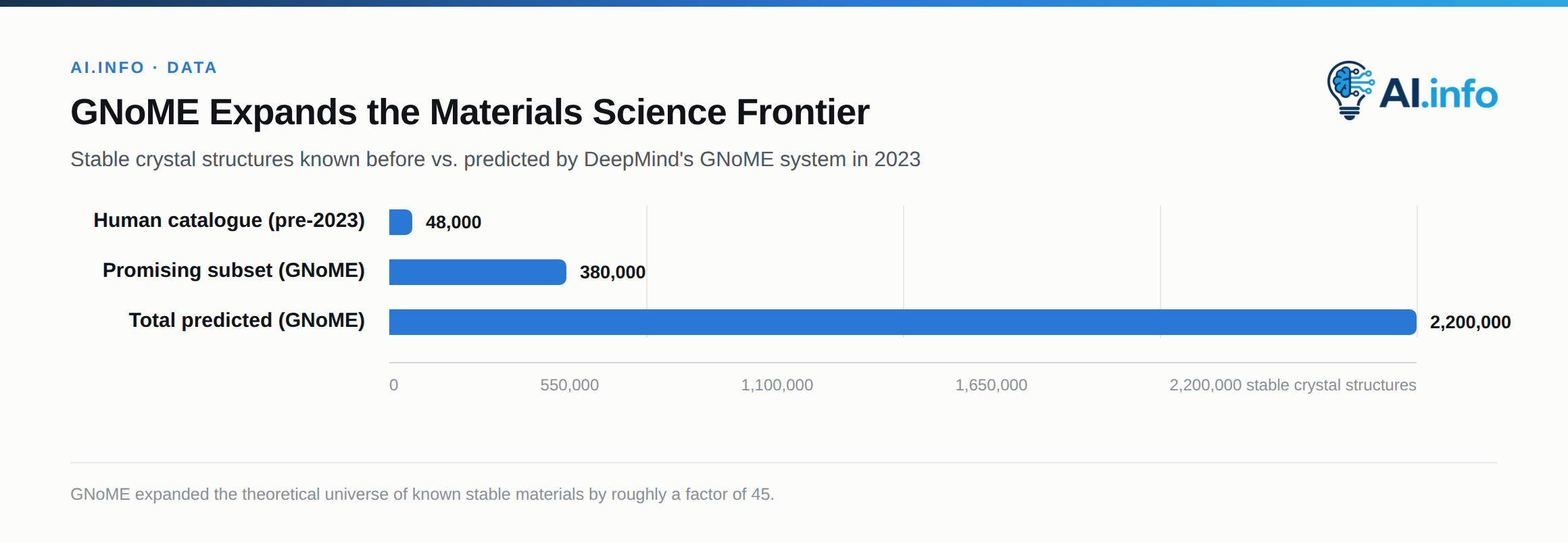
AI and Materials Science: Designing Matter from First PrinciplesIn 2023, Google DeepMind's GNoME system — Graph Networks for Materials Exploration — predicted the existence of 2.2 million new stable crystal structures, of which 380,000 were assessed as particularly promising for practical applications. For context: the entire history of human materials science had catalogued around 48,000 stable inorganic crystal structures. In a single computational run, DeepMind expanded the theoretical universe of materials science by a factor of roughly 45.
The announcement was celebrated in scientific circles and largely ignored by the general public. That gap in attention is itself a kind of data point: materials science is foundational to almost every technology humans depend on — batteries, semiconductors, pharmaceuticals, structural composites, solar cells, superconductors — yet it operates at a level of abstraction that rarely makes it into mainstream discourse. The question of which atoms, bonded in which configurations, produce which properties is simultaneously one of the most consequential and least visible frontiers in science.
AI is transforming that frontier at a pace and depth that is beginning to restructure entire industries. It has also, in the years since that announcement, collided with the oldest problem in the field: a crystal that is stable inside a computer is not yet a material. What follows is how the tools work, what they have produced, and where the published record stops.
The Old Way of Discovering Materials
To appreciate what AI changes, it helps to understand what materials discovery looked like before it.
The traditional process was empirical and slow. A researcher would formulate a hypothesis about which combination of elements might produce a desired property — higher electrical conductivity, lower thermal expansion, greater tensile strength at high temperature — based on existing knowledge of chemistry and physics. They would synthesise candidate materials in a laboratory, characterise their properties using a range of analytical techniques, and iterate based on what they found. A single iteration cycle might take weeks. A successful discovery might require years or decades of iteration.
The speed of the process was constrained by two fundamental limits. First, the chemical space is enormous: even considering only the 83 stable, non-radioactive elements in the periodic table, the number of possible two-element combinations is in the thousands, three-element combinations in the hundreds of thousands, and the number of possible crystal structures for any given elemental composition is effectively infinite. Experimental exploration of this space, one experiment at a time, is hopelessly slow.
Second, the relationship between a material's atomic structure and its macroscopic properties is complex and often counterintuitive. The properties of a material depend not just on which atoms it contains but on how they are arranged — the crystal structure, the defect density, the grain boundaries, the surface chemistry. A small change in synthesis conditions can produce materials with radically different properties from the same elemental composition. Developing intuition for these relationships requires years of accumulated experimental experience.
Computational methods — density functional theory, molecular dynamics simulation — have been used to assist materials discovery since the 1980s. But these methods are computationally expensive: a single first-principles calculation of a complex crystal structure can take days on a high-performance computing cluster. They improved the odds but did not fundamentally change the pace.
What AI Changes
AI approaches to materials science work differently from both experimental and conventional computational methods. Rather than simulating the physics from first principles in every instance, they learn the relationship between structure and properties from large datasets of existing materials data, and use that learned relationship to predict the properties of new structures without running the full physics simulation each time.
The key technique is the machine learning interatomic potential — a neural network trained to predict the energy of an atomic configuration given its structure. Once trained, such a potential can evaluate the stability and properties of a new atomic arrangement in milliseconds, compared to hours for an equivalent first-principles calculation. The speed advantage allows the search space to be explored at a fundamentally different scale.
Google DeepMind's GNoME system exemplifies the approach. It uses a graph neural network — a type of neural network well-suited to representing atomic structures as graphs of atoms connected by bonds — trained on the Materials Project database of known crystal structures. By learning the relationship between structure and stability from this database, it can predict whether a proposed new structure will be thermodynamically stable without running a full quantum mechanical simulation. The result is the ability to screen millions of candidate structures in the time it would previously have taken to evaluate dozens.
The count is where the argument starts. In April 2024 Anthony Cheetham and Ram Seshadri examined the GNoME release in Chemistry of Materials and reported “scant evidence for compounds that fulfill the trifecta of novelty, credibility, and utility”, their reading being that most of the predicted structures are compositional substitutions inside known structure types rather than new chemistry. A substitution can still be a useful material, and a screen was never meant to replace judgement. But 2.2 million is a number about search, not about discovery.
Microsoft's MatterGen, published in Nature on 16 January 2025, takes the inverse approach: instead of screening candidate structures, it uses a generative model to design new crystal structures with targeted properties from scratch. It was trained on 608,000 stable structures drawn from the Materials Project and the Alexandria database, and generates atomic arrangements predicted to carry a specified property — a magnetic susceptibility, a thermal conductivity, a mechanical stiffness — which inverts the traditional workflow. Microsoft released the source code under an MIT licence, so the claim is open to anyone with the compute to test it.
The paper also did the thing this field has been short of. One generated structure, the oxide TaCr2O6, was produced by conditioning the model on a bulk modulus of 200 gigapascals; it was then synthesised and measured at 169 gigapascals, inside the 20 percent margin the authors had set themselves. One compound is not a revolution. It is a data point of a kind that most of the announcements in this field still lack.
Meta's FAIR Chemistry team released Open Materials 2024 (OMat24) in October 2024 — more than 110 million density functional theory calculations, with trained models alongside it — as open infrastructure for the same work. It puts these approaches within reach of groups that cannot build proprietary datasets.
The Battery Problem: AI's Most Consequential Materials Challenge
Of all the applications of AI in materials science, none carries higher stakes than the search for better battery materials.
The clean energy transition depends on batteries. Electric vehicles need batteries with higher energy density, faster charging, longer cycle life, and lower cost than current lithium-ion chemistries. Grid-scale energy storage — essential for balancing variable renewable power — needs batteries that are safe, long-lasting, and manufactured from materials that are abundant and geographically distributed. Both applications are currently constrained by materials limitations: the dominance of lithium, cobalt, and nickel creates supply chain vulnerabilities and cost floors that impede adoption.
AI is being applied to this problem at every level of the battery materials stack. At the electrode level, companies including Aionics, Chemix, and Alchemy are using machine learning to design new electrolyte formulations that enable faster ion transport, higher voltage windows, and better stability at elevated temperatures. At the cathode level, AI is being used to explore the space of lithium-free and cobalt-free materials — sodium-ion, potassium-ion, and magnesium-ion chemistries — that could reduce the critical mineral constraints on battery production.
At the solid electrolyte level, perhaps the most transformative potential in battery chemistry, AI has made significant contributions to the search for solid-state electrolytes that could replace the flammable liquid electrolytes in current lithium-ion batteries. Solid-state batteries promise dramatically higher energy density, improved safety, and longer cycle life — but the materials challenge of finding an electrolyte with sufficiently high ionic conductivity at room temperature while being chemically stable and manufacturable has resisted decades of experimental effort. Google DeepMind's GNoME database has been mined for promising solid electrolyte candidates. How many of them have since been made, and how many of those behaved as the screen predicted, is not something the public record answers.
That silence is the honest state of the battery work. Screening campaigns run by companies and national laboratories have announced candidate electrolytes that would use less lithium than conventional designs, and the screens are genuinely fast. What has not reliably followed, in peer-reviewed form, is the cell: a battery built from the candidate, cycled and measured by someone other than the party that announced it.
Semiconductors: Designing the Next Generation of Chips
The semiconductor industry, which faces its own post-silicon transition described elsewhere in this series, is using AI in materials science to design the materials that will underpin the next generation of computing hardware.
The dominant material for transistors — silicon — is being supplemented and in some applications replaced by wide-bandgap semiconductors including gallium nitride and silicon carbide, which can operate at higher voltages, higher temperatures, and higher switching frequencies. These materials are critical for power electronics in electric vehicles, renewable energy systems, and industrial equipment. AI is accelerating the discovery and optimisation of these materials. Machine-learned interatomic potentials are used to screen dopants, interfaces and defect structures that would be prohibitively slow to model from first principles, and learned process models are used to narrow the growth windows within which a usable wide-bandgap film forms.
For the longer-term future of computing, AI is being used to explore the materials space for potential replacements for silicon in logic devices. Two-dimensional materials — graphene, molybdenum disulfide, hexagonal boron nitride — have theoretical properties that would make them superior to silicon at nanometre scales where quantum effects limit conventional transistors. The challenge is understanding how to grow, process, and integrate these materials reliably in a manufacturing context. AI models trained on the growing body of 2D materials data are being used to predict synthesis conditions, defect concentrations, and device performance.
The Pharmaceutical Connection: Drug Delivery and Biomaterials
Materials science intersects with medicine in ways that receive less attention than AI drug discovery but that may ultimately be equally transformative.
Drug delivery — getting a therapeutic molecule to the right location in the body, in the right concentration, at the right time — depends critically on the materials used to encapsulate and transport drugs. Polymeric nanoparticles, lipid nanoparticles (the delivery vehicle used in mRNA COVID-19 vaccines), hydrogels, and implantable devices all depend on materials with precisely tuned properties: biocompatibility, degradation rate, permeability, surface chemistry.
Traditionally, optimising these materials for specific drug-disease combinations required extensive empirical testing. Machine-learning-guided optimisation has been used to identify lipid nanoparticle formulations for mRNA delivery that accumulate preferentially in a target tissue rather than being swept up by the liver. That level of targeting was essentially impossible to achieve through trial-and-error approaches on a practical timescale.
For implantable medical devices — stents, joint replacements, neural probes, cochlear implants — AI is being used to design surface coatings and bulk materials that minimise the foreign body response, reduce infection risk, and improve long-term biocompatibility.
Structural Materials: Reinventing How We Build
Beyond electronics and medicine, AI is transforming the discovery and optimisation of structural materials — the metals, composites, and ceramics used in construction, aerospace, automotive manufacturing, and industrial equipment.
High-entropy alloys — alloys containing five or more principal elements in roughly equal proportions — represent one of the most promising frontiers in structural materials science. These alloys can exhibit combinations of strength, toughness, corrosion resistance, and high-temperature performance that are unachievable in conventional two or three-element alloys, but the compositional space is so vast — millions of possible combinations — that experimental exploration is hopelessly slow. Several groups have used ML models trained on existing high-entropy alloy data to predict promising new compositions, with experimental follow-up confirming theoretical predictions.
Aerospace manufacturers have used AI-assisted simulation to cut the weight of structural components, where every kilogram saved translates directly into fuel over an aircraft's lifetime. Carmakers use the same approach on electric vehicle parts, where weight buys range.
Carbon fibre composites are being redesigned with optimisation tools that explore fibre orientation, matrix composition and manufacturing parameters far faster than physical testing alone.
The Experimental Bottleneck: Synthesis and Validation
A recurring theme in AI-assisted materials discovery is the gap between computational prediction and experimental realisation. AI can identify millions of promising candidate structures; the bottleneck is now the rate at which those candidates can be synthesised and characterised in the laboratory.
The bottleneck is being addressed through autonomous experimentation platforms — robotic laboratory systems that perform synthesis, characterisation and data analysis with minimal human intervention, running continuously and feeding results back into models that update their predictions. The best known is the A-Lab at Lawrence Berkeley National Laboratory. Its Nature paper of 29 November 2023 reports that, over 17 days of continuous operation, the platform realised 36 compounds from a set of 57 targets identified from Materials Project and DeepMind stability data.
That result did not survive contact with crystallographers. In March 2024 a group at Princeton and University College London went through the synthesis products one by one in PRX Energy and found four recurring shortfalls in the analysis, chiefly in the automated Rietveld fitting of powder X-ray diffraction data and in the neglect of disorder, where elements predicted to sit on distinct crystallographic sites in fact share them. Their conclusion was not hedged.
These errors unfortunately lead to the conclusion that no new materials have been discovered in that work. — Josh Leeman, lead author, Department of Chemistry, Princeton University
Nature published an author correction to the A-Lab paper in January 2026. The robot still works as robotics: it can run a synthesis campaign unattended for weeks. What the episode removed was the claim that unattended operation had produced new materials, and with it the assumption that characterisation automates as readily as synthesis. Deciding what came out of the furnace is the hard part.
| System | Approach | Key result |
|---|---|---|
| GNoME (DeepMind) | Graph neural network screening | 2.2 million predicted stable structures, 380,000 promising; novelty contested |
| MatterGen (Microsoft) | Generative inverse design | TaCr2O6 synthesised and measured at 169 GPa against a 200 GPa target |
| A-Lab (Lawrence Berkeley) | Autonomous synthesis | 36 compounds from 57 targets in 17 days; author correction, January 2026 |
The combination of AI prediction and autonomous experimentation creates a closed loop that is qualitatively different from either approach alone: the model predicts, the robot synthesises and characterises, the results update the model. It runs at a pace limited only by the throughput of the platform — and, as the A-Lab showed, by the reliability of the characterisation step.
Commercial ventures including Citrine Informatics and Chemify are building platforms that make some of this capability available to industrial R&D teams that cannot fund an autonomous laboratory of their own.
What This Means for Industry and Policy
The acceleration of materials discovery through AI has implications that extend beyond the laboratory.
For clean energy, the central policy question is whether the clean energy transition can be sustained at the pace required to meet climate targets given the critical mineral constraints on current battery and solar cell technologies. AI-assisted materials discovery offers a pathway to technologies that are less dependent on scarce minerals — lithium-free batteries, silicon-free solar cells, copper-free power transmission — that could remove some of the most significant constraints on clean energy scaling.
For semiconductor manufacturing, materials innovation is increasingly central to the industry's ability to maintain performance improvements as silicon approaches its limits. The geopolitical competition around semiconductor technology — including the US-China chip war — is partly a competition around materials capabilities. Nations and companies that lead in AI-assisted materials discovery will have a structural advantage in the next generation of semiconductor development.
For pharmaceutical and biotechnology companies, AI-assisted biomaterials discovery is creating competitive advantages in drug delivery that are difficult to replicate without similar capabilities. The regulatory implications are significant: regulators must develop frameworks for evaluating AI-designed materials in human applications, balancing the need to maintain safety standards with the opportunity to accelerate access to genuinely improved therapies.
The Periodic Table as a Design Space
For most of human history, the periodic table has been a catalogue of what exists in nature. Materials science has been, fundamentally, a discipline of discovery: finding materials with useful properties by exploring the physical world, or by combining known elements in new configurations and observing what emerges.
AI is transforming the periodic table from a catalogue into a design space. For the first time, it is becoming possible to specify a desired property — a material that is hard as diamond but electrically conductive, or biocompatible and degrades in exactly thirty days, or that stores twice the energy of current lithium-ion batteries at half the cost — and search the space of possible atomic configurations computationally for candidates that meet the specification.
The capability is genuinely new. Its consequences will play out over decades rather than years, and the record of the last three years has made clear where the decades will go: not into the search, which is now cheap, but into validation, scale-up and the unglamorous business of proving that the thing in the crucible is the thing on the screen. But the trajectory is already visible: in batteries that could transform clean energy economics, in semiconductors that could extend computing progress beyond silicon's limits, in medicines that reach their targets with previously impossible precision, in structures built from materials designed atom by atom for their purpose.
The age of designed matter is beginning. Its implications are as large as the periodic table itself.