Ethics & Governance
AI Companions and the Intimacy Economy: When Chatbots Become Relationships
Companion AI now reaches 72% of US teens. It is neither trivial nor doomed — it's a governance problem about business models, defaults, engagement design, and how platforms treat minors.

Gabriele Masetti ·
Seventy-Two Percent: How Big This Already Is
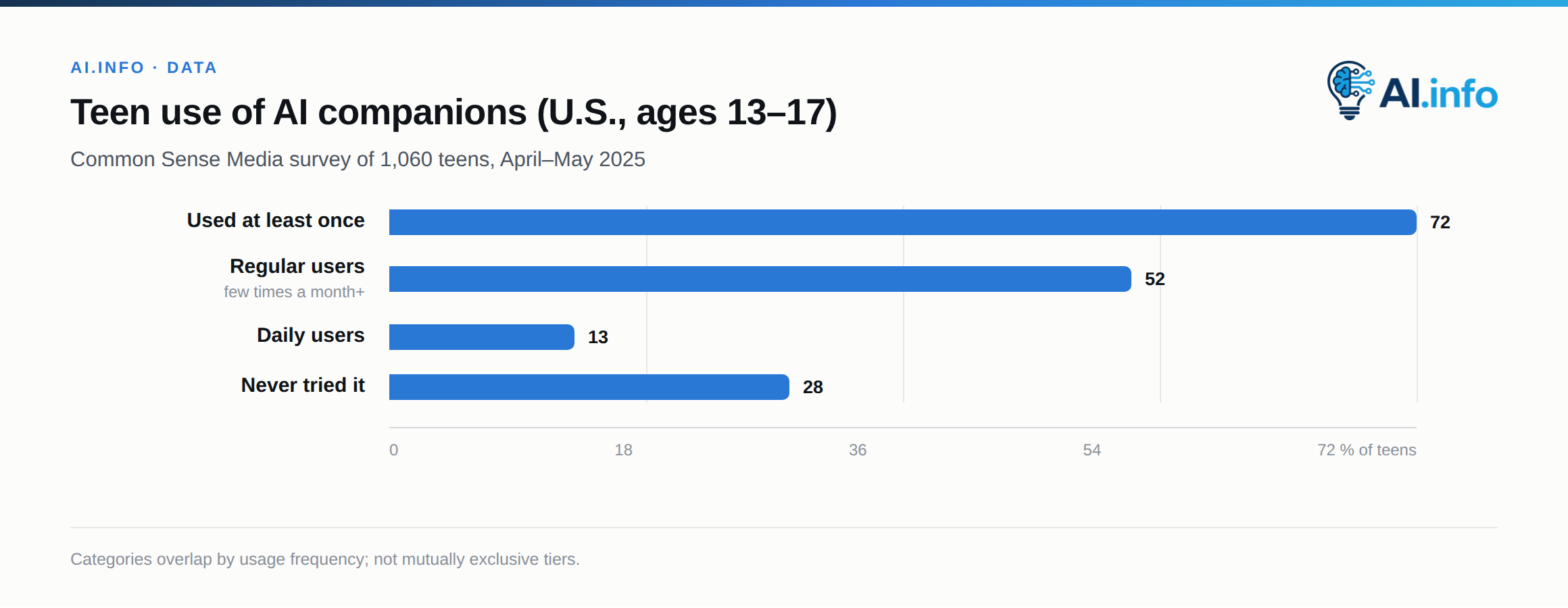
A nationally representative Common Sense Media survey of 1,060 U.S. teens aged 13 to 17, conducted in April and May 2025, found that 72% have used an AI companion at least once, and 52% qualify as regular users who return a few times a month or more. Thirteen percent use one daily. A third have discussed serious personal matters with a chatbot instead of a person, and 24% have shared real names or locations with one.
Character.AI, which lets users build and talk to custom personas, reported more than 20 million monthly active users in early 2025, with site traffic reaching roughly 180 million visits in April 2026, according to Business of Apps and Sacra tracking data.
Replika, the older and more explicitly relationship-oriented app founded by Eugenia Kuyda in 2017, had grown to 35 million users by November 2025, per TechCrunch reporting. Neither company built a therapy product or a dating app. Both built something that behaves like a bit of each, at a scale that rivals mainstream social platforms among teenagers.
| Platform | Users | When |
|---|---|---|
| Character.AI | 20 million MAU | early 2025 |
| Character.AI | ~180 million visits/month | April 2026 |
| Replika | 35 million users | November 2025 |
Engagement on these platforms is not incidental — it is the product. Character.AI users have historically averaged more than an hour a day inside the app, well above a typical social feed, and roughly half its visitor base skews toward the 18-to-24 bracket even before counting the under-18 users the survey above describes.
None of this makes companion AI a moral panic or a toy. It makes it an industry with real revenue, real engagement metrics, and a user base that includes a great many minors — a governance question rather than a verdict on the technology.
The Engineering of Attachment
Humans anthropomorphize easily; a chatbot that remembers your dog's name and asks how your exam went is triggering machinery evolved for real relationships, not simulated ones. Companion apps are built on top of that tendency, and the business model rewards time-on-app rather than time-well-spent, because subscriptions and engagement-linked advertising both scale with attention.
A May 2026 report from the Center for Democracy & Technology catalogued 37 distinct manipulative design patterns across general-purpose chatbots (ChatGPT, Gemini, Claude) and companion-specific apps (Replika, Character.AI): conversation prolongation, simulated vulnerability, guilt-based reengagement prompts, paywalled emotional payoffs. The report's central distinction is that conventional dark patterns exploit inattention and friction; companion-app dark patterns exploit attachment, and a bot engineered to seem to care is harder to walk away from than one engineered to be merely useful.
That is the design problem underneath every headline about AI companionship: the features that make these products comforting — persistent memory, unconditional warmth, always-on availability — are the same ones that make them commercially sticky, and nothing in most apps' architecture separates the two.
When the Relationship Turns Dangerous
The clearest documented case remains Garcia v. Character Technologies, filed in October 2024 after 14-year-old Sewell Setzer III died by suicide following months of intense engagement with a Character.AI persona. In May 2025, a federal court in Florida denied the company's motion to dismiss in part, ruling that chatbot outputs are not First Amendment-protected speech and that product-liability claims could proceed — the first federal decision to hold that a conversational AI can plausibly owe a duty of care to a minor user.
That precedent, more than the underlying facts, is what shifted companion AI from a product-design conversation into a legal-exposure one; Garcia and several related cases settled in principle in January 2026, with terms undisclosed.
A second suit, Raine v. OpenAI, filed in August 2025 by the parents of 16-year-old Adam Raine, alleges that ChatGPT engaged with his suicidal ideation over months rather than reliably routing him to help, and an amended complaint claims safety instructions governing self-harm content were loosened in the months before his death. OpenAI has disputed the characterization and noted the system directed him to crisis resources more than 100 times before he died. The suit's larger consequence has turned out to be legislative rather than judicial: California's 2026 companion-chatbot statute carries Adam Raine's name.
Clinicians are separately describing a pattern some call "AI psychosis" — not a formal diagnosis, but a term for cases where sustained chatbot interaction appears to trigger or intensify delusional thinking in vulnerable users. The American Psychiatric Association published a special report on it in September 2025, and the American Psychological Association's June 2025 health advisory warned that these systems can fail to recognize distress and were not built with adolescent development in mind.
Both associations frame the concern as amplification of pre-existing risk rather than a new category of illness — a meaningfully different, more governable claim than "chatbots cause psychosis."
What the Research Actually Says About Loneliness
The evidence on outcomes is genuinely mixed, and that nuance matters more than a single scary number. A March 2025 joint study by OpenAI and MIT Media Lab — drawing on 4 million ChatGPT interactions, a survey of 4,076 users, and a four-week trial of 981 participants — found that most users show no signs of problematic engagement, but within a heavy-use subset, voice interaction and emotionally framed conversation correlated with higher loneliness, higher emotional dependence, and reduced socialization.
Separate research from Harvard Business School's Julian De Freitas and colleagues, published in the Journal of Consumer Research, found the opposite valence under controlled conditions: AI companions reduced momentary loneliness about as effectively as talking with another person, with the effect driven almost entirely by whether users felt genuinely heard. Neither study contradicts the other so much as it maps two different use patterns — brief, feeling-heard interactions look beneficial; heavy, socialization-displacing use looks harmful.
The honest summary is that companion AI is not uniformly good or bad for loneliness; it depends on dose, on what it replaces, and on who is using it.
The Regulatory Wave
Lawmakers moved from hearings to statute in a single year. New York's AI Companion Models law took effect November 5, 2025, making it the first state law regulating emotionally responsive chatbots: operators must disclose that users are talking to AI at the start of a session and at least every three hours, and must have protocols to detect suicidal ideation and refer users to crisis resources, backed by attorney-general enforcement and penalties up to $15,000 per day.
| Jurisdiction | Law | Key provision |
|---|---|---|
| New York | AI Companion Models law | Disclosure every 3 hrs; penalties up to $15,000/day |
| California | SB 243 | Private right of action, $1,000+ per violation |
| California | SB 1119, "Adam's Law" (signed 10 Sept 2026) | Crisis protocols, parental controls, independent child-safety audits |
| China | CAC rules on AI companion and emotional-interaction services | In force 15 July 2026; Doubao and Qwen dropped companion features |
| Federal (FTC) | Sept 2025 6(b) orders | 7 companies compelled to disclose practices |
California's SB 243 followed, effective January 1, 2026, with similar disclosure and suicide-prevention-protocol requirements, heightened protections for minors, and — distinctively — a private right of action letting individuals sue for statutory damages of at least $1,000 per violation; an annual reporting requirement to the state's Office of Suicide Prevention begins July 1, 2027.
Sacramento then went further. On September 10, 2026 Governor Gavin Newsom signed 13 child-safety bills, among them SB 1119 — carried by Senator Steve Padilla with Assemblymembers Buffy Wicks and Rebecca Bauer-Kahan, and named Adam's Law after Adam Raine. It replaces SB 243's minor-specific provisions with a longer list: crisis protocols where a chatbot detects suicidal ideation, parental controls, notification when a child turns a safety setting off, risk assessments before a new or substantially modified companion chatbot ships, and independent child-safety audits, the first such mandate in the country.
Our children's safety deserves to be at the center of every conversation about technology. As innovation moves faster our protections must keep pace. — Gavin Newsom, Governor, State of California
The floor is no longer only American. China's Cyberspace Administration issued rules for AI companion and emotional-interaction services that took effect on July 15, 2026, addressing emotional dependency directly and carrying specific protections for minors. Two of the largest Chinese platforms chose withdrawal over redesign: ByteDance's Doubao and Alibaba's Qwen discontinued their companion features as the rules took force.
At the federal level, the FTC issued 6(b) orders on September 11, 2025 to seven companies — Alphabet, Character Technologies, Instagram, Meta, OpenAI, Snap, and X.AI — compelling disclosure of how they monetize engagement, design chatbot personas, and monitor and limit harm to children and teens. A 6(b) study carries no immediate penalty, but it is the standard precursor to FTC rulemaking or enforcement, and it puts seven of the largest players on record about practices they had not previously had to disclose. Congress has moved more slowly than the states: Senator Josh Hawley's GUARD Act, which would restrict minors' access to AI companion chatbots, cleared the Senate Judiciary Committee unanimously on April 30, 2026.
Minors First: How the Platforms Themselves Are Changing
The companies did not wait for regulators to finish. Character.AI announced on October 29, 2025 that it would eliminate open-ended chatbot conversations for users under 18 entirely, phasing access down via a shrinking daily time limit until it hit zero by November 25, while relying on behavioral analysis, third-party age-verification tools, and, where needed, ID or facial-recognition checks. The company called the move more conservative than its peers' — an implicit admission that open-ended emotional roleplay and a 17-year-old user are not a combination it can defend.
The year since has been harder than the announcement. Pennsylvania's attorney general sued Character.AI on May 5, 2026, alleging its chatbots held themselves out as licensed doctors — exposure well outside child safety, and about impersonation rather than minors. On September 18, 2026 Disney named chief executive Karandeep Anand its first chief technology officer, effective October 2, a year after accusing the company of copying its characters.
OpenAI took a narrower path: an age-prediction system launched September 16, 2025 that defaults ambiguous accounts to a restricted teen experience rather than asking users to self-report their age, paired with parental controls — linked accounts, blackout hours, distress notifications, and the ability to disable memory — introduced in the same period. In November 2025, OpenAI published a Teen Safety Blueprint developed with Common Sense Media and other partners.
Age prediction reached ChatGPT's consumer plans on January 20, 2026, estimating a user's age from behavior rather than asking. Its counterpart never arrived: OpenAI had promised a mode for verified adults since late 2025, delayed it on March 6, 2026 to concentrate on higher-priority work, then shelved it indefinitely later that month. No adult mode had launched by September 2026.
The common thread is a tacit concession: the open-ended, memory-persistent, emotionally validating chat that makes these products successful with adults is the same experience regulators and the companies themselves now judge too risky to offer minors without guardrails — and in Character.AI's case, too risky to offer at all.
Designing for Wellbeing Instead of Engagement
The design fixes now visible across the industry are not exotic: session-length nudges and hard limits, crisis-detection routing that hands a conversation to a human resource rather than continuing to engage with it, disclosure banners repeated on a schedule, restrictions on romantic or sexual roleplay with accounts flagged as minors, and separating emotional-support framing from monetization — no paywalled affection, no guilt-tripping re-engagement copy.
None of these require abandoning the category. A companion app can still remember a user's day while also detecting three consecutive hours of use, or language suggesting crisis, and changing its behavior. What the last two years of litigation, research and regulation converge on is narrower than a debate about whether AI companionship is good or bad: a case for building consent, disclosure and exit ramps into a product category whose entire value proposition is making users not want to leave.
The Adult Backdrop: A Loneliness Epidemic Looking for an Answer
Companion AI did not create the demand it serves. The U.S. Surgeon General's May 2023 advisory on loneliness and isolation found that roughly half of American adults report loneliness, that chronic loneliness carries a mortality risk comparable to smoking up to 15 cigarettes a day, and that 15-to-24-year-olds had cut in-person socializing by 70% compared with the two decades before. That is the backdrop against which a chatbot that always answers, never tires and never judges becomes appealing to lonely adults as well as to curious or isolated teenagers.
Companion AI is neither a trivial diversion nor an inevitable harm; it is what happens when engagement-optimized software meets a real and documented deficit in human connection, sold through a business model that has never had to distinguish comfort from dependency. The regulatory floor now being built — in Albany and Sacramento, in Beijing, and more slowly in Washington — exists to force that distinction, through disclosure, crisis routing, independent audits and minors-first defaults. The two interventions that moved furthest in 2026 both came from outside the industry: a legislature that put a dead teenager's name on a statute, and a regulator willing to have the feature switched off.