Ethics & Governance
AI and Climate Change: The Double-Edged Algorithm Facing the Planet's Biggest Problem
Google's 2026 report cut operational emissions 2% while supply-chain emissions rose 25% and electricity demand 37%. Microsoft's total rose a quarter. The AI climate ledger, read in the builders' own disclosures.
Gabriele Masetti ·
A Ledger, Not a Verdict
Every debate about artificial intelligence and climate change eventually collapses into a slogan: AI is either an environmental disaster or a climate savior. Neither slogan survives contact with the numbers. What survives is a ledger — one column of measured, disclosed, compounding energy and water costs, and another column of genuine but diffuse and unevenly deployed climate benefits. Read the ledger honestly, using the companies' own disclosures and the International Energy Agency's own modeling, and it does not balance.
Through the rest of this decade, on the trajectory the industry itself has published, AI is a net addition to the climate problem, not a solution to it. That is not a rhetorical flourish; it is what Google, Microsoft, and the IEA are now saying about themselves, in their own reports, in their own words.
The Meter Is Already Running Hot
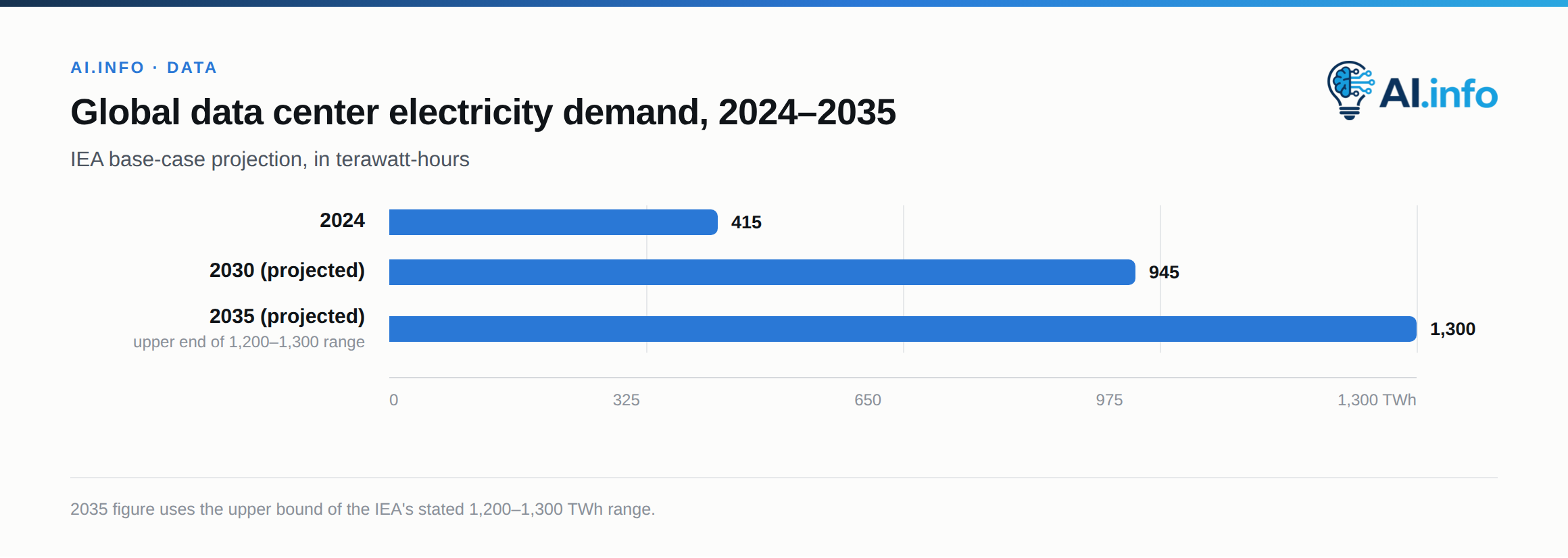
Start with the physical footprint, because it is the part of the ledger that is no longer speculative. The IEA estimated global data center electricity consumption at roughly 415 terawatt-hours in 2024, about 1.5% of global electricity use. That was already the baseline before the current AI buildout hit full stride.
In its 2025 update, the IEA found data center electricity use surged again — up roughly 17% year-over-year, with AI-optimized facilities alone driving a 50% spike within that total, even as overall global electricity demand grew only about 3%. The agency's base-case scenario, published in its "Energy and AI" report, projects data center electricity demand reaching about 945 TWh by 2030 — more than the entire current electricity consumption of Japan — and climbing toward 1,200–1,300 TWh by 2035.
Electricity use tied to AI accelerated servers specifically is projected to grow around 30% a year in that base case, versus roughly 9% for conventional servers, which is the clearest evidence available that AI, not general cloud computing, is the marginal driver of the increase.
The energy mix behind that demand matters as much as the volume. The IEA finds that fossil fuels currently supply close to 60% of the electricity powering data centers worldwide, with coal alone accounting for roughly 30% of the total — the largest single source, driven up in regions like China. Renewables meet about 27% of data-center demand today and nuclear another 15%.
The IEA does project this mix inverting by 2035, moving to roughly 60% clean power and 40% fossil fuels as renewables add more than 450 TWh of new generation to serve this specific demand. But that inversion is a decade-long bet, not a current fact, and it depends on transmission buildout and permitting timelines that have historically lagged data center construction schedules.
In the meantime, the IEA projects data-center-linked emissions rising from about 180 million tonnes of CO2 today to roughly 300 million tonnes by 2035 — still a small slice of total energy-sector emissions, under 1.5% by the agency's own accounting, but one of the only slices growing this fast in a sector otherwise trying to shrink.
What the Sustainability Reports Are Actually Confessing
The most useful data here doesn't come from AI critics — it comes from AI's biggest builders, in disclosures they were not obligated to phrase this candidly. Google's eleventh annual environmental report, published on 30 June 2026, put the company's 2025 carbon footprint at roughly 14.5 million metric tons of CO2-equivalent: 18% above 2024, and 81% above the 2019 baseline Google measures itself against.
The split underneath that total is the part worth reading twice. Operational emissions — Scope 1 plus market-based Scope 2, about 2.9 million tons — fell 2%, a second consecutive year of improvement. Supply-chain emissions rose 25% and now make up around 80% of the footprint: purchased goods, construction materials and chip manufacturing, much of it on Asian grids that still run heavily on coal and gas. Google is getting cleaner at running data centers and dirtier at building them.
Electricity demand across the company rose about 37%, its steepest annual increase on record. Google credits efficiency and clean-power work with holding the line, estimating that its 2025 footprint would otherwise have been five times larger. The report still calls the climate moonshot "getting harder," citing grid delays and supply-chain bottlenecks.
While the path to achieving our climate ambitions will not be linear — given our AI infrastructure buildout is currently accelerating faster than the grid is decarbonizing … — Kate Brandt, Chief Sustainability Officer, Google
| Company | Metric (latest report) | Figure |
|---|---|---|
| Total footprint, 2025 | ~14.5M tons CO2e (+18% YoY, +81% vs 2019) | |
| Operational emissions (Scope 1+2) | −2% | |
| Supply-chain emissions (Scope 3) | +25%, ~80% of total | |
| Electricity demand | +37% | |
| Microsoft | Total emissions, FY2025 | +25% YoY |
| Microsoft | Scope 2 share of footprint | ~2% → 13% |
| Microsoft | Water withdrawals (2021→2022) | +34% |
Microsoft's disclosures tell the same story with different numbers. Its 2026 environmental sustainability report, published on 9 July 2026, records a 25% rise in total emissions across all three scopes for fiscal 2025, attributed to data center expansion and to a deliberate decision to stop buying non-additional unbundled renewable energy certificates in favor of investments that add new carbon-free power directly to grids. The accounting change is visible in the split: Scope 2 jumped from roughly 2% of the company's footprint to 13% in a single year.
That's a defensible long-term strategy, but in the short term it means the number that matters — reported emissions — went the wrong direction, on the way to a 2030 carbon-negative commitment measured against a 2020 baseline the company is now far above. Brad Smith and Melanie Nakagawa, who signed the report's introduction, put the tension plainly: "While AI infrastructure is driving demand for energy, water, land, and materials, sustainability solutions are not scaling fast enough to meet demand."
None of this required a hostile outside audit. It is what the two companies leading the commercial AI buildout are telling their own shareholders.
Water Is the Footprint Companies Disclose Least Willingly
Electricity gets the headlines, but water tells a more uneven story, largely because disclosure is thinner. Independent estimates of GPT-3's training run — widely cited in the peer-reviewed literature on LLM environmental cost — put its electricity consumption at roughly 1,287 megawatt-hours and its direct water use at around 700,000 liters on-site for cooling, with total water footprint (including the water embedded in electricity generation) estimated near 5.4 million liters.
Reporting based on utility records found Microsoft's Iowa data center complex — which hosted OpenAI's GPT-4 training runs — consumed about 11.5 million gallons of water in July 2022 and 13.4 million gallons in August 2022, the two months coinciding with the training run's peak intensity. Company-wide, Microsoft disclosed a 34% increase in water withdrawals between 2021 and 2022, and Google disclosed a 20% increase over the same period.
More recently, Google's Council Bluffs, Iowa data center alone was reported to have consumed about 1 billion gallons of water in 2024, peaking at 2.7 million gallons in a single day — comparable to the daily water use of a city of roughly 25,000 people.
A 2025 University of Toronto review of six major data center operators — Amazon, Google, Microsoft, Meta, Digital Realty, and Equinix — found none disclosed site-specific water data in a fully consistent, comparable format, which is itself part of the story: the industry's water accounting lags well behind its energy accounting, at precisely the moment water stress is intensifying in many of the regions where new data centers are being sited.
Google's 2026 report shows the gap persisting even where a company discloses willingly: it reports replenishing about 7.7 billion gallons in 2025, roughly 78% of the freshwater it consumed — a company-wide ratio, not a site-level withdrawal figure.
The Other Side of the Ledger Is Real — and Genuinely Useful
None of this means AI has nothing to offer the climate fight. It has quite a lot, and dismissing it would be its own kind of dishonesty.
DeepMind's data center cooling system is the oldest and best-documented example: a neural network trained on thousands of sensor readings inside Google's facilities cut the energy used for cooling by about 40%, translating into a roughly 15% reduction in overall power usage effectiveness — a genuinely large efficiency gain in an industry where single-digit improvements are normally considered notable.
Weather forecasting is where the climate case has moved fastest. GraphCast, DeepMind's model published in Science in 2023, produced 10-day global forecasts in under a minute on a single Cloud TPU and beat the European Centre for Medium-Range Weather Forecasts' operational HRES system on roughly 90% of the thousands of variables and lead times tested. It has since been superseded twice: WeatherNext 2 arrived in November 2025, generating forecasts eight times faster at up to hourly resolution and out to 15 days, and WeatherNext 3 launched in September 2026, learning directly from raw geostationary satellite imagery, refreshing every hour and resolving surface temperature and moisture on a 5-kilometer grid.
The third generation is aimed squarely at the energy transition. It forecasts wind speed at 100 meters — roughly turbine hub height — alongside cloud cover and incoming solar radiation, the three variables a grid operator needs in order to know how much renewable output to expect tomorrow.
GNoME, DeepMind's materials-discovery system described in a 2023 Nature paper, screened candidate compounds and identified 2.2 million new crystal structures, of which about 380,000 were predicted to be stable; roughly 736 of these have since been independently synthesized by outside laboratories, and the effort — run in partnership with Berkeley Lab's Materials Project — contributed to a roughly tenfold increase in the number of known stable materials, an advance with plausible downstream applications in battery chemistry and superconductors relevant to the energy transition.
On the grid side, DeepMind and Google applied machine learning to roughly 700 megawatts of wind capacity in the central United States, using 36-hour-ahead output predictions to let operators make firmer day-ahead delivery commitments — Google reported this raised the effective value of that wind power by about 20%, since predictable renewable output is worth more to grid operators than intermittent output of the same volume.
And AI-assisted satellite systems — Carbon Mapper's Tanager-1, launched in August 2024 in partnership with NASA's Jet Propulsion Laboratory and Planet Labs, alongside AI-enhanced analysis of Sentinel and GOSAT imagery — can now attribute methane emissions to a specific facility within roughly a 50-meter radius, with an ambition to track up to 90% of high-emission sources globally on a near-daily basis, targeting a gas whose short-term warming potency makes rapid detection unusually valuable.
That constellation is finally growing. Planet shipped Tanager-2 to Vandenberg Space Force Base at the end of August 2026 for a SpaceX Transporter-18 rideshare — a hyperspectral imager reading 426 contiguous bands at 30-meter ground resolution — and says at least three more Tanagers will follow.
That same example is a useful check against overselling this side of the ledger: MethaneSAT, a complementary methane-tracking satellite backed by the Environmental Defense Fund, lost contact with ground control in June 2025 and was declared irrecoverable the following month, after only fifteen months in orbit. The climate-AI toolkit is real, but it is also young, unevenly funded, and still vulnerable to the kind of single-point failure that a mature, decade-tested system would not be.
Why the Ledger Still Doesn't Net Out
Weigh the two columns honestly and the imbalance is structural, not just a matter of current scale.
The consumption side of the ledger is direct, immediate, and — critically — already locked in by physical construction. Data centers under construction now will draw power for a decade or more regardless of what happens to any individual model's efficiency. The benefit side, by contrast, is indirect and conditional at nearly every step: a GNoME-predicted material still has to be synthesized, tested, and manufactured at industrial scale before it does anything for the energy transition; a WeatherNext forecast still depends on a grid operator or an emergency-response system acting on it; a methane plume detected by a Tanager still requires a regulator or an operator to shut the leak.
Every one of these benefits routes through years of additional human, industrial, and policy follow-through before it displaces a comparable quantity of emissions. The consumption is already showing up this year, in filed reports.
There's a second, more structural reason to doubt the ledger will self-correct through efficiency gains alone, and it has a name: the Jevons paradox. A 2025 peer-reviewed analysis presented at the ACM Conference on Fairness, Accountability, and Transparency examined exactly this dynamic in AI and found that efficiency improvements — like the 40% cooling reduction DeepMind delivered, or the well-documented order-of-magnitude annual drop in energy cost per AI inference task that the IEA itself has tracked — tend to lower the cost of AI capability, which in turn increases how much of it gets used, deployed, and embedded into new products.
The net effect, historically, is that total consumption keeps rising even as each unit of compute gets measurably greener. Google's 2026 report is the cleanest illustration yet: efficiency good enough to cut operational emissions 2% while electricity load grew 37%, and a total footprint up 18% anyway, because building the machines outran cleaning them.
The clearest evidence that the ledger isn't netting out doesn't come from environmental groups — it comes from the companies with the strongest incentive to claim otherwise. Google and Microsoft are simultaneously the leading commercial beneficiaries of the AI buildout and two of the corporate world's most visible climate pledge-makers. If the climate upside of their own AI systems were offsetting the downside, their own emissions accounting would show it.
Instead, Microsoft's latest disclosure shows total emissions up a quarter in a fiscal year, and Google's a footprint up 18% on the back of a 25% rise in supply-chain emissions — the one good number, Google's 2% operational cut, the smallest of the three. Both attribute the direction of travel to AI infrastructure, and both now hedge the language around targets set before the current buildout began. That is not what a self-balancing ledger looks like.
What Would Actually Flip the Sign
The imbalance is not permanent, and the IEA's own long-range numbers point to the conditions that could change it: a data-center electricity mix that inverts from majority-fossil to majority-clean by the mid-2030s, provided renewable buildout and transmission permitting keep pace with data center construction rather than trailing it as they have so far.
Getting there faster would require three things the industry has been slow to deliver voluntarily — standardized, site-level disclosure of energy and water use (the gap the University of Toronto researchers flagged across six major operators), enforceable reporting of training-run and inference-level footprints rather than the patchwork of independently estimated figures researchers currently rely on, and a shift of tools like GNoME, the WeatherNext models, and satellite methane monitoring from research demonstrations into deployed industrial and regulatory infrastructure with sustained funding — the kind MethaneSAT didn't survive to receive.
Google's 2026 report shows what partial progress looks like: the operational column can be bent downward with enough capital and clean-power contracting, while the supply-chain column — four-fifths of the problem — has not been bent by anyone yet. Until it is, the honest reading of the ledger is that AI is adding to the climate problem faster than it is helping solve it, and the companies building it are, in their own words, the first to admit the arithmetic isn't currently in their favor.