Technical Deep Dives
Inside the FDA's Rush to Approve AI That Reads Your X-Rays
Breakthrough Device status for Aidoc's First Read and Cognita CXR marks 2026's shift from AI that flags anomalies to AI that drafts the report -- forcing the FDA to define where decision support ends and autonomy begins.

Gabriele Masetti ·
The Line Radiology AI Just Crossed
For nearly a decade, AI in radiology has done one job well: point. A red box around a nodule. A flag on a worklist. A sensitivity score compared against a radiologist's read. The tool suggested; the physician decided. That division of labor — decision support, not decision-making — has been the FDA's regulatory anchor for hundreds of imaging algorithms.
In 2026, that anchor slipped. Two companies won FDA Breakthrough Device Designation within three months of each other for software that does not point at anomalies — it writes the radiology report itself, in prose, ready for a physician to review and sign. The shift from flagging to drafting looks incremental on paper. Regulators, radiologists, and the companies building the tools agree it is not.
The underlying engine changed too. Earlier radiology AI ran narrow classifiers trained to answer one question — nodule or no nodule, fracture or no fracture. The new generation runs vision-language models that scan an image the way a resident does on rounds: methodically, region by region, narrating what they see before committing to a conclusion. That architectural shift is what makes report drafting possible at all, and it is why the FDA's own AI-enabled device inventory, the industry's benchmark studies, and the accuracy bars set by adjacent clearances all matter for judging whether the technology is ready.
Aidoc's First Read: A Breakthrough Device for AI That Writes the Report
On June 25, 2026, Aidoc announced that the FDA had granted Breakthrough Device Designation to First Read, software built to analyze chest radiographs and generate preliminary radiology report text rather than a single flagged finding. The designation (Q260882) specifically covers four life-threatening findings on chest X-rays, though Aidoc says the eventual product is designed to draft report language across more than 100 pre-specified findings — a list the company declined to itemize publicly before the product reaches market.
Breakthrough Device status is not clearance. It fast-tracks FDA review and expands the agency's engagement with a company during development; First Read remains investigational, and Aidoc has been explicit that a radiologist must still sign every report the system produces.
Aidoc CEO Elad Walach framed the designation as a turning point for the specialty: "Radiology is entering a new era. For decades, radiologists have carried growing workloads with tools that were never designed for today's scale of imaging demand. First Read represents an important step toward a future where safe, clinically-validated AI can help absorb more of the operational burden, allowing radiologists to focus more of their time on interpretation, judgment, and patient care."
The urgency behind that framing has numbers behind it. Aidoc cites Neiman Health Policy Institute data showing imaging interpretation turnaround times more than doubled between 2014 and 2023, and notes that delayed CT reads alone can add up to 150 minutes to a patient's hospital stay. Robert Lookstein, professor of radiology and surgery at Mount Sinai Health System, offered a caveat that recurs across this story: "AI-assisted reporting has the potential to support more sustainable workflows but only if it is implemented in a way that is clinically reliable and thoughtfully integrated into practice."
First Read is Aidoc's second Breakthrough Device Designation in under a year — its CARE Triage product received the same status in September 2025 — and it builds on the CARE foundation-model architecture the company already uses across its cleared triage line. Aidoc, deployed in nearly 2,000 hospitals and reporting more than 120 million patient cases analyzed to date, raised a $150 million Series E round in April 2026 to help fund the work.
Cognita's Generative Model and the Radiology Partners Bet
Ten weeks earlier, on March 5, 2026, a different vendor pursued the same idea. Mosaic Clinical Technologies — a subsidiary of Radiology Partners, the practice group whose more than 4,000 radiologists read upward of 55 million studies a year — announced that its AI unit, Cognita, had received Breakthrough Device Designation for Cognita CXR, a generative vision-language model for chest X-rays.
Where conventional radiology AI isolates individual findings, Cognita CXR analyzes an entire study and produces integrated preliminary findings meant to slot directly into a radiologist's existing report workflow. In Mosaic's internal validation, participating radiologists using the tool showed enhanced detection ranging from 16% to 65% for certain significant findings, alongside a potential 18% boost in average interpretation efficiency — company-reported figures from pre-market testing, not yet independently replicated in a peer-reviewed study.
Nina Kottler, Mosaic's chief medical AI officer, tied the designation to the same capacity pressure Aidoc cites: "Breakthrough Device Designation marks a significant milestone for Cognita CXR. It reflects the urgency of the capacity crisis in radiology and provides the opportunity to work closely with the FDA as we advance through the regulatory process." Cognita co-founder and CEO Louis Blankemeier was blunter about the engineering challenge: "Building generative AI that can interpret medical images is one of the most complex challenges in applied AI."
Two competitors — one a venture-backed AI vendor, the other the in-house AI arm of the country's largest radiology practice group — reaching the same regulatory milestone within ten weeks of each other is itself a signal. Generative, report-drafting radiology AI stopped being a research demo and became a race.
Can AI Read X-Rays Better Than Doctors? What the Evidence Actually Shows
Neither company claims its software reads X-rays better than a radiologist, and the honest answer is more specific than a headline can hold: on narrowly defined tasks, some AI systems now match or exceed average human performance; on the open-ended job of writing a complete, correctly prioritized report across the full range of chest pathology, no generative model has cleared that bar in a way the FDA has certified.
The closest independent yardstick comes from outside chest radiography. A meta-analysis published in npj Digital Medicine on December 19, 2025, pooled 82 studies covering 887,244 examinations across 25 regulator-approved deep-learning devices in 28 countries screening for diabetic retinopathy. On a per-patient basis, pooled sensitivity was 93% and specificity 90%; per-eye, sensitivity was 92% and specificity 93% — accuracy the authors describe as broadly comparable to expert human graders, for a single, well-bounded diagnostic task with a clear ground truth.
Chest X-ray report drafting is a harder, less bounded problem, which is precisely why the FDA is treating First Read and Cognita CXR as Breakthrough Devices rather than routine 510(k) clearances: the validation bar rises with the scope of the claim.
| Tool / study | Sensitivity | Specificity |
|---|---|---|
| Aidoc CARE, 14 acute conditions (body CT) | 97% | 98% |
| Diabetic retinopathy screening, per-patient (meta-analysis) | 93% | 90% |
| Diabetic retinopathy screening, per-eye (meta-analysis) | 92% | 93% |
Clara Reason and Step-by-Step Visual Reasoning
The technical shift enabling report-drafting AI is the move from single-label classifiers to vision-language models that reason across an image the way a radiologist scans it — systematically, region by region, building toward a differential diagnosis. NVIDIA's clearest public demonstration is Clara Reason, built around NV-Reason-CXR-3B, a 3-billion-parameter open-source model released in October 2025 and fine-tuned from Qwen2.5-VL-3B using supervised fine-tuning followed by reinforcement learning on chest X-ray datasets including MIMIC-CXR, ChestX-ray14, and CheXpert.
Instead of outputting a bare probability score, NV-Reason-CXR-3B generates an explicit reasoning trace: anatomical review, findings both normal and abnormal, and a proposed differential diagnosis — the same structure a radiologist narrates while dictating a report. In a reader study described in the model's research paper, full reasoning traces increased radiologist confidence, supported error auditing, and reduced the time needed to finalize reports.
NVIDIA has said the National Institutes of Health is integrating Clara Reason models into radiology workflows to aid report drafting and clinician training. The model and its code are freely available on Hugging Face and GitHub, framed explicitly by NVIDIA as a research and explainability tool rather than a cleared clinical product — a reminder that the step from open research model to FDA-authorized device is its own long process.
Inside the FDA's Growing AI Device Inventory
The scale of what regulators are managing is easy to underestimate. As of 30 June 2026, the FDA's public list of AI-enabled medical device authorizations stood at 1,614 devices tracked since the agency began compiling the list in 1995 — up 5.9% on the 1,524 counted at the end of the first quarter, and up from 1,451 at the close of 2025 and 1,356 in the previous autumn snapshot. Radiology accounts for 1,230 of those authorizations, roughly 76% of the entire list, a share that has held between 73% and 80% for the past three years.
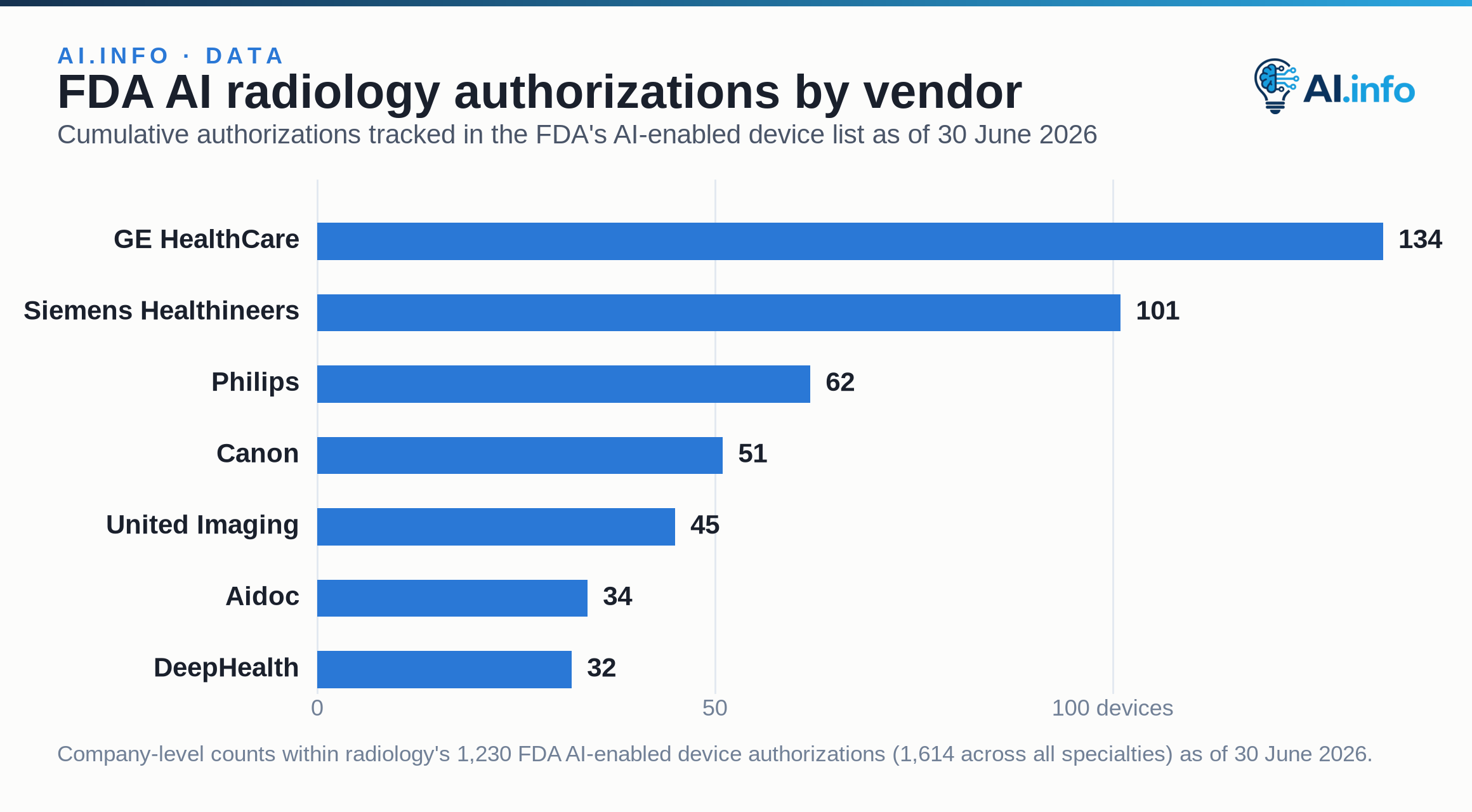
Market share within that radiology count is concentrated: GE HealthCare leads with 134 authorizations, including acquisitions such as Bay Labs and Caption Health, followed by Siemens Healthineers at 101, Philips at 62, Canon at 51, United Imaging at 45, Aidoc at 34, and DeepHealth at 32. Almost every one of those historical clearances covers detection or triage — a flag, a measurement, a worklist reprioritization. First Read and Cognita CXR would be among the first authorized devices, if cleared, to generate report language itself rather than annotate someone else's.
That inventory has been compounding for three decades, and the pace is holding rather than slowing: the FDA authorized 89 AI-enabled devices in the second quarter of 2026, a shade below the 92 it cleared in the first, and 66 of the 89 — 74% — were radiology devices, close to the 75% radiology share of the first quarter. Almost none of that recent growth involves generative report writing yet — it is still dominated by narrower detection and triage tools of the kind that built radiology's 76% share in the first place. First Read and Cognita CXR sit outside that count entirely for now, listed only as Breakthrough Devices, not as authorized products a hospital can buy.
| Snapshot | AI-enabled device count |
|---|---|
| Prior autumn snapshot | 1,356 |
| End of 2025 | 1,451 |
| End of Q1 2026 | 1,524 |
| 30 June 2026 | 1,614 |
Decision Support or Autonomy? Where the FDA Actually Draws the Line
The Breakthrough Device program does not require proof of superhuman accuracy — it requires that a device address an unmet need for a serious condition and show reasonable expectation of more effective diagnosis or treatment. That is a lower bar than final clearance, and both Aidoc and Cognita are careful to describe their tools as staying inside the decision-support boundary: a radiologist reviews, edits, and signs every draft before it becomes part of the medical record.
But drafting full report text is a qualitatively different kind of assistance than flagging a nodule. A flagged finding asks a radiologist to look harder at one region; a drafted report asks a radiologist to verify, correct, or overrule dozens of stated findings and their implied clinical significance in one pass — a task closer to editing than to interpreting. Lookstein's caveat about clinically reliable, thoughtfully integrated deployment is the industry's implicit acknowledgment that the line between decision support and autonomy gets thinner every time an AI's output looks more like a finished clinical document and less like an annotation on someone else's image.
The Accuracy Bar Autonomy Will Demand
Aidoc's own January 2026 clearance for body CT triage offers the clearest public benchmark yet of what regulators will accept for high-stakes automated interpretation. On January 21, 2026, the FDA cleared Aidoc's CARE foundation-model-based triage tool to flag 14 acute conditions — including aortic dissection, appendicitis, bowel obstruction, spleen injury, kidney injury, and pelvic fracture — from a single body CT scan in one unified workflow, combining 11 newly cleared indications with three the company already held.
The pivotal study behind that clearance reported mean sensitivity of 97% and mean specificity of 98% across the 14 conditions, which Aidoc describes as the first FDA clearance of a comprehensive, double-digit set of acute indications powered by a single foundation model.
That is a triage clearance, not a report-writing one — the CT tool still flags cases for urgent review rather than drafting findings language. But it sets the accuracy floor the industry will be measured against as generative report-drafting tools move from Breakthrough Device status toward actual clearance applications.
A flagging tool needed 97% sensitivity and 98% specificity to earn FDA sign-off on life-threatening findings; a tool that drafts an entire report a radiologist might sign with only light edits will need evidence at least that strong, replicated outside the vendor's own validation set, before the FDA treats generative drafting as more than a fast-tracked experiment. Aidoc and Mosaic Clinical Technologies have both said they intend to pursue full clearance applications for their generative tools, and neither had disclosed a filing date by mid-September 2026.