AI.info
Um debate além das fronteiras
Quem respondeu à ordem de substituir “Inteligência Artificial” por “Superinteligência”: pesquisadores, governos, juristas e a imprensa, críticos e apoiadores, cada um com a data e um link para onde…
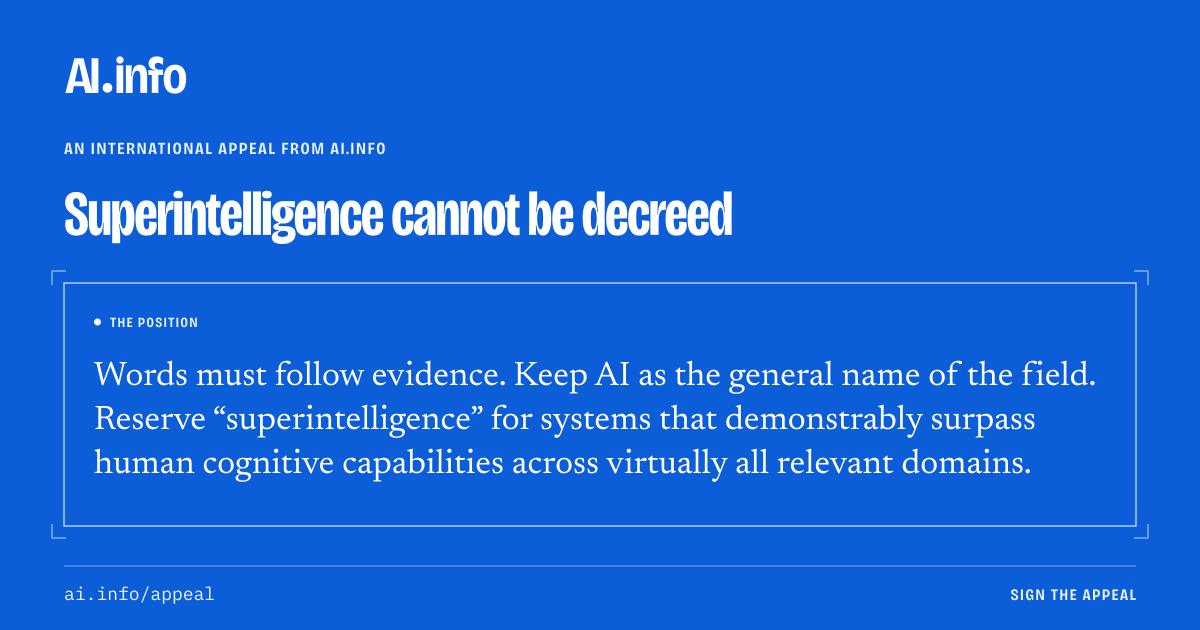
Em 22 de setembro de 2026, o presidente Trump apresentou o novo nome na Assembleia Geral da ONU; em 29 de setembro, uma ordem executiva determinou que as agências federais dos Estados Unidos escrevessem “Superinteligência” onde escreviam “Inteligência Artificial”. Em 8 de outubro, o presidente chamou de “THE ENEMY!” quem mantiver o nome antigo. Pesquisadores, governos, juristas e a imprensa responderam: críticos, apoiadores e quem está no meio. Aqui está o que disseram, cada posição com sua data e um link para onde foi dita.
85 posições · 18 países · 22 de set. de 2026 – 14 de out. de 2026
Documentação, não endosso: cada posição é de seu autor e não implica apoio ao apelo publicado pelo AI.info.
Pesquisadores e acadêmicos
26
David Krueger
CríticaAI professor and founder of the AI risk advocacy nonprofit Evitable · Canada
Krueger wrote on X that Trump is right that AI is not “fake”, but that “superintelligence” already names a hypothetical future AI that vastly exceeds human intelligence. He said the rebrand will make it harder to explain what superintelligence is and why it is dangerous.
“This attempted rebrand will make it harder to explain what superintelligence is and why it's dangerous.”
Onde foi ditoX (@DavidSKrueger)
Também noticiado porThe San Francisco Standard
Ben Leong
MistaComputer science lecturer, National University of Singapore · Singapore
Leong told the BBC his guess is that professionals will keep “SI” for a higher level of AI rather than use it for today’s AI, which he said does not yet feel like it is at that level.
“My guess is that professionals will want to save 'SI' for a higher level of AI, not so much to describe AI today. It doesn't feel like it's at that level yet.”
Onde foi ditoBBC News
Também noticiado porForbes IndiaYonhap News TV
Emanuela Girardi
CríticaPresident of Adra (AI, Data and Robotics Association) · Italy
Girardi told Corriere della Sera that, by definitions everyone accepts, superintelligence is not even on the horizon, and that calling today’s systems “super intelligence” is misleading because researchers use the term for a much bigger leap that may never come.
“La superintelligenza, nelle definizioni accettate da tutti, non è neanche all'orizzonte. Chiamare "super intelligence" i sistemi di oggi è quindi assolutamente fuorviante: è un termine che i ricercatori usano per un salto molto più grande, che potrebbe non arrivare mai”
Tradução do AI.infoSuperintelligence, by the definitions everyone accepts, is not even on the horizon. Calling today’s systems “super intelligence” is therefore utterly misleading: it is a term researchers use for a much bigger leap, one that may never come Onde foi ditoCorriere della Sera
Também noticiado porRadio Activa
Federico Cabitza
CríticaAssociate professor of Human-Computer Interaction and Decision Support, University of Milano-Bicocca · Italy
Cabitza told Corriere della Sera that the expression “artificial intelligence” is by now overused, so Trump coins a new term that is not new at all. He said today’s AI, however powerful, cannot be called superintelligence in the original sense of the term, and that the idea risks creating some confusion.
“L’intelligenza artificiale attuale, per quanto sia certamente molto potente, non può essere definita superintelligenza nel senso originario del termine.”
Tradução do AI.infoToday’s artificial intelligence, however powerful it certainly is, cannot be called superintelligence in the original sense of the term. Onde foi ditoCorriere della Sera
Kokil Jaidka
CríticaComputer scientist · Singapore
Jaidka told the BBC that not all AI platforms today exude super intelligence, and that the new name borrows the prestige of a term researchers reserve for a much bigger leap.
“borrows the prestige of a term researchers reserve for a much bigger leap”
Onde foi ditoBBC News
Simon Coghlan
CríticaDigital ethics lecturer, The University of Melbourne · Australia
Coghlan told the BBC the rebranding is “misleading” because super intelligence typically refers to a system able to improve by itself, and said he doubts “SI” will stick.
“I doubt 'SI' will stick, in part because it exaggerates the current capacities of AI”
Onde foi ditoBBC News
Também noticiado porThe Week USForbes IndiaYonhap News TV
Walter Quattrociocchi
CríticaFull professor of Computer Science, Sapienza University of Rome · Italy
In an article he wrote for Corriere della Sera, Quattrociocchi argues that calling the technology “Super Intelligence” suggests a hierarchy in which the user is consulting something cognitively superior, and that Trump’s proposal takes to caricature an industry habit of turning functional descriptions into cognitive categories and cognitive categories into marketing tools. He writes that a name is not a theory.
“«Artificial Intelligence» lasciava almeno uno spazio alla domanda; «Super Intelligence» incorpora già la risposta.”
Tradução do AI.info“Artificial Intelligence” at least left some room for the question; “Super Intelligence” already contains the answer. Onde foi ditoCorriere della Sera
Jean-Pierre Dubé
CríticaMarketing professor, University of Chicago · United States
Dubé told Newsweek the rebrand seems unlikely to take off unless tech leaders adopt the term, because “super intelligence” already has a specific meaning in tech, and that using the new term seems premature.
“[I]t seems unlikely the re-branding will take off unless tech leaders adopt the term”
Onde foi ditoNewsweek
Também noticiado porThe Next WebAFP (Yahoo News)
Susan Fournier
CríticaBoston University professor and dean emeritus · United States
Fournier told Newsweek that “super intelligence” is perhaps a worse label for controlling negative associations, because it implies intelligence beyond what humans can deliver and so more threatening and unpredictable. She said that for those in the know the term heightens sci-fi fears and makes safety regulation harder to imagine, and that she would bet on the tech industry winning this label war.
“Is super intelligence a better construct label to control these negative associations? It is perhaps worse. “Super intelligence” implies heightened intelligence beyond what we can deliver as humans: intelligence superior in scale and power and thereby more threatening, more unpredictable”
Onde foi ditoNewsweek
Também noticiado porBoston University
Junya Morita
CríticaProfessor, Department of Behavior Informatics, Faculty of Informatics, Shizuoka University · Japan
In a post on his note blog, Morita, who says he writes from the standpoint of cognitive science and AI research and not to support or criticise any politician, calls the renaming “interesting, but risky”. He argues that “Artificial Intelligence” at least keeps in the name the mark of “something made by humans”, while “Superintelligence” builds in from the start a story of an intelligence beyond humans, and concludes there is no need to call it “superintelligence”.
“Artificial Intelligence であれば、少なくとも「人間が作ったもの」という印が名前の中に残っている。しかし、Superintelligence になると、その人工物が「人間を超えた知能」であるかのような物語が最初から組み込まれてしまう。”
Tradução do AI.infoWith “Artificial Intelligence”, at least the mark of “something made by humans” remains in the name. But with “Superintelligence”, a story in which that artifact is “an intelligence beyond humans” is built in from the start. Onde foi ditonote (Junya Morita)
Pedro Domingos
CríticaProfessor of computer science, University of Washington · United States
Domingos told DW that most AI is not superintelligence but “different intelligence”, so calling it superintelligence is misleading. He said the new name feeds fears of AI and that for US labs it amounts to marketing.
“AI is doing different things from what humans do, so calling it superintelligence is misleading.”
Onde foi ditoDW
Também noticiado porThe Week US
Nick Bostrom
Críticaphilosopher who popularized the term superintelligence in an eponymous book · Sweden
Bostrom told WIRED in an email that superintelligence “refers specifically to systems that greatly surpass all the best human brains”, while “AI” has covered a much broader category, from spam filters and spell checkers to the chess engines of the 1970s, and that it seems awkward to call these “superintelligent”.
“‘AI’ has referred to a much broader category of systems, which includes, for example, email spam filters, spell checkers, simple navigation systems, early LLMs, and the chess engines of the ’70s that didn’t yet match the best human chess players.”
Onde foi ditoWIRED
Kathleen Hall Jamieson
NeutraCommunications professor at the University of Pennsylvania and director emerita of the Annenberg Public Policy Center · United States
Jamieson told Axios that AI is a contentious issue working against Trump because his position is unpopular, but that it is so pervasive that attaching positive rather than negative affect to it would accomplish something. In a passage on Trump’s punitive response to those who do not use his preferred language, Axios quotes her as saying that he may be adding a controversial function to the presidency: “namer-in-chief”.
“But AI … is so pervasive right now in the news environment and the anxieties of the culture that if you can attach positive affect to it as opposed to negative affect to it, you've accomplished something.”
Onde foi ditoAxios
Também noticiado porAskanews
Baobao Zhang
CríticaSyracuse University associate professor who studies the politics of AI · United States
Zhang told PolitiFact that getting the definition right matters for any attempt to regulate the technology, and that AI systems outside the definitions could still cause a lot of harm, including catastrophic harm. According to PolitiFact, she said super intelligence would be a misleading descriptor both for general-purpose AI and for narrower systems such as self-driving cars or AI that diagnoses medical problems.
“It’s really important that we get our definition right with any attempts at regulating this very fast-moving technology”
Onde foi ditoPolitiFact
Também noticiado porAskanews
Nature
MistaScientific journal (news explainer by Jenna Ahart) · United Kingdom
A Nature news explainer says researchers used “superintelligence” for hypothetical, highly capable technologies long before the order, and that by most researchers’ definitions it is still an aspirational category. It quotes Melanie Mitchell (Santa Fe Institute), who says the terms have no rigorous meaning, and Brookings’ Darrell West, who calls the hope that a new name will improve public acceptance “fanciful thinking”.
“But researchers were using the term superintelligence to refer to hypothetical, highly capable technologies long before the executive order.”
Onde foi ditoNature
Também noticiado porCrossref (DOI record)
Sylvia Sierra
CríticaLinguist and Associate Professor of Communication and Rhetorical Studies at Syracuse University · United States
Sierra told TheStreet she does not believe the “Superintelligence” term will last in the way Trump and tech executives are using it, because language changes imposed from the top, like “Freedom Fries”, tend not to stick. She said it might gain some traction temporarily but will probably not outlast Trump’s final term, and that this kind of simplified and extreme language casts some things as good and others as bad, removing nuance.
“Language change tends to take root when it's a bottom-up process, rather than a top-down process — people in power telling others how to use language tends not to stick.”
Onde foi ditoTheStreet (via Yahoo Finance)
Também noticiado porAskanews
Thomas Haigh
MistaUniversity of Wisconsin-Milwaukee professor and historian of computing and information technology · United States
Haigh told PolitiFact that people are more fearful than excited about AI and that rebranding it as superintelligence is unlikely to reassure them.
“Rebranding it to superintelligence is unlikely to reassure them.”
Onde foi ditoPolitiFact
Também noticiado porAskanews
Emily M. Bender
CríticaProfessor in computational linguistics · United States
Bender told CNET, for a commentary by senior editor Laura Michelle Davis, that languages belong to their communities and that, when there is a push for a change in language, linguists always find it important to ask what it is for: whether it serves propaganda or nationalism, or genuinely helps people understand better or show respect. She also said “intelligence” is a deeply flawed word because of its historical roots in race science and eugenics. Sharing the piece on Bluesky the same day, she wrote that it depends on why and how the pressure for change is applied.
“Languages belong to their communities”
Onde foi ditoCNET
Também noticiado porBluesky (Emily M. Bender)
Naomi Susan Baron
CríticaLinguist and author of the book Reader Bot: What Happens When AI Reads and Why It Matters · United States
Baron told CNET, for a commentary by senior editor Laura Michelle Davis, that the term “super intelligence” is meant to put a positive spin on AI, a redefining that is “Pollyannish and dangerous”, and that there is a clear ideological component which has somewhat of a tradition in the United States.
“Pollyannish and dangerous”
Onde foi ditoCNET
Hung-yi Lee (李宏毅)
MistaProfessor, Department of Electrical Engineering, National Taiwan University · Taiwan
Quoted by Taiwan’s Economic Daily News, Lee said that he could not make out any particular significance in going from AI to SI, only a change of name, and that AI development will not really slow down.
“從AI到SI,聽不出來有什麼特別的意義,只是名字改變了。”
Tradução do AI.infoFrom AI to SI, you can’t hear any particular meaning in it; only the name has changed. Onde foi ditoEconomic Daily News
Lee Rainie
MistaDirector of the Imagining the Digital Future Center, Elon University · United States
In a digital interview with The Center Square, Rainie said he is not sure rebranding AI as “super intelligence” will move the needle on the public’s views. He said his center’s recent surveys show growing public apprehension about AI, from job loss to the construction of data centers, while many people report good results from using it: “a very mixed and fluid picture”.
“I’m not sure rebranding AI as ‘super intelligence’ will move the needle on the public’s views.”
Onde foi ditoThe Center Square
Meredith Broussard
CríticaProfessor at New York University’s Arthur L. Carter Journalism Institute and author of Artificial Unintelligence: How Computers Misunderstand the World · United States
Quoted in a Fast Company article by Chris Stokel-Walker on the rebrand, Broussard says it is extremely misleading to call the technology “intelligence” because it makes people think there is a brain inside the machine; according to the article, she adds that “super” makes it sound like a superhero, which becomes worrying. She suggests “calculating machine” as an accurate name and says any new name has to be firmly attached to reality.
“Any new name has to be firmly attached to reality.”
Onde foi ditoFast Company
Sima Yazdani
MistaFounder, MagiqCircle LLC; graduate student, ASU College of Health Solutions · United States
In an essay published by the Free Iran Scholars Network, Yazdani notes that Section 3 of the order defines “Super Intelligence” as the technologies already covered by the statutory definition of artificial intelligence (“the same machines, under a grander name”), and that within 60 days the President’s science adviser must propose a federal definition. The essay proposes five conditions any such definition should carry, so that the claims made for a system can be checked.
“Renaming a technology does not change what it can do, but it can change what gets examined.”
Onde foi ditoFree Iran Scholars Network
Tony Thorne
CríticaLexicologist at King’s College London · United Kingdom
Quoted in a Fast Company article by Chris Stokel-Walker, Thorne says the vagueness of the term “AI” has helped the industry thrive and the technology survive, describes Trump’s alternative term as “boosterist” and “triumphalist”, and says that usage, not regulation, decides whether a word is taken up and survives. He would prefer something like “cognitive computing agent” (CCA).
“Usage, not regulation, decides a word’s take-up and survival”
Onde foi ditoFast Company
Lekshmi MK
MistaResearch assistant, National Institute of Advanced Studies (NIAS), Bengaluru · India
In NIAS’s weekly review The World This Week, Lekshmi MK writes that renaming AI as “Super Intelligence” is Trump’s attempt to reshape the political narrative around advanced AI, and that its significance will depend on whether it is accompanied by concrete investments, research advances and effective policies.
“However, a change in terminology does not itself demonstrate a technological advantage over China.”
Onde foi ditoNIAS · The World This Week
Geoffrey Hinton
CríticaComputer scientist, 2024 Nobel laureate in Physics, professor emeritus at the University of Toronto · Canada
In an interview with Leyland Cecco for the Guardian, Hinton said Trump’s use of “superintelligence” proves he understands “almost nothing” about AI: he has taken a technical term with a very clear meaning, smarter than people, in use for at least 20 years, and reused it for AI as a whole. In the same interview he rejected letting AI companies regulate themselves, comparing it to tobacco companies designing the warnings on their own packets.
“You can’t make it smarter than people just by calling it smarter than people.”
Onde foi ditoThe Guardian
Governos e instituições
8
Evan Solomon
MistaMinister of Artificial Intelligence and Digital Innovation (Canada) · Canada
According to The Canadian Press, Solomon declined to comment on Trump’s UN statement that he would change the term from “artificial intelligence” to “super intelligence”, saying that Canadians are not enthusiastic about renaming things and that the substance is what they care about.
“Canadians are not enthusiastic at all about renaming things, so let me leave that aside. It’s the substance that I think Canadians care about”
Onde foi ditoThe Canadian Press (CP24)
Também noticiado porImplicator.ai
Michael Kratsios
A favorAssistant to the President and Director of the White House Office of Science and Technology Policy · United States
Speaking for the United States at a UN Security Council meeting on artificial intelligence and international security, the day after Trump announced the new name at the General Assembly, Kratsios introduced the technology as “superintelligence, formerly known as AI” and used “superintelligence” throughout his statement, which rejected global governance of the technology.
“the most consequential technological development of our time – superintelligence, formerly known as AI”
Onde foi ditoUS Mission to the United Nations
Também noticiado porThe Next WebAnadolu Agency
Ministry of Foreign Affairs of China
NeutraSpokesperson’s answer to a reporter’s question, published by the ministry · China
Asked about the US readout of Xi Jinping’s state visit, which used “super intelligence” instead of “artificial intelligence”, the ministry’s spokesperson said that China attaches importance to the US position and respects its choice of term, and that, as the technology keeps developing, the parties can step up exchanges to seek consensus. The statement does not say whether China will use the term.
“关于人工智能表述问题,中方重视美方的立场,也尊重美方的提法。”
Tradução do AI.infoOn what term to use for artificial intelligence, China attaches importance to the position of the U.S. side and respects their choice of the term. Onde foi ditoMinistry of Foreign Affairs of China
Também noticiado porAFP (Gulf News)HK01
Mark R. Warner
CríticaU.S. Senator (D-VA), Vice Chairman of the Senate Select Committee on Intelligence · United States
In a statement on the executive order, Warner says that while the companies building the most powerful AI systems warn that the technology is outpacing safeguards, the president’s response is to rename it and tell the companies developing it to regulate themselves, and that changing what it is called does nothing to address the risks of increasingly powerful AI systems. He points to his bill requiring testing and evaluation of the most advanced systems.
“The president’s response? To rename it and tell the companies developing it to regulate themselves. But changing what we call artificial intelligence does nothing to address the very real risks that come with increasingly powerful AI systems.”
Onde foi ditoOffice of Senator Mark R. Warner
Também noticiado porFalls Church News-Press
The White House
A favorFact sheet issued with the executive order · United States
In the fact sheet issued with the order, the White House says the United States is the world leader in the technology and that the federal government should use a name that reflects its “full promise and opportunity”, arguing that “Super Intelligence” conveys capabilities beyond the imitation or automation of human intelligence implied by “Artificial Intelligence”.
“The name Super Intelligence conveys the true capabilities of the technologies being developed today, unlocking new forms of human creativity and empowering Americans to achieve what was previously impossible—not simply imitating or automating human intelligence as is implied by the term “Artificial Intelligence.””
Onde foi ditoThe White House
Também noticiado porAnadolu Agency (Bernama)Wiley Rein (Mondaq)
Gavin Newsom
CríticaGovernor of California · United States
Newsom signed Executive Order N-10-26, which directs the California agencies and departments under his authority to keep referring to the technology as “Artificial Intelligence” and “AI”, notwithstanding any rebranded terminology used by the federal government, unless inconsistent with the law. The order’s preamble says that purporting to change something’s name cannot distract from what it calls a failure to act on the documented safety and security risks of AI.
“Super intelligence is clearly not coming from the White House – that’s why California continues to lead.”
Onde foi ditoOffice of the Governor of California
Também noticiado porThe NationalThe Daily BeastInternational Business Times UK
Sanae Takaichi
MistaPrime Minister of Japan · Japan
Asked in the House of Representatives by Democratic Party for the People leader Yuichiro Tamaki whether she agreed with Trump that AI should be called “SI”, Takaichi said that “AI” is the common term in Japan, starting with government documents and academic papers, and that replacing it everywhere with “SI” right away would be difficult. She said Japan would assess whether a change is needed in light of international usage and other governments’ responses, but that for now it is AI.
“AIの呼称につきましては、我が国では政府文書や学術論文をはじめ、AIという呼称が一般的であり、すぐにすべてをSIという呼称に置き換えることは難しいと考えます”
Tradução do AI.infoAs for the name AI, in our country the term AI is the common one, beginning with government documents and academic papers, and I think it would be difficult to replace it all at once with the term SI. Onde foi ditoHouse of Representatives of Japan (video)
Também noticiado porTV Asahi (ANN)Sankei ShimbunKyodo News
Bruno Rodríguez Parrilla
CríticaForeign Minister of Cuba · Cuba
Rodríguez wrote on X that the US government, no longer satisfied with military aggression, blockades and changing geographical names, is now trying to impose a new technical name for artificial intelligence through new threats and blackmail. He said it is seeking a legacy that will be remembered for barbarism, ignorance and chaos.
“Ahora intentan imponer un nuevo nombre técnico a la #InteligenciaArtificial a golpe de nuevas amenazas y chantajes, buscando un legado que será recordado por la barbarie, la incultura y el caos.”
Tradução do AI.infoNow they are trying to impose a new technical name on #ArtificialIntelligence through new threats and blackmail, seeking a legacy that will be remembered for barbarism, ignorance and chaos. Onde foi ditoX (@BrunoRguezP)
Também noticiado porCiberCuba
Depois de “THE ENEMY!”
15
Adam Keiper
CríticaExecutive editor, The Bulwark; cofounder of The New Atlantis · United States
Sharing a screenshot of Trump’s post, Keiper wrote on Bluesky that pushing the term “super intelligence” is stupid for many reasons, not least because “superintelligence” already had a specific meaning in semi-technical and policy or philosophical discussions about AI, and that Trump’s bullying about it is now reaching an Orwellian pitch.
“Trump's pushing the term "super intelligence" is stupid for many reasons (not least because "superintelligence" was already a term with a specific meaning in semi-technical and policy/philosophical discussions about AI). But now his bullying about it is reaching an Orwellian pitch.”
Onde foi ditoBluesky (@adamkeiper.com)
Donald J. Trump
A favorPresident of the United States · United States
Trump wrote on Truth Social that the White House considers anyone who uses the term “Artificial Intelligence” instead of “Super Intelligence” “THE ENEMY!”. The post did not say what consequences, if any, would follow.
“The White House considers anyone that uses the term, “Artificial Intelligence,” as opposed to the highly accepted new and more accurate term, “Super Intelligence,” THE ENEMY!”
Onde foi ditoTruth Social
Também noticiado porTrump’s Truth (archive)Arab News (AFP)Axios
Eliot Higgins
CríticaFounder and creative director of Bellingcat · United Kingdom
Posting a screenshot of Trump’s statement, Higgins wrote on Bluesky that the phrase is used to identify those loyal to the in-group and the members of the out-group who need to be targeted and attacked.
“It's because the phrase is used to identify those loyal to the in-group, and identify those members of the out-group who need to be targeted and attacked.”
Onde foi ditoBluesky (@eliothiggins.bsky.social)
Jacob T. Levy
CríticaTomlinson Professor of Political Theory, McGill · Canada
Posting a screenshot of Trump’s statement, Levy wrote on Bluesky that he remembers a decade-long panic about undergraduates, activists or Tumblr pages declaring new language rules and denouncing people for violating them.
“I remember a decade-long panic about undergraduates, activists, or Tumblr pages declaring new language rules and denouncing people for violating them.”
Onde foi ditoBluesky (@jacobtlevy.bsky.social)
James E. Clyburn
CríticaMember of Congress for South Carolina’s 6th District · United States
Quoting a post that reported Trump’s statement, Clyburn set what Americans worry about, electricity bills driven up by data centers and jobs threatened by AI, against Trump’s answer: “If you don’t call AI Super Intelligence, you are the enemy!”
“Americans: I’m worried about data centers driving up my electricity bills and AI threatening my job security. Trump: If you don’t call AI Super Intelligence, you are the enemy!”
Onde foi ditoX (@RepJamesClyburn)
Michael McFaul
CríticaProfessor of political science, Stanford University; US ambassador to Russia, 2012–2014 · United States
McFaul wrote on X that calling people “THE ENEMY” for exercising their First Amendment rights is deeply disturbing and is what autocratic leaders do, and that doing so “for such a trivial, vain matter is just nutty”. He added that many AI models still make mistakes and that no one should call their output “super intelligence” yet.
“Calling people "THE ENEMY" for exercising their First Amendment rights is deeply disturbing. That's what autocratic leaders do, not American leaders.”
Onde foi ditoX (@McFaul)
Também noticiado porHuffPost
Scott Kupor
A favorOffice of Personnel Management Director; Vice Chair, Super Intelligence Force · United States
Asked by Jake Tapper on CNN’s The Lead whether using the term artificial intelligence made him an enemy, Kupor replied that he could not protect him and that “SI is the new word”. Asked whether there would be any punishment, he said he did not know and that Tapper would have to ask the president.
“I can't protect you, you know. But yes, SI is the new word.”
Onde foi ditoCNN, The Lead with Jake Tapper (transcript)
Também noticiado porBreitbart News
Ted Lieu
CríticaMember of Congress · United States
In a post on X quoting a Punchbowl News reporter’s post about Trump’s statement, Lieu listed rising gas and diesel prices and AI companies losing control of their models and agents, asked what Trump is focused on and answered “Renaming stuff”, adding “November is coming.”
“-Gas prices skyrocketed. -Diesel prices skyrocketed. -AI companies lost control of their models and agents. What is trump focused on? Renaming stuff. November is coming.”
Onde foi ditoX (@tedlieu)
Também noticiado porThe Poke
Andreas Proschofsky
CríticaJournalist, Der Standard (Web section) · Austria
Writing in Der Standard about the “THE ENEMY!” post, Proschofsky says the tech industry’s response has become a kind of litmus test of how subservient individual companies are willing to be, and suggests that Trump most likely picked up the term from the AI-hype maximalists around him and took it out of context to play the visionary.
“Im Zweifelsfall hat er diesen Begriff einfach in seinem an KI-Hype-Maximalisten nicht armen Umfeld aufgeschnappt – und dann für seine Zwecke entkontextualisiert, um einmal mehr die Rolle als Vordenker zu imitieren.”
Tradução do AI.infoMost likely he simply picked up the term in his circle, which has no shortage of AI-hype maximalists – and then stripped it of its context for his own purposes, to imitate once again the role of a visionary. Onde foi ditoDer Standard
Também noticiado porDer Standard, 11 Oct 2026
Eugene Volokh
CríticaThomas M. Siebel Senior Fellow at the Hoover Institution at Stanford, and the Gary T. Schwartz Distinguished Professor of Law Emeritus and Distinguished Research Professor at UCLA School of Law · United States
In a post on The Volokh Conspiracy at Reason titled ‘I Am Now “THE ENEMY!” (as Is Everyone Who Uses the Term “Artificial Intelligence”)’, Volokh linked and reproduced Trump’s post and asked what it is supposed to mean and whether it is “just self-parody”.
“What is this even supposed to mean? […] Is it just self-parody?”
Onde foi ditoReason (The Volokh Conspiracy)
John Moravec
CríticaEducation futurist; founder and principal of Education Futures · United States
In an essay on disinformation and democratic power, Moravec wrote that the executive order establishes a preferred designation without demonstrating a change in capability, and that declaring citizens enemies for refusing a leader’s vocabulary uses the language of totalitarian conformity and turns a choice of terminology into a test of allegiance.
“Declaring citizens enemies for refusing a leader’s vocabulary uses the language of totalitarian conformity. It turns a choice of terminology into a test of allegiance and casts dissenters, including fellow citizens, as people outside legitimate public discussion.”
Onde foi ditoEducation Futures
Steve Benen
CríticaProducer for “The Rachel Maddow Show,” editor of MaddowBlog and MS NOW political contributor · United States
Benen wrote on MaddowBlog that the more Trump tries to impose his linguistic preferences on the public, the closer he comes to Orwell’s “newspeak”, and that it is easy to imagine Big Brother declaring those who resist it “the enemy”. He listed earlier administration language rules and wrote that those on the right who once decried “speech codes” and “language rules” have gone quiet.
“While social media didn’t exist in the world Orwell described, it’s easy to imagine Big Brother publishing a missive that declares those who resist “newspeak” as “the enemy.””
Onde foi ditoMS NOW (MaddowBlog)
Craig Grannell
CríticaRegular contributor to Stuff magazine and Stuff.tv · United Kingdom
In a column for Stuff, Grannell wrote that he will keep saying artificial intelligence until the AI around him is consistently super rather than so often wasteful, irritating, obtrusive and objectively wrong, and that if that makes him ‘the enemy’, so be it. He said he is not an anti-AI zealot but that the way AI is being foisted on everyone strikes him as anything but super.
“So until the AI that surrounds me really is consistently super, rather than so often wasteful, irritating, obtrusive and objectively wrong, I’m sticking with the old term. And if that makes me ‘the enemy’, so be it.”
Onde foi ditoStuff
William Keenan
CríticaMiddle East Analyst (blogger, The Times of Israel); former counterterrorism analyst at the Pentagon · United States
In a post on The Times of Israel’s blogs, Keenan wrote that a government can choose a preferred term for official communications but cannot settle a scientific question by changing a label, and that the absence of an announced punishment does not remove the potential chilling effect of calling people enemies. He concluded that a president should be able to advocate for a technology without demanding rhetorical loyalty to it.
“Calling critics enemies does not settle the scientific debate, build public trust, or make the technology safer.”
Onde foi ditoThe Times of Israel (blogs)
Alessio Jacona
CríticaJournalist and technology commentator · Italy
In a video on LinkedIn, Jacona introduces himself as an enemy of the White House, since that is what Trump calls everyone who will not call AI “super intelligence”, and calls the renaming a classic rebranding meant to change how users perceive the product. He links it to Big Tech’s failure to manage AI’s risks and to data-centre investments that do not add up.
“un’iniziativa che non cambia la sostanza dei problemi, ma anzi contribuisce a evidenziarli”
Tradução do AI.infoan initiative that does not change the substance of the problems, but rather helps to highlight them Onde foi ditoLinkedIn (Alessio Jacona)
A imprensa e o debate público
36
Lance Ulanoff
CríticaEditor At Large, TechRadar · United States
Writing on the day of the UN speech, Ulanoff calls the new name inaccurate, notes that super intelligence already names something further down the line that far exceeds human cognition, and says he hopes the AI industry and those covering AI reject the proposal and focus instead on the more existential AI problem and on Trump’s declaration that he will encourage the technology, not rein it in.
“But it's also inaccurate. AI is not super intelligence. It's not yet human intelligence with extra juice.”
Onde foi ditoTechRadar
Subimal Bhattacharjee
Mistadefence and tech policy adviser and author of The Digital Decades: On 30 Years of the Internet in India · India
Bhattacharjee argues in The Indian Express that the renaming is a rhetorical gesture that leaves AI’s underlying realities unchanged, and calls for an international AI regime in which a limited set of safety provisions is mandatory from the outset.
“A change of name does not change the substance.”
Onde foi ditoThe Indian Express
Marjorie Taylor Greene
CríticaFormer Congresswoman of Georgia’s 14th District · United States
Sharing a screenshot of Trump’s Truth Social post saying Xi seemed to like calling AI “SUPER INTELLIGENCE”, Greene wrote on X that changing the name will not make people support data centers built where they live, citing their water use and round-the-clock noise.
“Changing the name Artificial Intelligence to “Super” Intelligence is not going to all of a sudden make people support data centers built where they live sucking up their water and making 24/7 noise.”
Onde foi ditoX (@FmrRepMTG)
Também noticiado porBenzinga (TradingView)
Amber Sinha
CríticaContributing editor at Tech Policy Press; Executive Director of European Digital Rights (EDRi) · Belgium
Opening with Trump’s UN case for rebranding frontier AI as “super intelligence”, Sinha writes that both AI hype and AI panic trap us in a world of “broken metaphors” that distort public understanding and policy, and argues for treating AI as normal technology and regulating its present harms.
“The terms we use to describe computational systems do not merely reflect their technical capabilities; they actively distort our cognitive understanding, misdirect public concern, and derail legal and policy frameworks.”
Onde foi ditoTech Policy Press
Jeffrey Blehar
CríticaNational Review staff writer · United States
Blehar writes in National Review’s The Corner, on the day Trump was due to sign the order, that “officially” renaming a term coined as part of common usage “means nothing”; he calls it a useless Trump “vanity gesture” and predicts that Trump will have even less success in shifting the American vernacular than the French have had with the Académie française.
“It means nothing, of course — the quintessentially useless Trump “vanity gesture,” like renaming the Gulf of Mexico or Lake Ontario for attention.”
Onde foi ditoNational Review (The Corner)
Margaret Hartmann
CríticaSenior Editor, Intelligencer (New York Magazine) · United States
In a signed explainer, Hartmann calls the switch Trump’s “dopey renaming ploy”, a plan to shut down “AI doomerism” by changing the name, and notes that he cannot force people, foreign governments or private companies to stop saying “artificial intelligence”; comparing it with “Gulf of America” and “Lake America”, she doubts people will use it in everyday life.
“But now Trump has a plan to shut down all this AI doomerism: Simply change the name “artificial intelligence” to “super intelligence.””
Onde foi ditoNew York Magazine (Intelligencer)
Paul Krugman
CríticaProfessor, CUNY Grad Center, Nobel laureate and former columnist, NY Times · United States
In his newsletter, Krugman writes that Trump believes the public’s antipathy towards AI is a marketing problem he can solve by making everyone call it “super intelligence”, and argues that, given Trump’s approval ratings, his advocacy probably taints the technology further in Americans’ eyes.
“He believes that the public’s antipathy towards AI is just a marketing problem — and that he can solve that problem by forcing everyone to call it “super intelligence”.”
Onde foi ditoPaul Krugman (Substack)
Adam Kovacevich
CríticaCEO of the progressive tech industry coalition Chamber of Progress · United States
Kovacevich told POLITICO that the CEOs’ embrace of the term is a way to signal fealty to the president and that no one in the industry is about to start calling it superintelligence, comparing the name to “Gulf of America” and “Lake America”.
“No one in the industry is about to start calling it superintelligence. It’s like Gulf of America and Lake America. It’s something that only MAGA supplicants use.”
Onde foi ditoPOLITICO
Também noticiado porNTD
Adam Thierer
MistaSenior researcher on technology and innovation at the libertarian R Street Institute · United States
Quoted by POLITICO, Thierer said changing the terminology would be easier than conducting a comprehensive new study of AI, but cautioned that it could muddy the policy debate, because the term superintelligence means different things to different people and already had a general meaning in the literature on advanced AI.
“I think it adds some confusion to the ongoing policy discussion because the term superintelligence means different things to different people, but it already had a general meaning in the literature and debates about advanced AI”
Onde foi ditoPOLITICO
Daniel J. Flynn
CríticaSenior editor of The American Spectator · United States
Flynn, who writes that Trump “takes the correct and not the populist position on AI”, argues that the renaming is “a rebrand for a damaged label” that evokes the euphemism treadmill, and that ordinary people continue to say “artificial intelligence”, as they continue to say “Lake Ontario” and “Kennedy Center”.
“President Trump holds a long-sighted view on artificial intelligence. But his attempts to rewrite history and reorient speech through the stroke of a pen look small.”
Onde foi ditoThe American Spectator
Katie Notopoulos
MistaSenior correspondent at Business Insider, covering technology and culture · United States
In a signed column, Notopoulos writes that Trump is right that “Artificial Intelligence” is a bad name and that his instinct to rename it is “spot-on”, but calls “Super Intelligence” “a rare miss”: the problem, she argues, is not the word “artificial” but “intelligence”, which implies human thinking. She proposes “Robo Doodad”, or R.D., instead.
“Because the problem isn't the word "artificial" — it's "intelligence."”
Onde foi ditoBusiness Insider
Mike Pearl
CríticaNights and weekends editor at Gizmodo · United States
Pearl writes that words have meanings and that people obliged to phrase things accurately cannot replace “artificial intelligence”, the widely accepted term for a real technology, just because the president prefers another; he calls the rollout “an absolute farce”.
“those of us with at least somewhat of an obligation to phrase things accurately can’t just start replacing “artificial intelligence”—which is the widely accepted term for a real technology—with a new term simply because the President of the United States prefers it.”
Onde foi ditoGizmodo
Também noticiado porGizmodo, 12 Oct 2026
Pier Luigi Pisa
CríticaJournalist, la Repubblica (technology section) · Italy
Pisa writes that the change of name sells a power that does not yet exist, using for today’s AI a word that until now described mainly tomorrow’s; words set expectations, he argues, and here they promise a technology that cannot yet live up to its new name, so the White House’s hype reinforces the AI companies’ own.
“Ma le parole stabiliscono aspettative. Definiscono rapporti di forza. E in questo caso promettono anche una tecnologia che non può ancora tenere fede al suo nuovo nome. L’hype delle aziende IA viene così rafforzato da quello della Casa Bianca.”
Tradução do AI.infoBut words set expectations. They define power relations. And in this case they also promise a technology that cannot yet live up to its new name. The AI companies’ hype is thus reinforced by the White House’s. Onde foi ditola Repubblica
Jacob Weisberg
Críticaauthor of the recent book Profiles in Cowardice: A Study of Collaboration in the Trump Era · United States
Quoted by Steven Levy in WIRED, which reports that he views the renaming episode as a classic Trump loyalty test, Weisberg says the only way to resist “this kind of thing” is by acting collectively, and asks what Trump would have done had the executives accepted the self-regulation terms but rejected the name change.
“The only way to resist this kind of thing is by acting collectively”
Onde foi ditoWIRED
Steven Levy
CríticaEditor at Large, WIRED · United States
Levy writes in WIRED’s Backchannel newsletter that “the lords of AI meekly acquiesced” to a name change that, from a scientific perspective, makes no sense; he calls the episode a loyalty test and argues that the executives’ failure to push back casts doubt on the self-regulation agreement they obtained.
“To their shame, the lords of AI meekly acquiesced.”
Onde foi ditoWIRED
Elon Musk
A favorSpaceX CEO · United States
Musk wrote on X that “SI” is better than “AI”, and replied “Yes, we will make that change” when a user asked whether SpaceXAI would be renamed SpaceXSI.
“No more AI SI It’s better”
Onde foi ditoX (@elonmusk)
Também noticiado porReuters (The Star)Forbes
Mélissa Canseliet
CríticaExpert in neuroscience and cyberpsychology; author of the book Génération écrans · Canada
In an opinion piece in La Presse, Canseliet argues that “artificial” is a clear and useful word because it reminds us we are dealing with a machine; dropping it humanises the machine and adding “super” places it above humans, which, she writes, encourages admiration and a race rather than regulation.
“Notre cerveau social a déjà tendance à attribuer des intentions à tout ce qui converse avec lui, alors retirer l’adjectif « artificielle », c’est humaniser davantage la machine. Et ajouter « super », c’est la situer au-dessus des humains.”
Tradução do AI.infoOur social brain already tends to attribute intentions to anything that converses with it, so removing the adjective “artificial” humanises the machine further. And adding “super” places it above humans. Onde foi ditoLa Presse (Montréal)
Sam Altman
MistaOpenAI CEO · United States
Altman told Politico’s Decoded that he considers “super intelligence” a more accurate term but doubts the public will find it “less scary”; he expects people to keep saying “AI” and ruled out renaming OpenAI to OpenSI.
“Brands are sticky”
Onde foi ditoPolitico, Decoded
Também noticiado porFast CompanyThe Verge
Jeff Bezos
A favorAmazon executive chairman · United States
Asked by Bret Baier on Fox News’ “Special Report” whether he is “into SI or AI”, Bezos said he likes SI because “artificial” is not flattering and “sort of means fake”.
“I do like SI, because artificial is not a very flattering thing”
Onde foi ditoFox News, “Special Report”
PolitiFact
Neutrafact-checking outlet (article by Loreben Tuquero) · United States
PolitiFact reports that the AI industry already uses “superintelligence” for AI that exceeds human cognition in nearly all fields and does not exist yet, which differs from the order’s definition; it quotes Syracuse University’s Baobao Zhang, who says it is important to get the definition right in any attempt to regulate the technology.
“There’s one issue: The AI industry already uses the term “superintelligence,” and it means something different than the government’s new definition. It’s a type of AI that doesn’t exist yet.”
Onde foi ditoPolitiFact
Também noticiado porThe Daily Wire
Gustavo Ghidini
CríticaJurist, columnist for Corriere della Sera · Italy
In a Corriere della Sera column on the missing rules for military uses of AI, Ghidini warns against dismissing the renaming as the whim of a self-absorbed politician: the message is that AI is American and that Washington decides its future, to the point of giving it a new name, while the gravest risks to human safety, from military uses, remain unregulated.
“Il messaggio è chiaro: l’Ai è americana, e siamo noi —anzi: io: ego — a deciderne il futuro.”
Tradução do AI.infoThe message is clear: AI is American, and it is we — or rather I, ego — who decide its future. Onde foi ditoCorriere della Sera
Jacob Aron
CríticaColumnist, New Scientist · United Kingdom
In a New Scientist column, Aron writes that Trump’s rebrand is an effort to cement US dominance in AI, that Trump’s “super intelligence” and Nick Bostrom’s superintelligence have distinct meanings worth preserving, and that superintelligence in Bostrom’s sense clearly has not been achieved.
“For me, Trump’s super intelligence and Bostrom’s superintelligence have distinct meanings that are worth preserving.”
Onde foi ditoNew Scientist
Joshua Keating
CríticaFreelance journalist; author of the 2018 book Invisible Countries · United States
In an analysis for Foreign Policy, Keating writes that Trump’s rechristening of AI as “super intelligence” seems unlikely to stick, and argues that talk of super intelligence distracts from a nearer risk: “jagged intelligence”, systems that people increasingly trust although they still make elementary errors.
“U.S. President Donald Trump’s rechristening of artificial intelligence as “super intelligence” seems unlikely to stick, executive order notwithstanding.”
Onde foi ditoForeign Policy
Adi Robertson
CríticaSenior Editor, Tech & Policy, The Verge · United States
Robertson argues in a Verge analysis that a “super” euphemism is unlikely to make Americans forget their concerns about AI, that forcing “SI” on the whole field stretches a term the industry keeps for far more advanced systems, and that the campaign makes Trump and the industry “look awfully weak”.
““Super intelligence,” by contrast, simply comes off as a euphemism.”
Onde foi ditoThe Verge
Laura Michelle Davis
CríticaSenior Editor, CNET · United States
Davis argues in a CNET commentary that words change through public use, not presidential order, and that journalists and researchers should not use “super intelligence” as a blanket replacement for AI.
“Journalists, researchers and anyone concerned with describing reality shouldn’t use “super intelligence” as a blanket replacement for AI.”
Onde foi ditoCNET
Marc Benioff
A favorChair and chief executive of Salesforce · United States
Benioff announced on X that Salesforce’s AIForce agent platform has been renamed SIForce, writing that “the era of Super Intelligence is here”.
“The era of Super Intelligence is here. AIForce is officially SIForce.”
Onde foi ditoX (@Benioff)
Também noticiado porFast CompanyTNW
Kwangseob Ahn (안광섭)
MistaAdjunct professor at Sejong University and head of INLEVEL9; columnist, ZDNet Korea · South Korea
In his ZDNet Korea column, Ahn writes that the order changes only the name the US government uses — not the technology, the legal definition or private companies’ duties — and reads it as a rebrand that moves the debate from risk to performance and shifts to Washington the starting point for deciding how the technology is judged and who sets the rules; he urges Korean media and public bodies not to translate SI as “superintelligence” without noting that it means today’s AI.
“국내 언론과 공공기관이 SI를 '초지능'으로 옮기면 인간을 넘어선 AI라는 기존 뜻이 그대로 따라온다.”
Tradução do AI.infoIf the Korean press and public institutions translate SI as ‘superintelligence’ (chojineung), the existing meaning — AI that surpasses humans — comes along with it unchanged. Onde foi ditoZDNet Korea
Anouch Seydtaghia
CríticaJournalist, Le Temps · Switzerland
In a column headlined “Donald Trump’s ‘super-intelligence’ is a real marketing scam”, Seydtaghia notes that on September 29, surrounded by the heads of almost every digital empire, the US president officially authorised them to regulate themselves in an act one A4 page long, a major decision that came with a change of vocabulary.
“Donald Trump, timidement suivi par les géants américains, veut imposer un nouveau récit en remplaçant le terme «intelligence artificielle». Mais rien de cela n’a de sens”
Tradução do AI.infoDonald Trump, timidly followed by the American giants, wants to impose a new narrative by replacing the term “artificial intelligence”. But none of it makes sense Onde foi ditoLe Temps
M.G. Siegler
CríticaTechnology writer, author of the Spyglass newsletter · United States
In “SIgh”, Siegler writes that “Super Intelligence” has been turned into political signalling: using the term in talking points marks a company as loyal, not using it makes it “THE ENEMY!”. He argues that Big Tech companies have little choice but to play along.
“we now have a new, more direct litmus test of fealty to President Trump.”
Onde foi ditoSpyglass
Matthias Bastian
CríticaJournalist, The Decoder · Germany
Writing about Microsoft CEO Satya Nadella’s latest blog post, which uses “Super Intelligence” instead of artificial intelligence, Bastian recalls that Trump had posted that anyone who keeps saying “Artificial Intelligence” should be considered an enemy, and argues that applying the new name to today’s language models breaks with the term’s scientific meaning.
“The rebranding of "Super Intelligence" to describe today's language models breaks with decades of scientific meaning behind the term, but the US tech elite doesn't seem to care as long as Trump gets what he wants.”
Onde foi ditoThe Decoder
Terrence O'Brien
CríticaWeekend editor, The Verge · United States
O'Brien lists the Silicon Valley leaders who have adopted the new name: Elon Musk promised to rename SpaceXAI to SpaceXSI; Marc Benioff announced, hours after the “THE ENEMY!” post, that Salesforce would rename AIForce to SIForce; Nvidia’s billion commitment to science included “super intelligence research”; and Satya Nadella repeatedly wrote “super intelligence” in a post calling for an “emergency brake” for AI.
“While most of the broader population is sticking with AI, some of Silicon Valley’s most powerful are falling in line and trying to give Trump the great AI rebrand he so desires.”
Onde foi ditoThe Verge
Marin Saillofest
MistaJournalist, Le Grand Continent · France
In a brief headlined “Trump’s attempt to promote ‘super intelligence’ is struggling to convince”, Saillofest counts that of the 15 tech executives at the White House summit of September 29, only 3 (Elon Musk, Satya Nadella and Jensen Huang) appear to have fully embraced the term, 3 use it partially and the other 9 still publicly say “artificial intelligence”. Over the past month, Google searches for “super intelligence” stayed well below those for “artificial intelligence” in every one of the 50 states.
“Sur les 15 dirigeants d’entreprises du secteur présents à la Maison-Blanche le 29 septembre pour le sommet de Trump sur la super intelligence, seulement 3 semblent avoir depuis pleinement embrassé le terme.”
Tradução do AI.infoOf the 15 industry executives at the White House on September 29 for Trump’s summit on super intelligence, only 3 seem to have since fully embraced the term. Onde foi ditoLe Grand Continent
Também noticiado porLe Grand Continent (edizione italiana)
Riccardo Luna
CríticaJournalist, Corriere della Sera · Italy
In a Corriere della Sera piece, Luna calls the White House meeting a “sceneggiata” (a charade), with Silicon Valley leaders stumbling because they keep calling the technology by the name it has had since 1956, and describes “super intelligence” as Trump’s search for a new brand that people would not associate with the end of the world and with the abuses of a handful of huge companies.
“non «super intelligenza» come Donald Trump ha ordinato in cerca di un nuovo brand che la gente non associasse alla fine del mondo e ai soprusi di una manciata di enormi aziende”
Tradução do AI.infonot “super intelligence” as Donald Trump ordered, in search of a new brand people would not associate with the end of the world and the abuses of a handful of huge companies Onde foi ditoCorriere della Sera
James Fallows
CríticaJournalist and author, Breaking the News; former national correspondent for The Atlantic · United States
In a day-by-day “time capsule” of recent events, Fallows records the October 2 executive order requiring federal agencies to stop using “Artificial Intelligence” and “AI” and to use only “Super Intelligence” and “SI”, and Trump’s October 8 post declaring anyone still using “AI” to be “THE ENEMY”. He describes the tech executives who adopted the term as capitulating.
“Elon Musk and the heads of Microsoft, Nvidia, Salesforce, and other tech firms capitulate by starting to use this preposterous new lingo.”
Onde foi ditoBreaking the News (Substack)
Mike Harris
CríticaHow To Editor, Digital Camera World · United Kingdom
Asking whether “super intelligence” can really catch on in a consumer tech industry where AI is ingrained, from autofocus algorithms to editing tools, Harris argues for keeping the old term: the word “artificial” reminds people that AI removes the human element, a distinction that matters in the creative industries, where he would rather see more transparency initiatives such as Content Credentials.
“Personally, I don’t want to see the term ‘artificial intelligence’ dropped precisely because it reminds us that AI removes the human element.”
Onde foi ditoDigital Camera World
Sharon O’Dea
CríticaDigital workplace and future of work specialist, writing in UNLEASH · United Kingdom
Writing for HR and communications leaders, O’Dea notes that federal contractors and vendors may find it commercially sensible to follow the new terminology, while anyone operating in Europe works under the EU AI Act, which defines an “AI system” in law: global employers are left navigating two vocabularies. Her advice is not to rebrand internal programmes and to focus on what the tools do, what they don’t and when to trust them.
“The job of HR and Comms isn't to make employees fluent in the vocabulary of whoever happens to be in power.”
Onde foi ditoUNLEASH
Como esta página é feita: cada posição é lida na página em que foi publicada, e toda posição favorável ou neutra é confirmada também por uma fonte independente. As citações são copiadas palavra por palavra no idioma em que foram ditas, com a tradução do AI.info ao lado. Falta uma posição, ou há um erro? Escreva para appeal@ai.info.